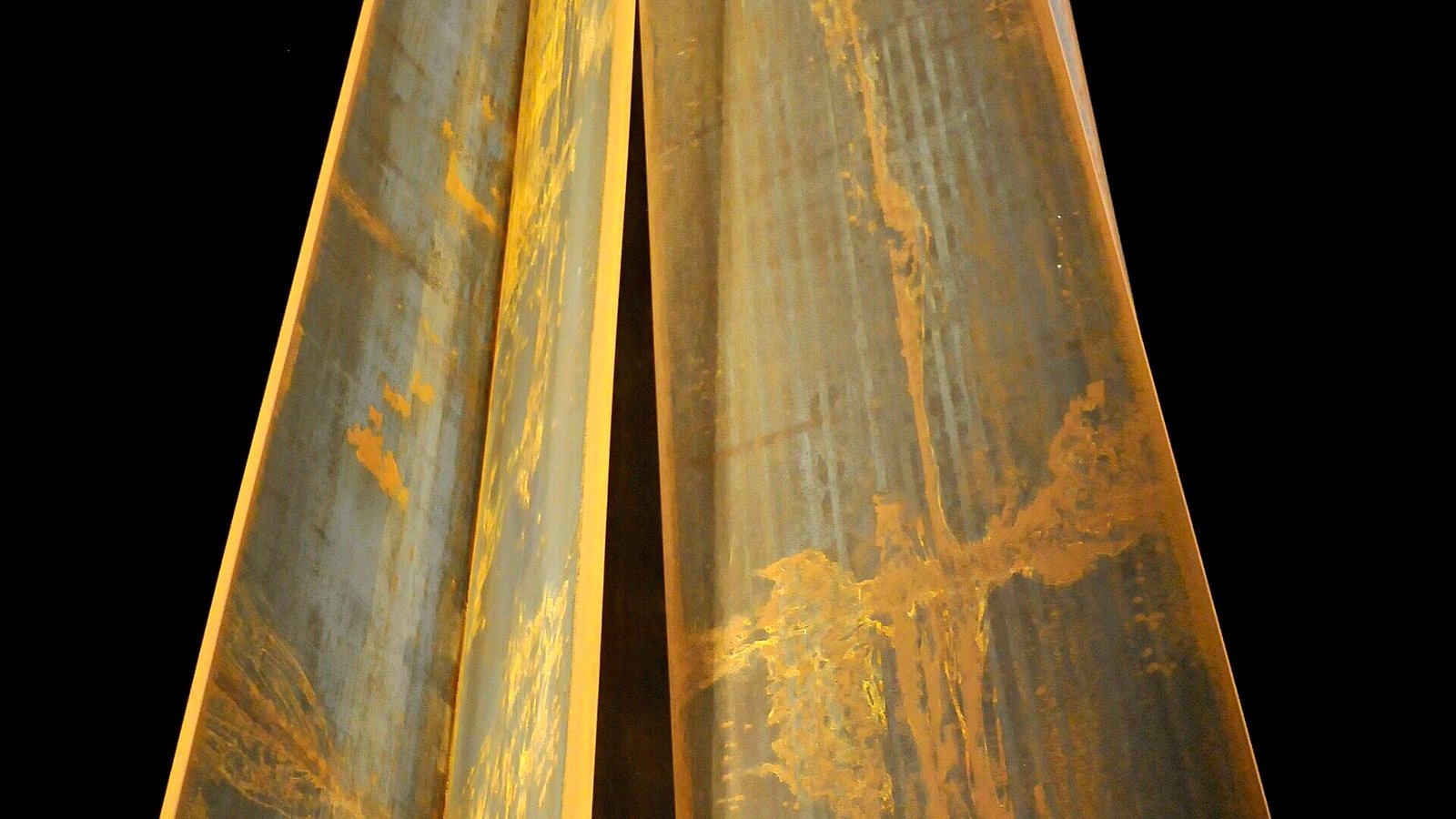
Richard Serra’s 7, MIA Park Doha
Walk to the tip of MIA Park, step inside Richard Serra's 24-metre steel tower and watch the West Bay skyline light up at dusk.
Tip of the promenade, MIA Park, Corniche, Doha
Overview
At the far tip of the crescent-shaped promenade in MIA Park, about as far out into Doha Bay as you can walk, stands a 24-metre tower of rusted steel. This is 7, a sculpture by the American artist Richard Serra, and it is one of the most rewarding free art experiences in the city. Most people photograph it from a distance on their way to the Museum of Islamic Art. Far fewer walk right up to it, step inside and look up.
The work is made of seven tall steel plates leaning together to form a seven-sided column with three triangular openings at the base. From outside it looks heavy, almost industrial. From inside it becomes a tall, quiet shaft with a sliver of sky at the top, and the sounds of the park fall away.
This guide treats 7 as a destination in its own right: how to experience it rather than just snap it, the best light for photographs, what else to look for on the way, and how to fit it into an evening on the Corniche. It suits art lovers, photographers, runners and walkers, and anyone who wants a slow half-hour by the water. It costs nothing and the park is open around the clock.
The story behind the sculpture
Qatar Museums commissioned the piece for the park that surrounds the Museum of Islamic Art. According to The Peninsula, it was I. M. Pei, the architect of the museum, who recommended Serra for the job. Serra, known worldwide for monumental works in weathering steel, made 7 his first public artwork in the Middle East, and when it was unveiled in December 2011 it was the tallest public artwork in Qatar.
The idea grew from the number itself. Serra pointed to the many references to seven in the Quran and to the work of the 10th-century Persian mathematician Abu Sahl al-Quhi, who studied how to construct a regular heptagon. The tall, tapering form also recalls Islamic minarets; Serra’s early sketches were influenced by the historic minaret at Ghazni in Afghanistan. His first design was eight-sided and shorter, and it changed as the project developed.
The sculpture stands on a purpose-built extension of the park that reaches roughly 76 metres out from the shoreline into the bay. Each plate is about 2.4 metres wide and around 10 centimetres thick, made of weathering steel that forms a protective layer of rust. In 2021 the Museum of Islamic Art worked with a local company, Seashore Group, to clean and restore the surface. In 2025 Qatar Museums added a second contemporary work to the park, Nairy Baghramian’s Privileged Points, so there is now more than one reason for art lovers to walk the promenade.
What to see and do
Walk the crescent slowly
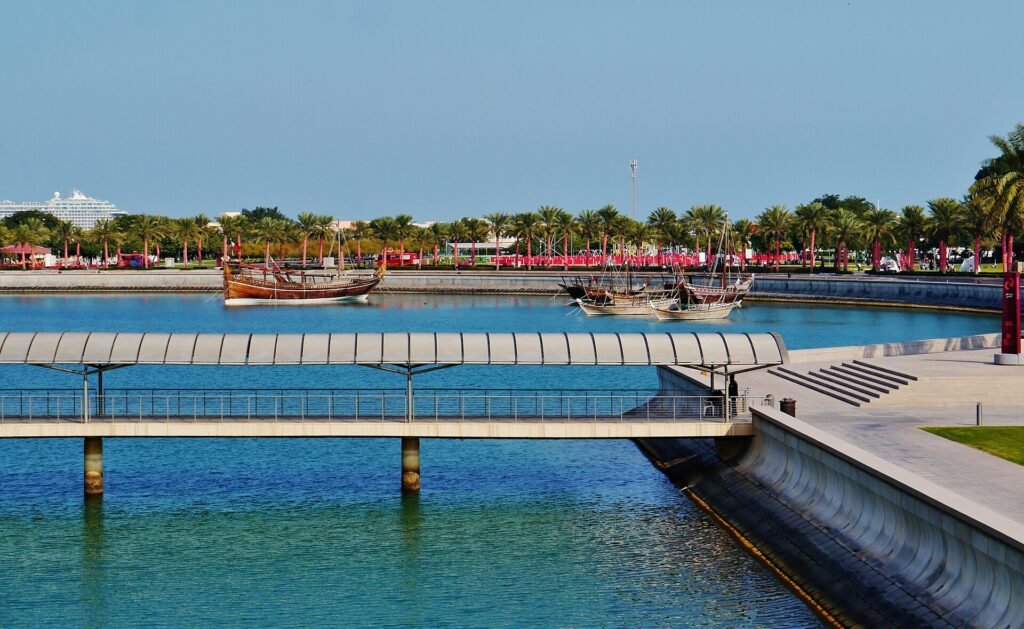
The approach is part of the work. As you follow the curved promenade out from the museum, 7 changes shape: from some angles it reads as a single blade, from others as a cluster of leaning plates. Stop a few times on the way and notice how the gaps between the plates open and close. With the West Bay towers behind it on one side and the museum on the other, it also frames the city in a way no viewpoint on the Corniche does.
Step inside and look up
Walk through one of the three triangular openings and stand in the centre. The plates rise and converge, and at the top they frame a seven-sided patch of sky. Your voice sounds different and the noise of the park seems to drop away. Give it a few minutes; this is the experience Serra intended, a private space inside a very public one.
Read the steel
Up close, the surface is far from uniform. Weathering steel develops its rust layer unevenly, so you will see streaks of orange, brown and near-purple, drip marks and patches where the patina is thicker. In the late afternoon the low sun turns the whole column a deep copper colour.
Find Privileged Points
Nairy Baghramian’s Privileged Points, unveiled in April 2025, is a group of tubular bronze forms finished in soft pastel lacquer and resting on rounded, drip-like bases. It was first shown at Skulptur Projekte Münster in 2017 and is now part of Qatar Museums’ public art collection. Its lightness and colour make an interesting counterpoint to the mass of Serra’s steel, so look for it as you walk the park.
Watch the skyline change at dusk
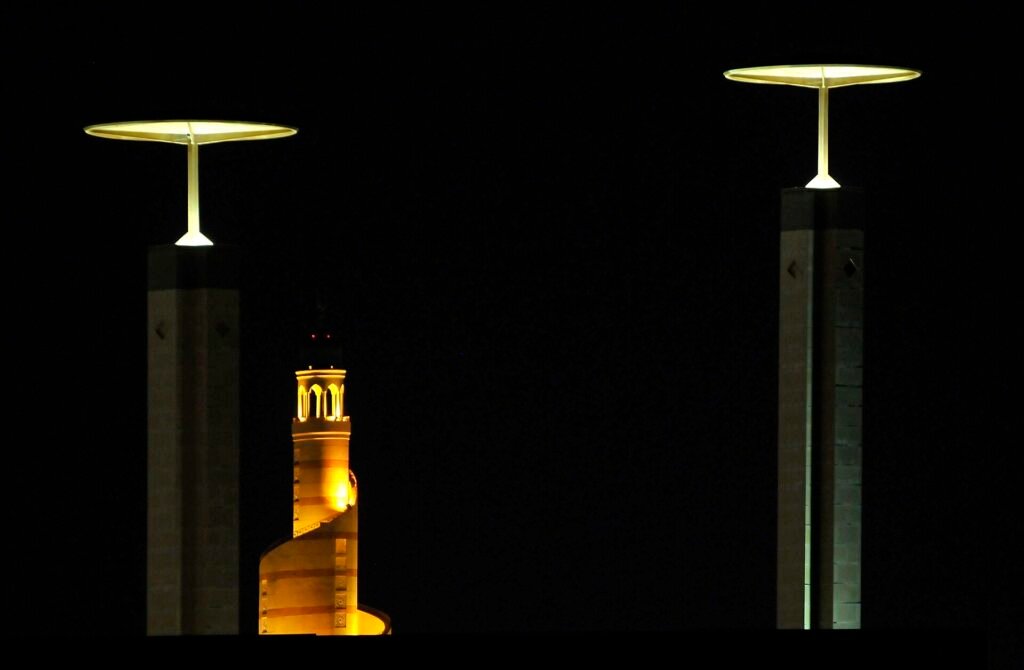
The point where 7 stands has one of the best open views across the bay to West Bay. Arrive about 30 minutes before sunset, watch the towers turn gold and then light up, and see the sculpture itself lit from below after dark. It is one of the most atmospheric places in Doha to end a day.
Make a park afternoon of it
MIA Park itself has lawns, three playgrounds, picnic spots, a park café and bicycles for hire, and in the cooler months it hosts a weekend bazaar and outdoor events. If you are with children, let them run on the grass while one adult takes a quiet walk out to the sculpture.
How to get there
7 stands at the tip of the promenade in MIA Park, beside the Museum of Islamic Art at the eastern end of the Doha Corniche. Ask a taxi or ride-hailing driver for the Museum of Islamic Art; the park entrances are next to it. From the museum, the walk out along the crescent to the sculpture takes around 10 to 15 minutes at a gentle pace.
If you drive, the museum has its own car park, but its website warns that spaces fill quickly at weekends and parking may close during large park events. There is a taxi stand within the museum car park and taxis can be hailed on the Corniche. The nearest Doha Metro stations are Souq Waqif (Gold Line) and Corniche (Red Line), but neither is on the doorstep, so expect a walk along the Corniche or a short taxi ride. Walking from Souq Waqif along the waterfront is pleasant on a winter evening.
Best time to visit
From November to March the weather is ideal for walking the promenade at any time of day. In the hot months, from roughly May to September, go only early in the morning or after sunset, when the sculpture is lit and the breeze off the bay helps. The park is open 24 hours, so a late-evening visit is easy.
For photographs, late afternoon gives warm light on the steel and the best skyline views; blue hour, just after sunset, gives the dramatic lit shots. Friday and Saturday evenings in winter are the busiest, especially when the weekend bazaar or an event is running. Weekday mornings are almost empty.
Tips for your visit
- Go to the end. The sculpture only makes sense once you are inside it. Don’t settle for the view from the museum steps.
- Plan around the museum’s day off if you want both. The park is open 24 hours, but the Museum of Islamic Art is closed on Wednesdays and opens only from 1.30pm on Fridays.
- Bring a wide lens. A phone’s ultra-wide setting is perfect for shooting straight up inside the column.
- Respect the dress code. MIA Park asks for modest dress, so avoid very short shorts and sleeveless tops.
- Leave the bike at the edge. Bicycles can be hired in the park, but ride with care on busy evenings and never inside play areas.
- Check for events. Concerts, festivals and private events sometimes close parts of the park or the car park, so look at the MIA calendar before a special trip.
- No swimming, fishing or barbecues. The park rules prohibit them, along with pets and open fires.
What to bring
- Comfortable shoes for the promenade walk
- Water, and a hat and sunscreen outside winter evenings
- A phone or camera with a wide-angle lens
- A light layer on winter nights, when the wind off the bay can feel cool
Combine it with nearby places
- Museum of Islamic Art. I. M. Pei’s museum is a few minutes’ walk away and holds one of the world’s great collections of Islamic art. Tickets are needed for the galleries.
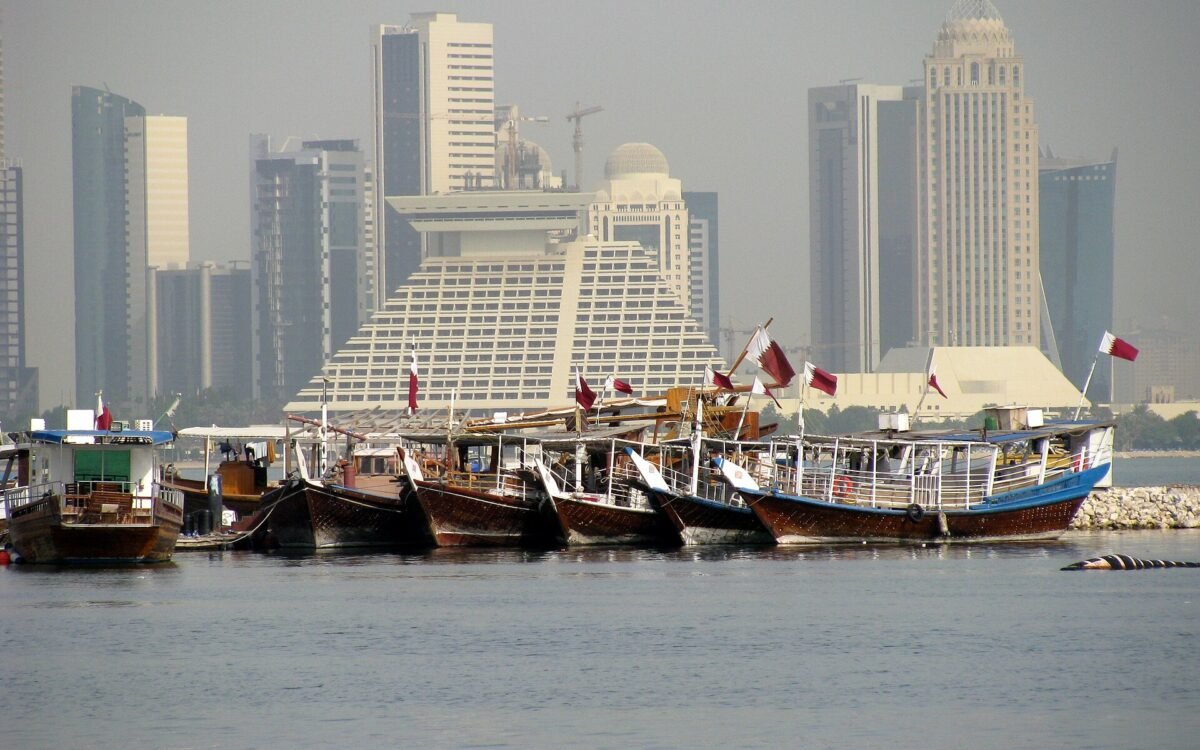
- Dhow Harbour. Just along the Corniche from MIA Park, the harbour where traditional wooden dhows moor, with short boat trips around the bay.
- Al Bidda Park. A large green park at the other end of the Corniche, with walking and cycling paths and plenty of shade.
- Msheireb Museums. Four restored heritage houses in the Msheireb district that tell the story of old Doha, about a ten-minute taxi ride away.
- Souq Waqif. The rebuilt old market is a short taxi ride or a 20-minute walk. Finish with tea at Shay Al Shoomoos or dinner at Bandar Aden.
Frequently asked questions
Is it free to see Richard Serra’s 7?
Yes. The sculpture stands in MIA Park, which is free and open 24 hours a day. You only need a ticket if you also want to visit the galleries of the Museum of Islamic Art.
Can you go inside the sculpture?
Yes. Three triangular openings at the base let you walk into the centre and look up through the column to the sky.
How tall is 7?
It is about 24 metres (80 feet) high and made of seven weathering steel plates arranged in a heptagon.
Why is it called 7?
The work refers to the significance of the number seven in Islamic culture and the Quran, and to a 10th-century mathematician’s method of constructing a seven-sided figure.
When is the best time to photograph 7?
Late afternoon for warm light on the steel, and the half-hour after sunset for the lit sculpture against the West Bay skyline.
Is MIA Park open at night?
Yes. The Museum of Islamic Art’s website lists the park as open 24 hours, although events can occasionally restrict access to some areas.
Last checked October 2026. Hours, fees and access can change, so confirm with the official source before you go.
Read the Companies in Qatar visitor guide ↗
More places nearby
All places →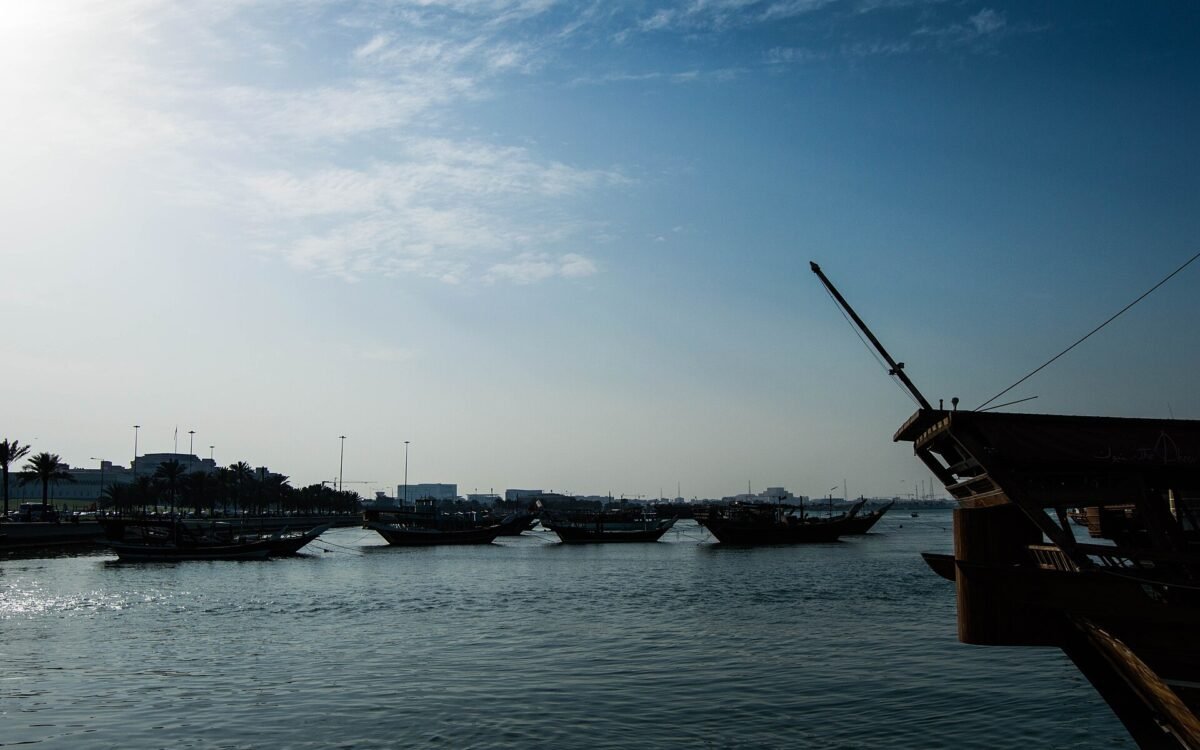
Run a tour, café or stay near Richard Serra’s 7, MIA Park Doha?
List your business free on Companies in Qatar, or get featured on Qatar Unseen in front of people planning their trip.