The Miraculous Journey by Damien Hirst, Sidra Medicine
Fourteen giant bronzes by Damien Hirst trace a baby's journey from conception to birth outside Sidra Medicine. Free to see, and best walked slowly.
Outside Sidra Medicine, Al Gharrafa St, Al Rayyan
Overview
Outside Sidra Medicine, the women’s and children’s hospital on the edge of Education City, stand fourteen huge bronze sculptures by the British artist Damien Hirst. Together they are called The Miraculous Journey, and they follow the development of a human baby from fertilisation to birth, ending with a newborn boy 14 metres tall. It is one of the boldest pieces of public art in the Gulf, and one of the most talked about.
You do not need a ticket or an appointment to see it; the sculptures stand in the open in front of the hospital. Yet many people only ever glimpse them from a car window on the way somewhere else. Walking along the line, one figure at a time, is a very different experience: part science lesson, part meditation on how strange and remarkable the start of every life is.
This guide is about seeing the work properly and respectfully. It covers the story of its long road to public view, how to read the sequence, when the light is best, what to know about visiting the grounds of a working hospital, and how to make it part of an art trail through Education City. It suits art lovers, photographers, parents-to-be, curious families (with some preparation for younger children) and anyone interested in how contemporary art is changing Doha’s public spaces.
The story behind the sculptures
Hirst made his first drawings for the series in 2005. According to the work’s history, Sheikha Al Mayassa bint Hamad Al Thani, chairperson of Qatar Museums, visited his studio and suggested that the monumental figures should stand in front of the new Sidra hospital, a place where, as Qatar Museums puts it, this journey happens every day. The finished work weighs a total of 216 tonnes and is reported to have cost around 20 million US dollars.
The sculptures were first unveiled in 2013, but they were covered up soon afterwards and stayed hidden behind wrapping for about five years. The official explanation pointed to works around the site, while commentators linked the long pause to the sensitivity of showing an unborn child and a naked baby in such a public setting. In November 2018 the covers came off for good, and the work has been on permanent public view ever since.
The debate was intended. Qatar Foundation said at the time that it did not expect everyone to like the sculptures and that sparking discussion was part of their purpose, while Sheikha Al Mayassa pointed out that the Quran speaks of the miracle of birth. Hirst himself has said that while everyone talks about life’s journey, we all make a whole journey before we are born. Today the work is part of Qatar Museums’ public art collection and a regular stop on art tours of the city.
What to see and do
Walk the sequence in order
The sculptures are designed to be read like a story. Start at the beginning of the line, where the work opens with fertilisation, and walk along it so the figures grow beside you, through the early weeks of the embryo, the curled foetus inside the womb, twins, and the later stages when the baby turns and prepares for birth. Taking it one figure at a time, rather than as a single panorama, is the best way to appreciate the detail.
Look at the scale shift
The middle sculptures range from about 5 to 11 metres in height, and the last, the newborn boy, rises to 14 metres. Standing at the foot of the final figure and looking up is the moment most visitors remember. Notice how the bronze surfaces show the textures of the womb and the umbilical cord; up close they are far more sculptural than they appear from the road.
Think about the setting
Few artworks are so tightly connected to the building behind them. Sidra is a hospital where babies are born and sick children are treated, and the sculptures greet patients, families and staff every day. Seeing the work in that context, rather than as a sculpture park, gives it real emotional weight.
Photograph it thoughtfully
The long row of figures photographs best at an angle, with the line receding into the distance. A wide lens helps with the final figure. You are on hospital grounds, so focus on the artwork and avoid photographing patients, staff or people arriving at the entrances.
Look for the twins
Among the stages of development is a sculpture of twins curled together in the womb. It is one of the most tender pieces in the sequence and often the one children notice first. Pause here and look at how Hirst arranges the two bodies within the rounded form of the womb.
See it in the context of Doha’s public art
Qatar Museums has spent more than a decade placing major works by international artists in everyday places: Richard Serra’s steel tower at MIA Park, Louise Bourgeois’s spider in a convention centre, and many more pieces across the city and the desert. The Miraculous Journey is one of the clearest examples of that approach. It is not hidden in a gallery, so people who would never visit a museum walk past it on the way to an appointment. Seeing it with that in mind helps explain why it was placed here, and why it still prompts conversation.
Join a guided public art tour
Qatar Museums sometimes runs public art tours and educational programmes that include this work, and has published learning materials about it in several languages. If you want the background explained on site, check the Qatar Museums calendar for current tours.
How to get there
The sculptures stand outside Sidra Medicine on Al Gharrafa Street in Al Rayyan, on the north-eastern side of Education City. From West Bay or the Corniche, allow around 20 to 30 minutes by car via Al Luqta Street or Al Rayyan Road, depending on traffic. Set your maps app to Sidra Medicine; the bronze figures are impossible to miss as you approach.
If you drive, use the hospital’s visitor parking and walk to the sculptures; do not stop on the access roads or in drop-off zones, which need to stay clear for patients and emergency vehicles. Taxis and ride-hailing apps can drop you at Sidra’s main entrance. There is no metro station at the hospital itself; the nearest Green Line stations are in and around Education City, so a short taxi ride is the practical option if you come by metro.
Viewing is free, and there is no visitor centre or ticket desk. The surrounding paths are paved and generally flat, so the walk along the line is manageable for most visitors, including with a pushchair.
Best time to visit
The work is outdoors with little shade, so the season matters. From November to March you can walk the line comfortably at most times of day. From May to September go very early in the morning or around sunset, when the bronze glows warm and the heat eases.
Late afternoon is best for photographs: the low sun picks out the texture of the bronze and throws long shadows across the forecourt. Hospital car parks tend to be busiest during daytime clinic hours, so an early-evening visit is often easier for parking.
Tips for your visit
- Remember it is a hospital. Keep voices down, stay off access roads and give priority to patients and families.
- Prepare younger children. The sculptures show the stages of pregnancy in anatomical detail and end with a naked newborn. Most children find them fascinating, but a quick explanation beforehand helps.
- Do not climb the sculptures. They are artworks, not play equipment, and the bronze gets very hot in the sun.
- Take your time. Twenty to thirty minutes lets you walk the full line and back without rushing.
- Bring water and a hat outside winter; there is little shade around the figures.
- Read up on Hirst first. Knowing that this is the artist behind the famous shark in formaldehyde adds an interesting layer to such a tender subject.
- Respect privacy. Photograph the art, not the people visiting the hospital.
What to bring
- Sun hat, sunglasses and sunscreen
- Water
- A phone or camera with a wide-angle setting
- Comfortable shoes for walking the forecourt
Combine it with nearby places
- Maman by Louise Bourgeois. The giant bronze and steel spider in the Qatar National Convention Centre, a short drive away and a natural partner on an art trail.
- Lawh Wa Qalam: M. F. Husain Museum. Education City’s newest museum, free to enter, devoted to the Indian modernist who spent his final years in Qatar.
- Oxygen Park. A landscaped park in Education City with shaded walking routes and play areas.
- Education City Mosque. The striking mosque with two tall, slanting minarets inscribed with Quranic verses, one of the most photographed buildings on the campus.
Frequently asked questions
Where is The Miraculous Journey?
Outside Sidra Medicine on Al Gharrafa Street in Al Rayyan, next to Education City in Doha.
Is it free to see?
Yes. The sculptures stand in the open in front of the hospital and are part of Qatar Museums’ public art collection. There is no ticket.
How many sculptures are there?
Fourteen bronze sculptures, following a baby’s development from fertilisation to birth. The final figure, a newborn boy, is 14 metres tall.
Why were the sculptures covered?
They were unveiled in 2013 and then covered for several years before being revealed again in November 2018. The official reason given related to works at the site, though many observers linked the delay to the sensitivity of the subject.
Is it suitable for children?
Generally yes, especially as a way to talk about how babies grow, but the anatomical detail and nude newborn mean parents may want to explain what they will see first.
How long should I allow?
About 20 to 30 minutes to walk the full sequence, longer if you are photographing.
Last checked October 2026. Hours, fees and access can change, so confirm with the official source before you go.
More places nearby
All places →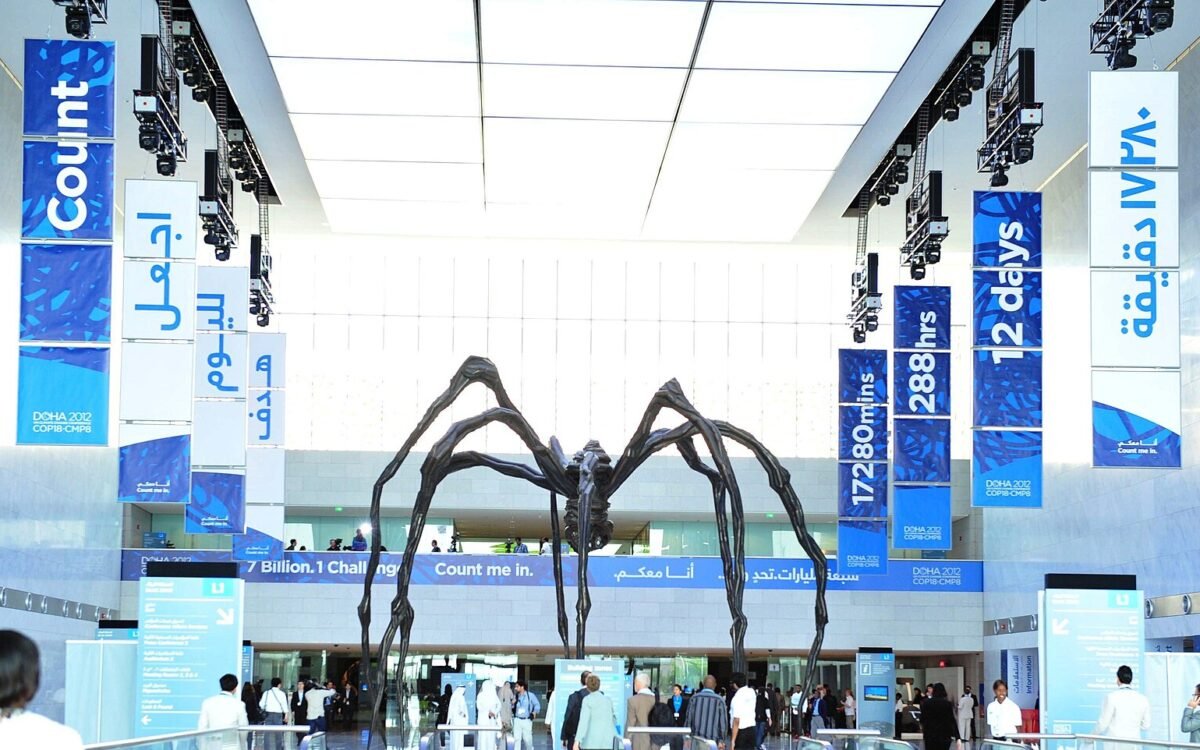
Run a tour, café or stay near The Miraculous Journey by Damien Hirst, Sidra Medicine?
List your business free on Companies in Qatar, or get featured on Qatar Unseen in front of people planning their trip.