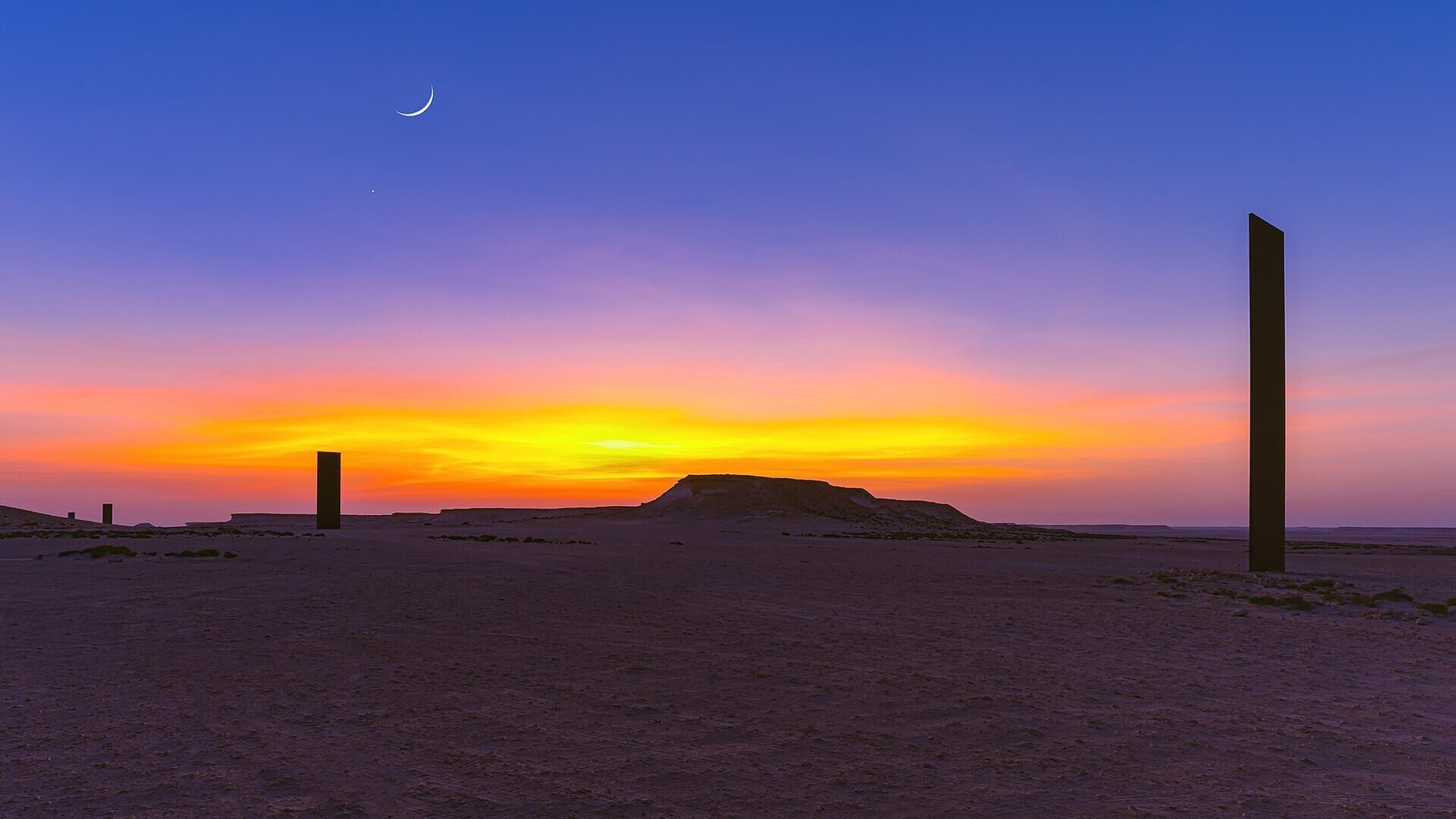
East-West/West-East by Richard Serra, Zekreet
Richard Serra's four steel plates in the Brouq Nature Reserve. How to walk the line, where to watch sunset and how to get there.
Brouq Nature Reserve, Zekreet Peninsula (west coast)
Overview
Four slabs of steel stand in a line across a shallow desert valley on the Zekreet Peninsula. From a distance they look like thin dark marks on the horizon. Walk towards one and it grows until it fills the sky, while the next one, hundreds of metres away, seems to shrink. That shifting sense of scale is what Richard Serra’s East-West/West-East is about, and you only get it by walking the line yourself.
This is Qatar’s most celebrated piece of land art and one of the country’s best sunset spots. It is free, unfenced and has no set opening hours. It also has no facilities, no shade and no paved road for the last few kilometres, which is exactly why it still feels remote.
This guide approaches the work as an experience to plan rather than a photo stop: how to read it, when the light is at its best, where to stand, and how to behave around a sculpture that has already had to be cleaned of graffiti. It suits art lovers, photographers and anyone who wants a desert outing with a clear destination.
The story behind the sculpture
Richard Serra (1938–2024) was an American sculptor known for monumental works in weathering steel. His first large commission in Qatar was 7, the tall steel tower completed in 2011 at the end of MIA Park in Doha. Qatar Museums, then the Qatar Museums Authority, led by its chairperson Sheikha Al Mayassa bint Hamad Al Thani, encouraged him to consider a work in the desert. According to later interviews, he was hesitant until he saw the site.
What persuaded him was the landform. The chosen corridor is a flat valley running across the Brouq peninsula, bounded on each side by low plateaus of white gypsum and limestone. Serra measured the plates against that topography rather than against each other: two stand 14.7 metres tall and two 16.7 metres, set so that they relate to the level of the plateaus as the ground dips and rises. The result is a line of four plates spanning more than a kilometre, designed so that all four can be seen from either end.
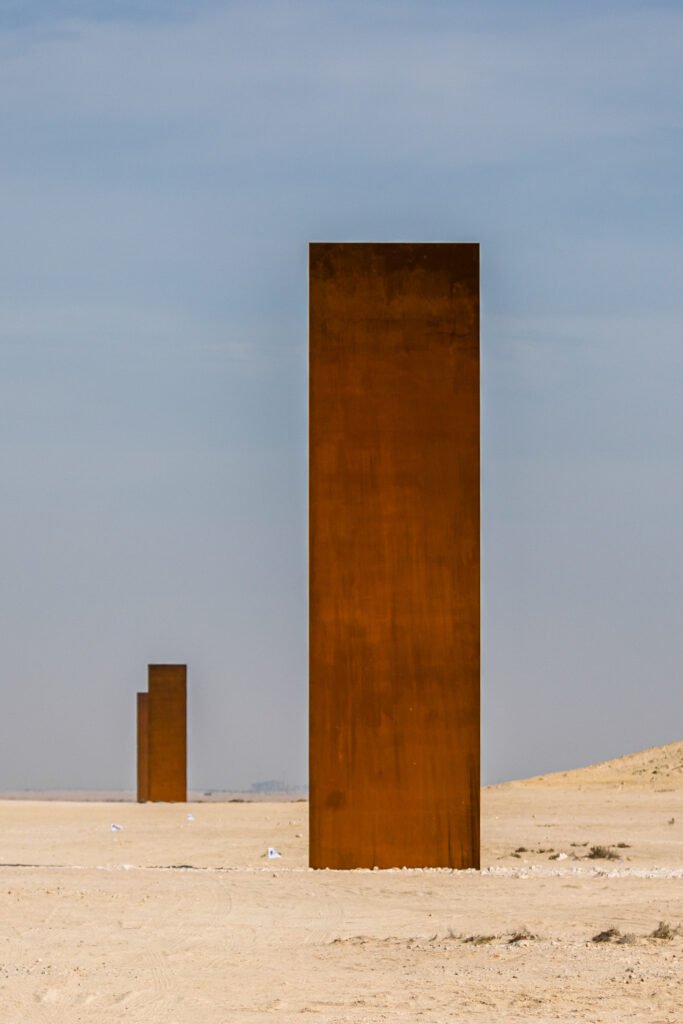
The plates were made from steel fabricated in Germany and left untreated. They were grey when installed and have been weathering ever since, through orange towards a deep brown. Serra himself admitted that nobody knows exactly how long they will last in the desert.
The work was unveiled in April 2014, alongside two Serra exhibitions in Doha that ran from 10 April to 6 July that year: a career survey at the QMA Gallery in Katara and Passage of Time, two long curving steel walls, at Al Riwaq. Qatar Museums quotes Serra calling the desert piece “the most fulfilling thing I’ve ever done.”
Its remoteness has not protected it completely. By 2020 the lower parts of the plates were covered with scratched names and spray paint. Qatar Museums launched an anti-vandalism campaign in September 2020, put up signs listing banned acts such as drawing, marking and scratching, and cleaned the steel. In April 2021 The Peninsula reported that six people had been detained for defacing the work, with Qatar Museums stressing that vandalism is a crime punishable by law.
What to see and do
Walk the full line
Serra made the piece to be walked, and the full length is a little over a kilometre each way. As you move, the plates slide in and out of alignment. From the ends they stack up almost into a single line; from the middle they spread across the valley. Allow about an hour for a relaxed walk there and back with stops.
Stand at the foot of a plate
Close up, the steel is enormous: a flat, rust-brown wall rising more than 14 metres above the sand, with its surface texture and weathering streaks visible at arm’s length. Look up along the edge and you can see how precisely it has been set. Look back down the valley and the next plate looks tiny.
Climb a plateau for the overview
The low gypsum ridges on either side of the valley give the classic elevated view along the whole row. The slopes are crumbly and uneven, so pick a gentle route up, keep away from the edges and do not drive onto the plateaus. From above you can see how the plates tie the two sides of the valley together.
Watch the sunset
The work runs roughly east to west, so at sunset the sun drops towards the western end of the line and the plates become black silhouettes against the sky. In an interview with The Globe and Mail, Qatar’s head of public art suggested approaching on foot from the east at least 30 minutes before sunset. Stay a little after the sun has gone for the afterglow, which often gives the best colour of the evening.
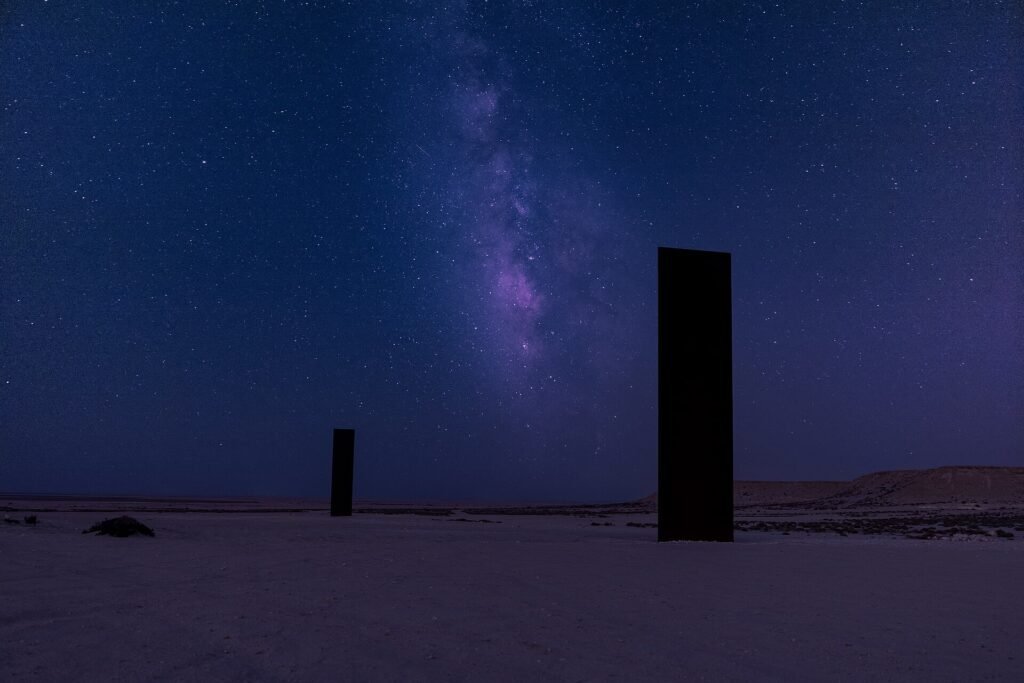
Stay for the stars
With no towns nearby, the Zekreet area is one of the darker skies within easy reach of Doha. On a clear, moonless winter night you can see the Milky Way above the plates. If you plan to stay, make sure you know your route out in the dark before the light goes.
Look at the reserve around you
The sculpture sits within the Brouq Nature Reserve, part of the wider Al Reem Biosphere Reserve. Wikipedia notes a high concentration of ostriches on the Ras Abrouq side, and oryx and gazelles have been reported in the area. Scan the plain on your drive in, and keep your distance if you see animals.
How to get there
The sculpture is on the Zekreet Peninsula on Qatar’s west coast, north of Dukhan. Plan on roughly an hour and a quarter from central Doha each way. Use the coordinates 25.5166, 50.8625 for your map pin, and save it offline before you leave.
- Take Dukhan Highway west from Doha, past Al Shahaniya.
- Take the Zekreet exit (listed by Visit Qatar as exit 72) and follow Zekreet Road towards the coast.
- Continue north on the desert tracks towards the Brouq reserve and Ras Abrouq. The plates become visible from a distance across the flat ground.
- Park beside the track near either end of the line or by one of the plates, on hard ground.
Road conditions. The final section is unpaved: a network of graded and rutted tracks with rocky patches and soft sand in places. A Globe and Mail writer described covering the last four kilometres in about 40 minutes in a small sedan. That shows it can be done in dry weather with great care, but a 4×4 or high-clearance SUV is the sensible choice. If you are unsure of desert driving, go with a second vehicle or an experienced friend.
Without a car. There is no public transport, and taxis or ride-hailing cars are not a realistic option on the tracks, especially for the return. Several Doha operators run half-day or sunset 4×4 tours of the Zekreet Peninsula that include the sculpture and Film City.
Best time to visit
November to March is the season. Temperatures are comfortable for walking the full line, and the evenings are cool and clear. From May to September the valley is extremely hot, with no shade at all, and the steel surfaces become far too hot to touch.
For light, come in the last hour and a half before sunset. Arrive early enough to walk from the eastern end with the sun in front of you, and reach the western plates as it goes down. Early morning is the quiet alternative, with low light from the opposite direction and far fewer people.
Friday and Saturday afternoons in winter are the busiest times, and from late November the Visit Qatar winter season at nearby Ras Abrouq brings more traffic onto the peninsula. For a lonelier experience, go on a weekday.
Tips for your visit
- Do not touch, scratch or write on the steel. The plates have already been cleaned of graffiti once, and people have been detained for defacing them.
- Park on hard ground only. Keep to existing tracks and do not drive up onto the gypsum plateaus or across the valley floor.
- Leave early enough to drive out in daylight if you are not confident on desert tracks. Finding the right track in the dark is much harder.
- Fill up with fuel and buy water before leaving Dukhan Highway. There are no shops or facilities at the site.
- Wear proper shoes. The walk crosses sand and loose stone, and the plateau slopes are crumbly.
- Tell someone your plans. Mobile coverage can be patchy on the peninsula.
- Drones need permission. Flying in Qatar requires registration and approval from the civil aviation authority.
- Take all rubbish home. There are no bins and the area is a protected reserve.
What to bring
- Two to four litres of water per person
- Hat, sunglasses and sunscreen
- Walking shoes with good grip
- A wide-angle lens for close-ups and a longer lens to compress the line
- A torch or head torch if you are staying after sunset
- A warm layer for winter evenings
- Recovery gear (tow strap, tyre gauge, compressor) if you are driving yourself
Combine it with nearby places
Zekreet Film City. The walled “fake village” built for an Arabic TV series stands further north on the peninsula. It is open during Visit Qatar’s winter season, so check dates before combining the two.
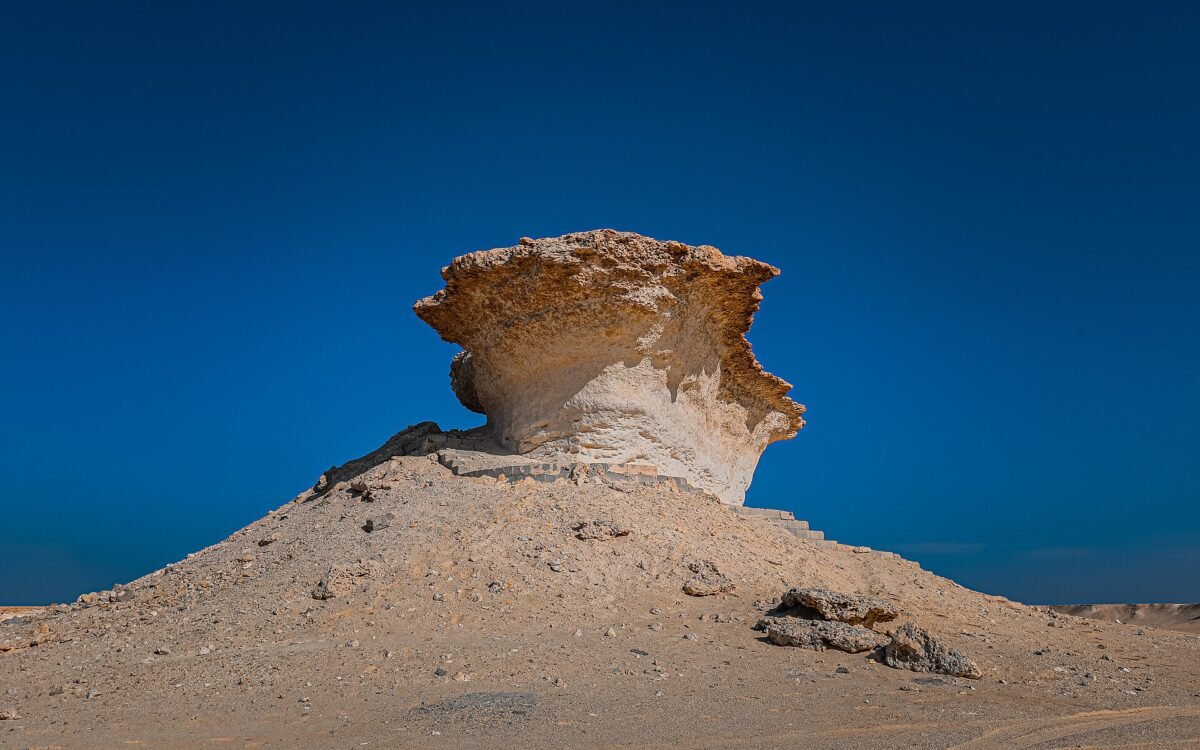
Zekreet mushroom rocks. Wind-carved limestone pillars with wide caps stand a short drive away on the peninsula. They make a good late-afternoon stop before you head to the plates for sunset.
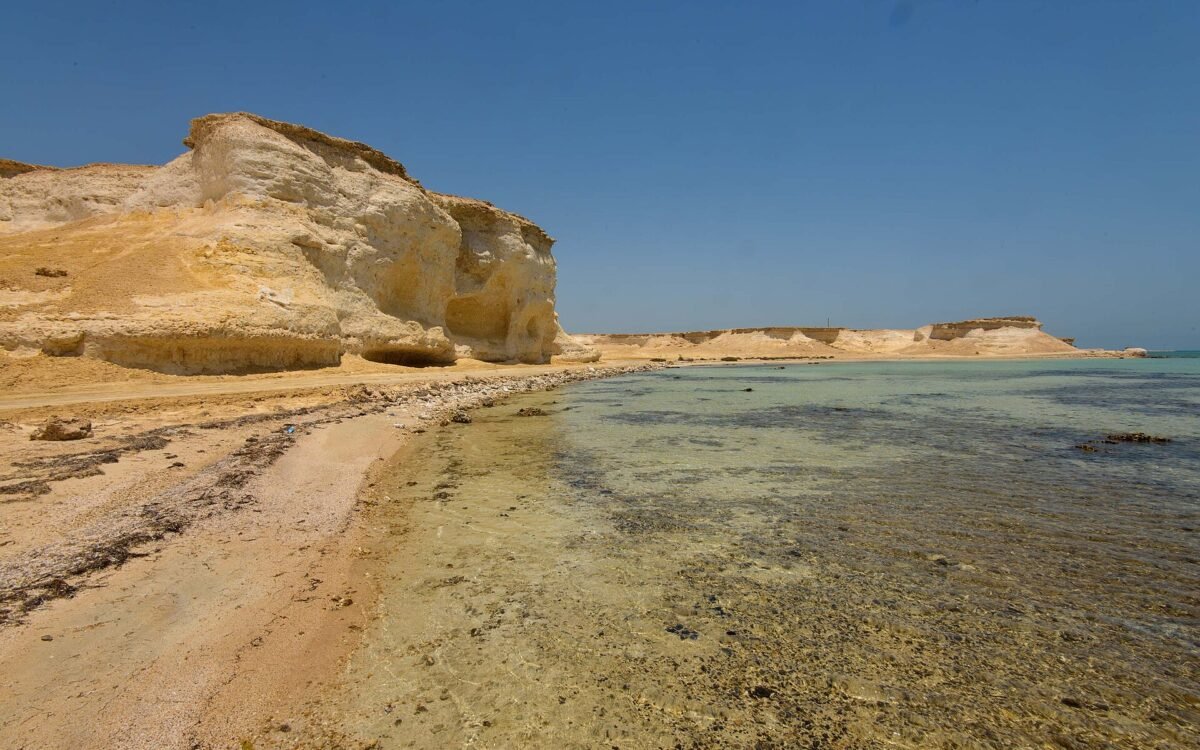
Ras Abrouq and the Al Reem Biosphere Reserve. The northern tip of the peninsula has white cliffs, a quiet coast and wildlife, plus the Our Habitas Ras Abrouq resort if you want to eat or stay nearby.
7 at MIA Park, Doha. Back in the city, Serra’s first Qatar commission stands at the tip of the MIA Park peninsula. Seeing both on the same weekend shows the two sides of his work here, one urban and vertical, one horizontal and lost in the landscape.
Frequently asked questions
Is East-West/West-East free to visit?
Yes. There is no ticket, gate or visitor centre. It is an open-air work in a nature reserve, and you can walk right up to the plates.
How tall are the Richard Serra plates in Qatar?
There are four steel plates. Two are 14.7 metres tall and two are 16.7 metres, and together they span more than a kilometre.
Can I drive there in a normal car?
The last few kilometres are on unpaved desert tracks. People have managed it slowly in small cars in dry weather, but a 4×4 or high-clearance SUV is strongly recommended, and a tour is the easiest option if you are unsure.
When is the best time to see the sculpture?
Between November and March, in the hour and a half before sunset. Walk in from the eastern end so you arrive at the western plates as the sun goes down.
Why is it called East-West/West-East?
The plates are set along a line running across the peninsula from east to west, and the work is designed to be experienced walking in either direction.
Can I touch the plates?
Do not scratch, mark or climb them. The steel also gets extremely hot in the sun. Qatar Museums treats any damage to public art as a criminal offence.
How long should I spend there?
Allow one to two hours on site to walk the line and wait for sunset, and a half day in total including the drive from Doha.
Last checked October 2026. Hours, fees and access can change, so confirm with the official source before you go.
Read the Companies in Qatar visitor guide ↗
More places nearby
All places → Beaches & IslandsDukhan Beach, DukhanDukhan & West Coast
 Nature & MangrovesRas Abrouq & Al Reem Biosphere Reserve, Zekreet PeninsulaDukhan & West Coast
🏝️ Beaches & IslandsOur Habitas Ras Abrouq, Zekreet PeninsulaDukhan & West Coast
Nature & MangrovesRas Abrouq & Al Reem Biosphere Reserve, Zekreet PeninsulaDukhan & West Coast
🏝️ Beaches & IslandsOur Habitas Ras Abrouq, Zekreet PeninsulaDukhan & West Coast
 Desert & DunesZekreet Mushroom Rocks, Zekreet PeninsulaDukhan & West Coast
Run a tour, café or stay near East-West/West-East by Richard Serra, Zekreet?
List your business free on Companies in Qatar, or get featured on Qatar Unseen in front of people planning their trip.