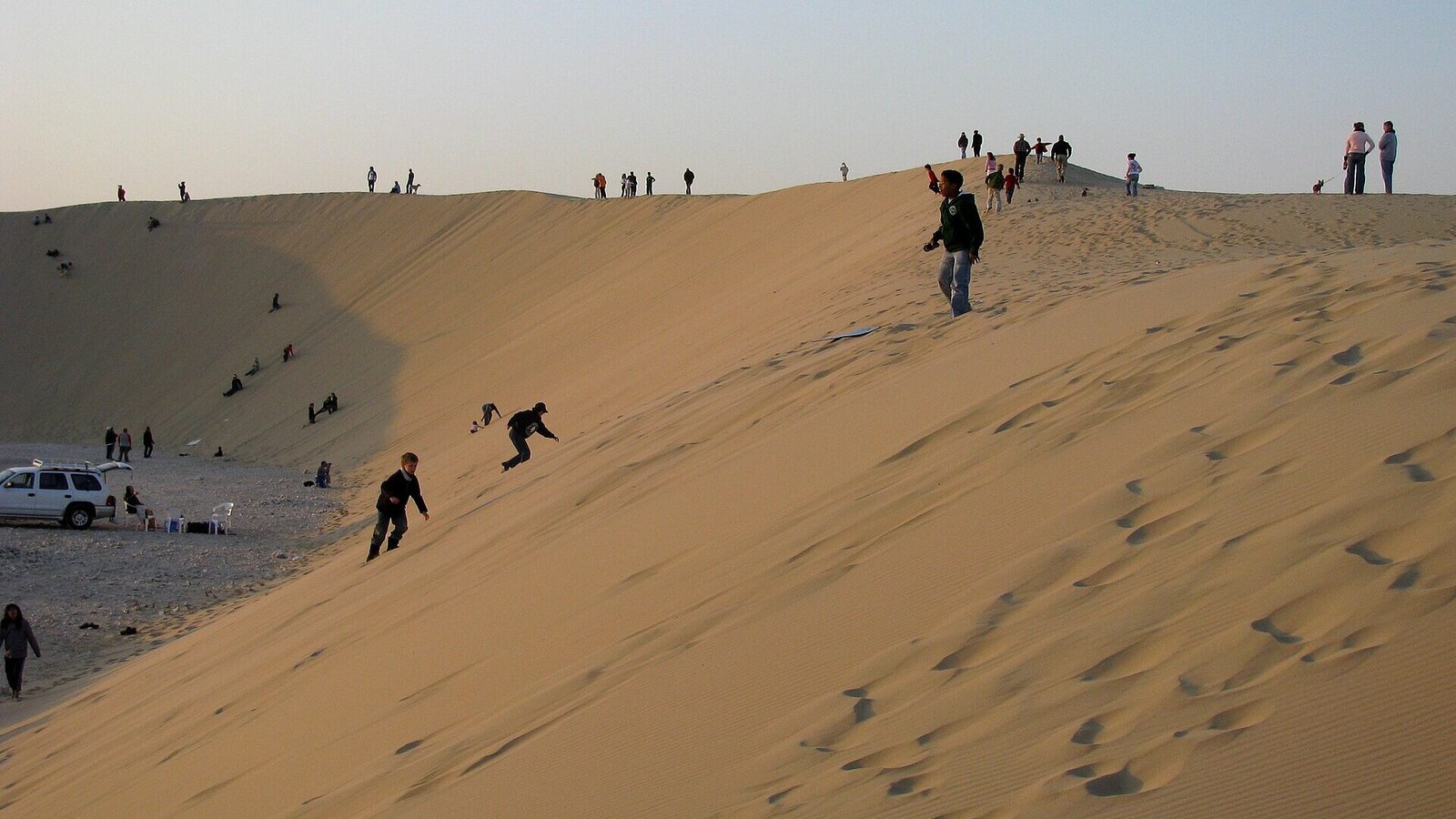
Singing Sand Dunes, Mesaieed
Crescent dunes inland of Mesaieed whose sand can hum when it slides. The science behind the sound and how to give yourself the best chance of hearing it.
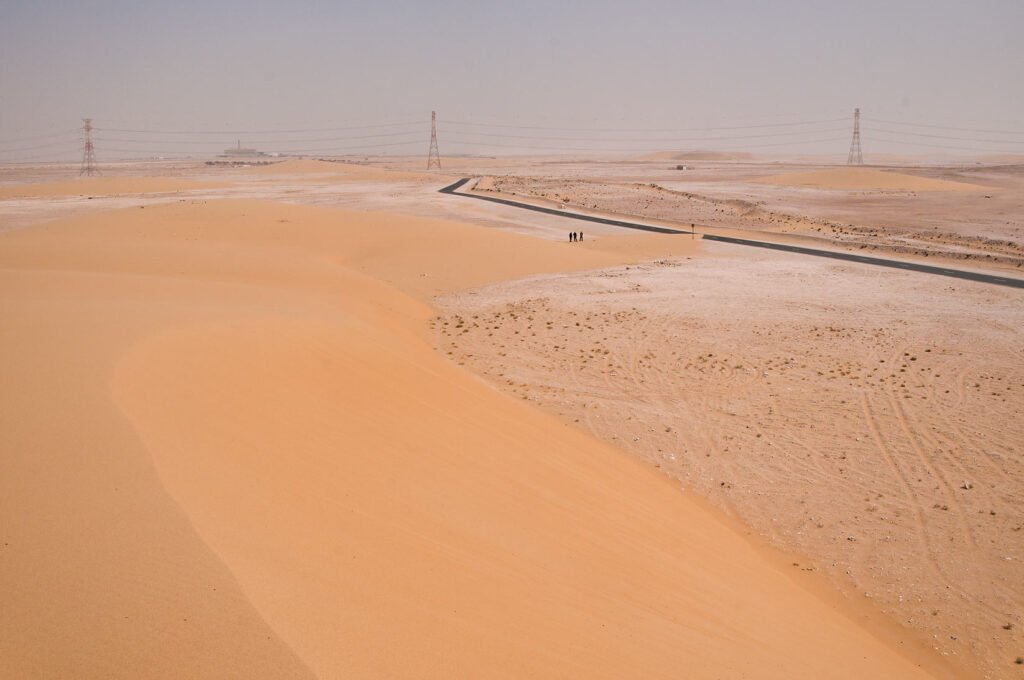
Desert west of Mesaieed, Al Wakrah (about 40 km south-west of Doha)
Overview
A few kilometres inland from Mesaieed, where the flat gravel desert south of Doha starts to break into sand, a cluster of crescent-shaped dunes has earned Qatar one of its more unusual natural claims. Push the sand on their steep face and, if conditions are right, the whole slope answers back with a deep, droning hum that you feel in your feet as much as you hear it.
These are the Singing Sand Dunes, about 40 km south-west of Doha by road. They are not a managed attraction: there is no gate, ticket or visitor centre, just open desert, a few dunes and whoever else has turned up. That makes them one of the easiest real desert outings from the city, and also one of the easiest to get slightly wrong. People arrive at midday in summer, in a saloon car, after rain, and wonder why the sand is silent and the car is stuck.
This guide focuses on the sound itself: what makes it, which conditions give you the best chance of hearing it, and how to plan a short trip around those conditions. It suits curious families, photographers, anyone with visitors in town and residents who want a quick taste of the desert without committing to a full day at the Inland Sea.
The science behind the song
Singing, or booming, sand is rare. Wikipedia’s summary of the research lists around 35 places in the world where it has been recorded, and the dunes near Mesaieed are one of them. Others include the Mojave Desert and Death Valley in California and the Mingsha Shan dunes at Dunhuang in China.
The sound comes from avalanches. When a layer of dry sand slides down the steep downwind face of a dune (the slip face), the moving grains start to shear against each other in step, and that synchronised motion sets the sand and air vibrating. The result is a low, steady tone usually described as a boom, a roar or a deep hum. Wikipedia notes that the loudest singing dunes can reach around 105 decibels. Studies by Caltech researchers Nathalie Vriend, Melany Hunt and Rob Clayton, published in 2015, measured booming in the range of about 70 to 105 hertz and distinguished it from a shorter, broader “burping” sound that some dunes make. Reports on that work noted that the team was also carrying out research in Qatar.
Not all sand can do it. The grains need to be fairly uniform in size (roughly 0.1 to 0.5 mm), rich in silica, well rounded and clean. A thin coating of dust or moisture adds enough friction or stickiness to kill the sound. That is why the same dune can roar one afternoon and stay stubbornly quiet the next.
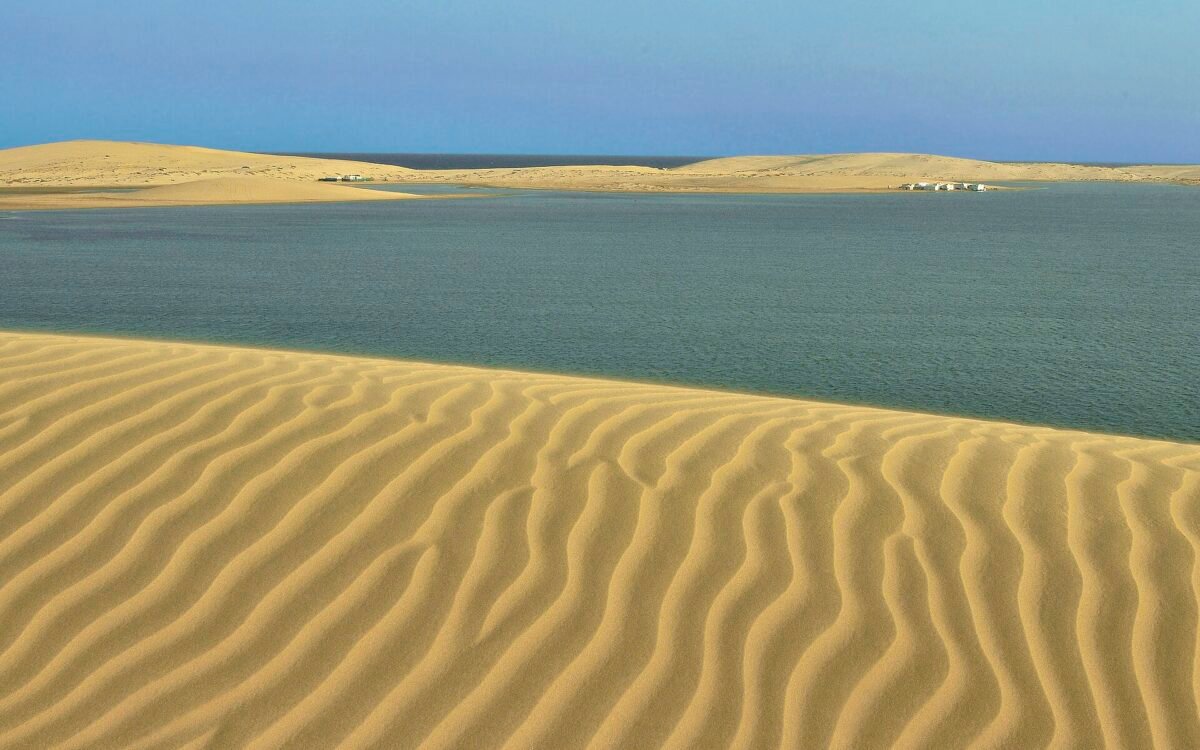
The dunes themselves are barchans, the crescent shape that forms where wind blows mostly from one direction over limited sand. In Qatar that wind is the north-westerly shamal. The two horns of the crescent point downwind, and the steep, concave slip face sits between them. That concave face is where you want to be.
Culturally, the area has been a weekend spot for Doha residents for decades. Blog directions from 2007 already described the route and the advice still given today: park a saloon car by the road and walk, and bring a 4×4 only if you want to get closer.
What to see and do
Make the dunes sing
Walk to the crest of the tallest dune, find the steep slip face on its downwind side, and sit down at the top. Then slide down on your bottom, pushing as much sand ahead of you as you can. The bigger the sheet of sand that moves, the better your chances. Some people prefer to shuffle sideways along the crest, kicking sand down the face, or to run down in a group. If the conditions are right, you will feel a vibration first and then hear a hum that carries on for a few seconds after you stop.
If nothing happens, try a different part of the slope, higher up where the sand is drier and looser, or wait for the late-afternoon breeze. Don’t expect it every time. Treat the sound as a reward rather than a guarantee.
Read the shape of a barchan
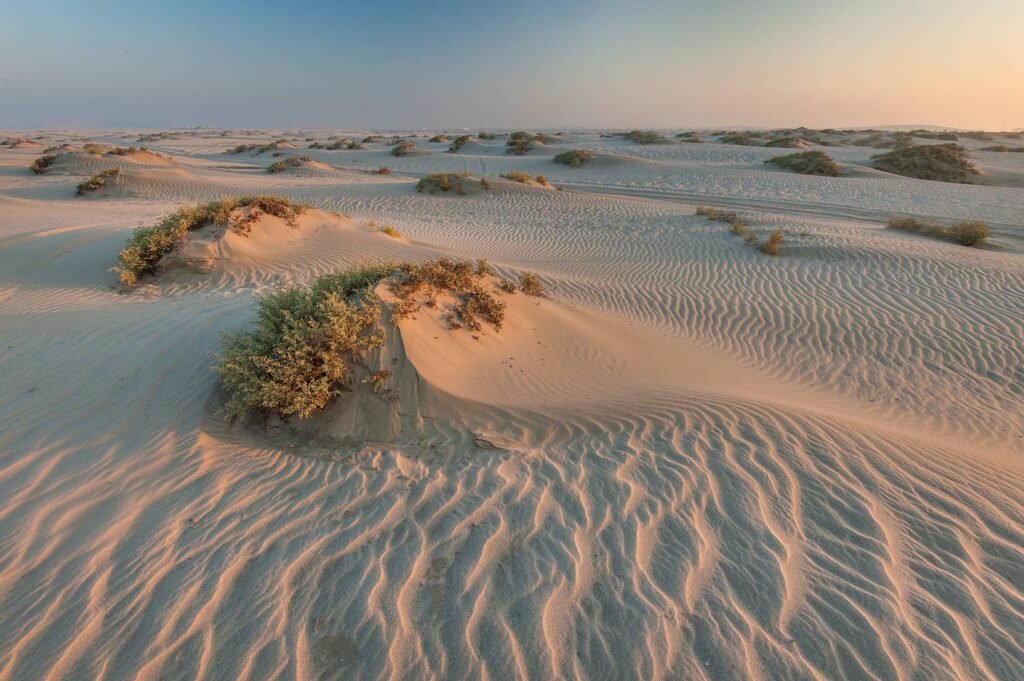
From the top, look at the dune’s outline. The gentle, firm slope you walked up faces the prevailing wind. The steep slip face falls away on the other side, framed by two horns of sand. Wind ripples run across the windward side, and on a breezy day you can watch grains being lifted over the crest and settling on the face. It is a small, live lesson in how the desert moves.
Sandboarding and sliding
The steep face is short but good for sandboarding, and children often spend an hour doing nothing but sliding down and climbing back up. Bring your own board or a plastic sledge, or book a desert tour that includes one. Keep well clear of the bottom of the slope if vehicles are around.
Photography
The curved crest lines and ripples look best in low, raking light, so arrive about an hour before sunset or just after sunrise. Shoot along the crest towards the sun for strong shadows, or from the bottom of the slip face upwards with people on the ridge for scale. A zoom lens helps you isolate patterns without walking over the ripples you want to photograph. Protect your camera from blowing sand, and change lenses in the car, not on the dune.
A short desert picnic
The flat ground around the dunes is a common spot for a simple picnic or a flask of karak in the cooler months. There is no shade or service of any kind, so bring everything you need, including a mat and a bag for your rubbish.
Join a southern desert tour
Several Doha operators include the Singing Sand Dunes on half-day southern desert trips, often paired with the Dahl Al Misfir cave, a dune drive or a trip to Sealine. One tour listing describes about an hour at the dunes as part of a four-hour trip with hotel pick-up. It is a sensible option if you don’t drive, or if you want a guide to explain what you are hearing.
How to get there
The dunes are around 40 km south-west of central Doha, and the drive usually takes 40 to 50 minutes.
- Leave Doha on Salwa Road, heading south-west past the industrial area.
- Turn south onto the road signposted for Mesaieed.
- West of Mesaieed, turn off onto the smaller local roads that run into the desert. Directions shared by residents over the years mention crossing a pipeline corridor shortly before the dunes come into view.
- Park on firm ground beside the road and walk the last stretch across the sand.
Signage is minimal, so navigate with a map app, where the site is usually listed as Singing Sand Dunes. The pin on this page (25.0417, 51.3812) marks a dune mapped on OpenStreetMap in the area where the singing dunes are found, so treat it as a guide and check your route on a current map before you go.
Do you need a 4×4? No, as long as you stay on hard ground. A saloon car is fine for the roads, but do not drive it onto the sand: soft patches catch ordinary cars very easily. With a 4×4 and lowered tyre pressures you can get closer, but the walk from the road is short and it is part of the fun.
There is no public transport. A taxi or ride-hailing car can drop you off, but finding one to take you back is unreliable, so arrange a return pick-up or book a tour. Half-day southern desert tours from Doha often include the dunes.
Best time to visit
The season runs from about November to March. In summer the sand is hot enough to burn bare feet by mid-morning, and the heat makes even a short climb hard work.
For the sound, dry weather matters more than anything. Go after several days without rain, and avoid mornings with heavy dew or fog, when the surface sand is damp. Late afternoon is usually the best time: the sand has had all day to dry out, a light breeze is common, and the light is at its best for photos. Very dusty days after a sandstorm can also dull the effect, as fine dust coats the grains.
Weekends (Friday and Saturday) bring families, tour cars and sometimes quad bikes, so go on a weekday afternoon if you want to hear the dunes without engine noise in the background.
Tips for your visit
- Check the weather first. Recent rain, fog or high humidity will almost certainly silence the sand.
- Go high and go big. Start from the crest where the sand is driest, and move as much sand as you can in one go.
- Keep quiet. Turn off car engines and music nearby. The hum is low and easily drowned out.
- Wear closed shoes. The sand gets very hot, and there can be sharp debris near the roads.
- Stay on hard ground in a normal car. Getting a saloon car stuck in soft sand is the most common way a visit goes wrong.
- Watch for vehicles. 4x4s and quad bikes sometimes use the area. Keep children away from the base of slopes and the tops of blind crests.
- Take everything home. There are no bins, toilets or shops, so leave the dunes as clean as you found them.
What to bring
- Water, at least a litre per person
- Sun hat, sunglasses and sunscreen
- Closed shoes you don’t mind filling with sand
- A sandboard or plastic sledge
- A mat and snacks for a picnic
- A cloth or bag to protect your phone and camera from sand
- A rubbish bag
Combine it with nearby places
Dahl Al Misfir. Qatar’s best-known cave lies about 40 km south-west of Doha near Rawdat Rashid, with walls lined with gypsum crystals. It reopened in 2022 with paths, barriers and shaded rest areas, and tour operators often pair it with the dunes.
Sealine Beach. South of Mesaieed, the tarmac ends at a long beach backed by much bigger dunes. Go there for a swim, a camel ride or a quad bike session after your stop at the singing dunes.
Khor Al Adaid Inland Sea. If the singing dunes give you a taste for the desert, the Inland Sea is the full version: a 4×4 crossing of big dunes to a tidal lagoon on the Saudi border.
Al Wakrah Souq and Beach. On the way back to Doha, stop at the seaside souq in Al Wakrah for dinner and a walk along the waterfront.
Frequently asked questions
Why don’t the dunes always sing?
The sound needs dry, clean, well-sorted sand moving in a large enough avalanche. Moisture from rain, dew or humidity, or a coating of fine dust, adds enough friction or stickiness to stop the grains moving in step. Come back on a dry, breezy afternoon and try again.
What does the sound actually sound like?
A low, continuous hum or drone, often described as a boom or a roar. You tend to feel it as a vibration in the sand and your body as well as hear it, and it can carry on briefly after the sand stops moving.
How far are the Singing Sand Dunes from Doha?
About 40 km south-west of central Doha, inland from Mesaieed. The drive takes around 40 to 50 minutes.
Can I visit in a normal car?
Yes, as long as you park on firm ground by the road and walk the final stretch. Don’t drive a saloon car onto the sand.
Is it free?
Yes. It is open desert with no gate, ticket or opening hours. There are also no facilities.
How long should I spend there?
An hour or two is plenty for climbing, sliding and photos. Combine it with Sealine, Dahl Al Misfir or Al Wakrah to make a half-day trip.
Last checked October 2026. Hours, fees and access can change, so confirm with the official source before you go.
Read the Companies in Qatar visitor guide ↗
More places nearby
All places →
Run a tour, café or stay near Singing Sand Dunes, Mesaieed?
List your business free on Companies in Qatar, or get featured on Qatar Unseen in front of people planning their trip.