Zekreet Mushroom Rocks, Zekreet Peninsula
Wind-carved limestone pillars and mesas on Qatar's west coast. How they formed, which parts you can reach and when the light is best.
Zekreet Peninsula, Al Shahaniya (west coast, north of Dukhan)
Overview
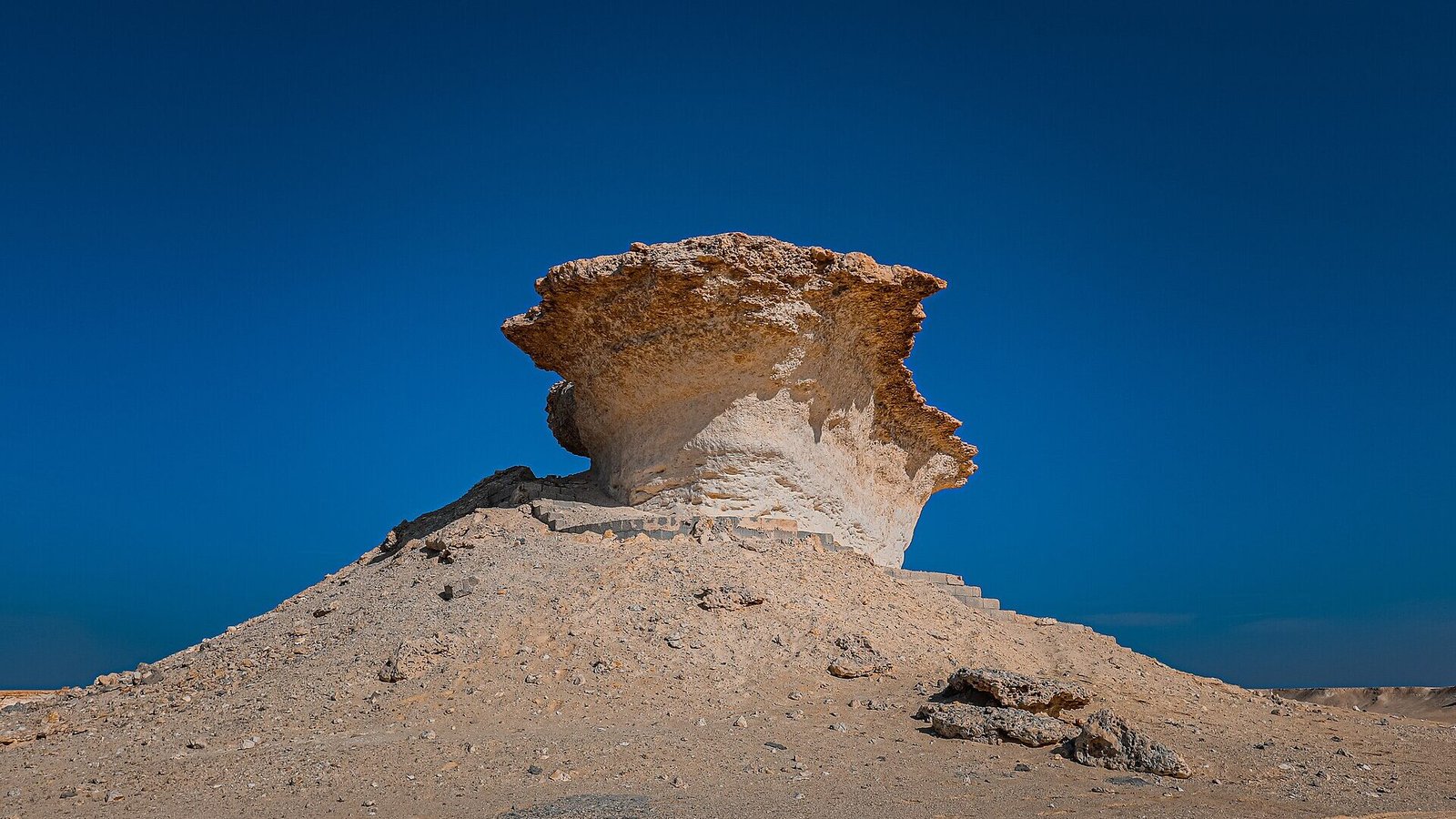
On the Zekreet Peninsula, the flat desert of western Qatar suddenly breaks up into white mounds, low cliffs and pillars of pale rock. The most striking of them look like giant mushrooms: a broad, flat cap of harder limestone balanced on a narrow, chalky stem. Some have holes worn right through them. Others lean at angles that seem impossible. Together they make one of the most otherworldly landscapes in the Gulf.
People know the area by several names: the Zekreet mushroom rocks, the Zekreet rock formations, the limestone escarpment or Bir Zekreet. Whatever you call it, it is a place for slow exploring on foot, photography and, on a clear night, stargazing. It suits walkers, photographers, families with older children and anyone curious about how landscapes are made.
Before you go, know that access is not uniform across the peninsula. The formations near Film City and the Our Habitas Ras Abrouq resort, including the famous hut perched on a pillar, lie in the northern part, which has been gated for much of the time since around 2020–21. Outcrops further south, around the Richard Serra valley and the tracks from Zekreet, are more easily reached. This guide explains both.
How the mushroom rocks formed
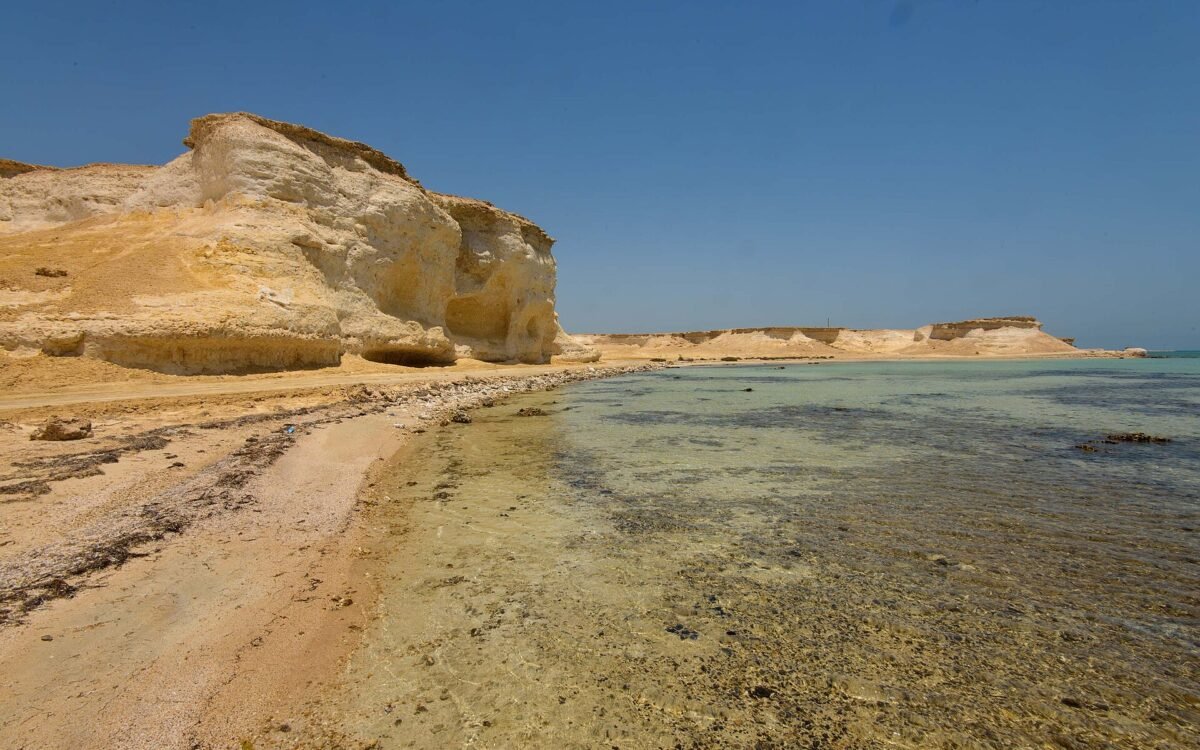
Most of Qatar sits on sedimentary rock, largely limestone laid down in shallow seas many millions of years ago. On the Zekreet Peninsula, erosion has cut these layers into mesas, escarpments and isolated stacks. Qatar Tourism describes the white limestone cliffs here as sculpted by wind and water erosion over millennia, and the Wikipedia article on Zekreet notes erosional landforms such as foothills and mesas.
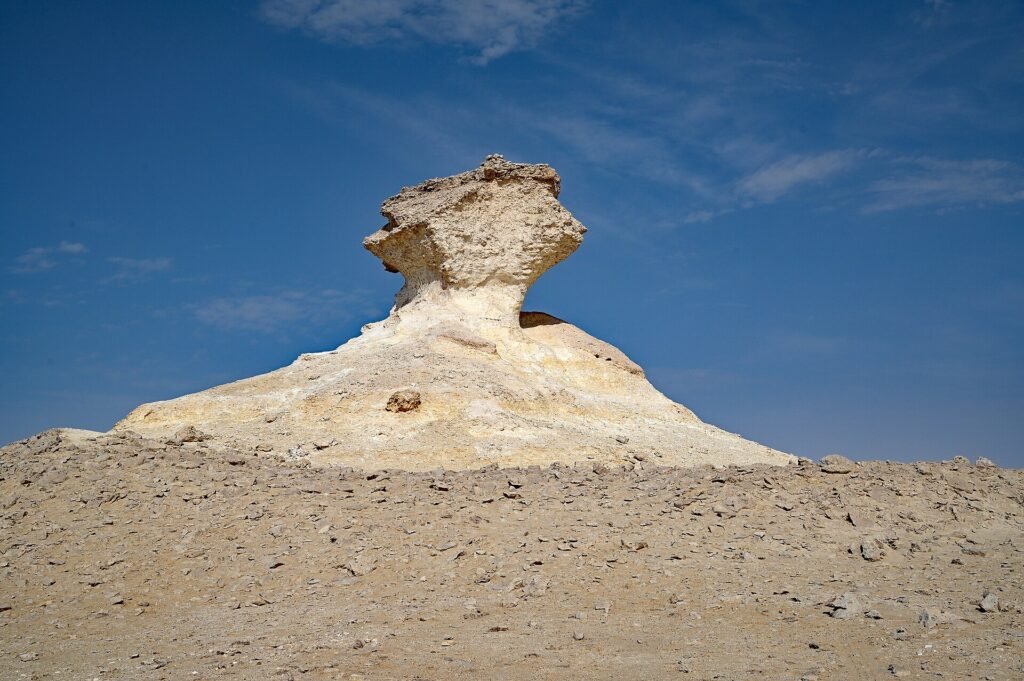
The mushroom shape comes from layers of different hardness. A tougher band of limestone forms the cap. Beneath it, the rock is softer and chalkier. Sand carried by strong winds scours the lower part of each outcrop most, because that is where most of the airborne grit travels, and the rare but heavy winter rains wash loose material away. Over time the base is undercut while the cap survives, leaving a flat top on a slender neck. Atlas Obscura sums it up as wind blowing away the softer sedimentary rock and leaving the harder limestone skeleton exposed.
This is not only a geological site. Ras Abrouq, at the northern tip of the peninsula, is considered one of the most extensive Neolithic sites in Qatar. Archaeologists have recorded flint tools, Ubaid-period pottery, Dilmun-era ceramics, burial mounds and the remains of an ancient fishing station. Today the peninsula lies within the Al Reem Biosphere Reserve, recognised by UNESCO in 2007.
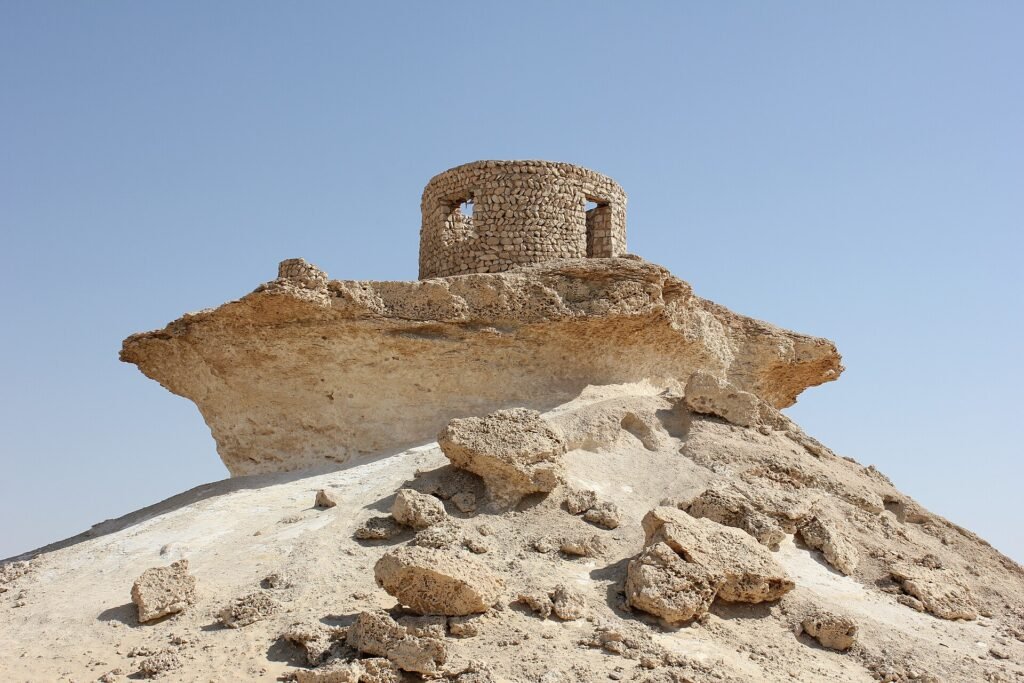
One part of the scene is newer than it looks. The small round stone huts built against the cliffs and on top of one pillar north of Film City are not ancient. Atlas Obscura reports they were built as part of the film set, and CNN described them as modern recreations of traditional shelters.
What to see and do
The classic mushroom pillars
The best-known formations are single pillars standing on pale, cone-shaped mounds, with a wide cap that overhangs on every side. Walk all the way round one: from some angles the cap looks like a bird’s head, from others like an anvil or a table. The contrast of the creamy rock against a deep winter sky is what draws most photographers.
Arches, windows and overhangs
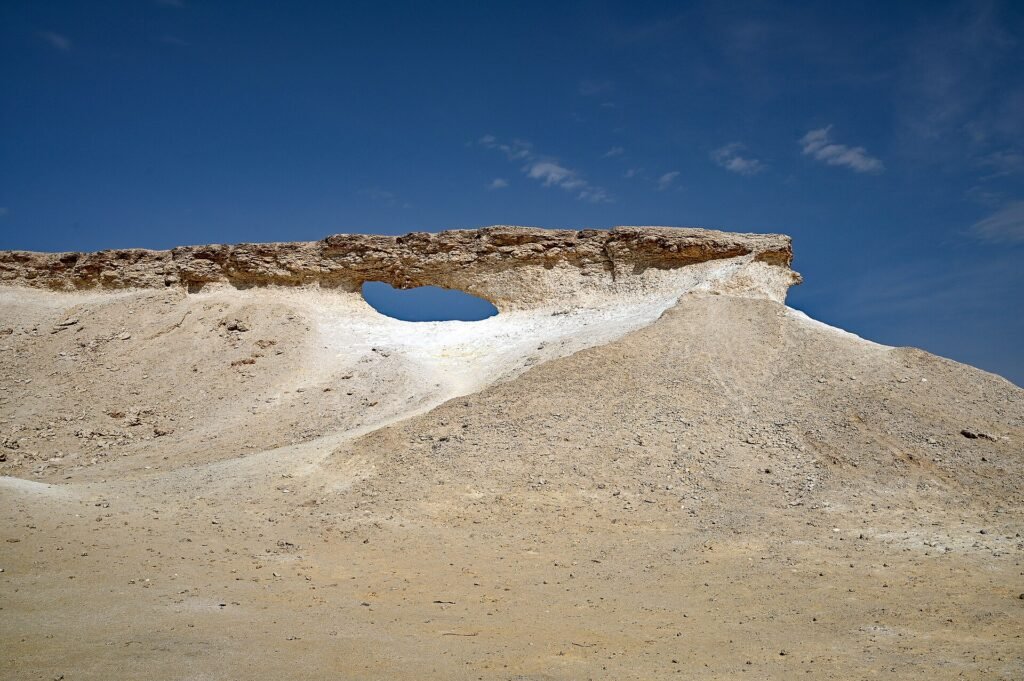
Some caps have eroded through in the middle, leaving natural windows you can frame the sky through. Elsewhere, long ledges of harder rock hang over undercut hollows. Look closely at the layers in the cliff faces and you can see the bands of harder and softer rock that explain the shapes.
The hut on the pillar
North of Film City, one small stone hut sits on top of a free-standing pillar, with others tucked against the escarpment. It is the most photographed view on the peninsula. It lies in the northern zone that has been closed off for long periods, so treat it as a bonus if you are there during an event season, not a guarantee.
Walking the escarpment edge
The mesas form a broken escarpment with flat tops and crumbly edges. A short walk along the base gives you a sense of scale and changing views. If you climb anything, choose gentle slopes of firm ground, keep well back from overhangs, and never climb onto the caps themselves: they are brittle and can break.
Wildlife on the plain
The biosphere reserve supports Arabian oryx and gazelles, and visitors and the resort both report seeing them in the area. Scan the flat ground between the outcrops, especially early and late in the day. Stay in or near your car if animals are close, and never approach or feed them.
Night sky
Away from Doha’s lights, the peninsula has some of the darkest skies within easy reach of the city. On a moonless winter night the pale rock glows faintly under the stars, and the silhouettes of the pillars make a strong foreground for astrophotography.
How to get there
The formations are spread across the Zekreet Peninsula on Qatar’s west coast, north of Dukhan and roughly an hour to an hour and a quarter from central Doha. For the map pin, the photogenic cluster near Film City sits around 25.5834, 50.8353; the open outcrops to the south are scattered along the tracks towards the Richard Serra sculpture (25.5166, 50.8625).
- Take Dukhan Highway west from Doha.
- Leave at the Zekreet exit (listed by Visit Qatar as exit 72) and follow Zekreet Road towards the coast.
- Past Zekreet village, the tarmac gives way to desert tracks heading north across the peninsula. Rock outcrops appear on both sides as you approach the Serra valley.
- Further north, OpenStreetMap marks gates across the tracks south of Film City. If they are shut, turn back: the area beyond is managed and the northern formations are not publicly accessible at those times.
Vehicle. The tracks are unpaved, with ruts, stony patches and soft sand. A 4×4 or high-clearance SUV is strongly recommended. Visitors have warned that the network of tracks is confusing, so use GPS and download an offline map. Avoid the area just after rain, when the ground can turn to sticky mud.
Tours. Several Doha operators run west-coast 4×4 tours that combine Zekreet, the mushroom rock formations and the Serra sculpture, and recent reviews from late 2025 describe visits to the rock formations. It is the easiest option if you have no off-road experience. There is no public transport, and taxis are not a practical option.
Seasonal access to the north. During Visit Qatar’s winter Brouq Season at Ras Abrouq (in 2025–26 it opened on 26 November), the area around Film City has been open to ticket holders. The Our Habitas Ras Abrouq resort, which sits beside the northern formations, is another way in if you are staying or visiting.
Best time to visit
November to March is the season for walking among the rocks. Summer heat on the reflective white ground is intense, and there is almost no shade.
Light matters here more than almost anywhere in Qatar. At midday the pale rock looks flat and washed out. In the first hour after sunrise and the last hour before sunset, low sun picks out every ledge and layer and turns the rock gold and pink. Blue-hour and night shots work well too.
Weekday mornings are the quietest time. Winter weekends, especially during the Brouq Season, bring many more cars onto the peninsula.
Tips for your visit
- Do not climb on the caps or pillars. The limestone is brittle and the overhangs can break, which is both dangerous and permanent damage.
- Respect gates and signs. Parts of the peninsula are closed outside event periods. If a gate is shut, do not drive around it.
- Stay on existing tracks. This is a UNESCO biosphere reserve, and fresh tyre marks on the crust last for years.
- Fill up and stock up before Zekreet. There are no shops or facilities among the formations.
- Protect your eyes. The white ground reflects a lot of light; good sunglasses make a big difference.
- Go with two cars if you can, and tell someone your route. Mobile signal can be weak.
- Leave no trace. Take all rubbish home, including food waste, and do not stack stones or carve into the rock.
- Drones need approval from Qatar’s civil aviation authority, and resort and event areas may have extra restrictions.
What to bring
- Plenty of water and snacks
- Sunglasses, hat and sunscreen
- Walking shoes with good grip for chalky slopes
- A camera with a wide-angle lens, and a tripod for dusk or night shots
- A head torch if you are staying after dark
- Tyre gauge, compressor and tow strap for the sandy tracks
- A rubbish bag
Combine it with nearby places
East-West/West-East by Richard Serra. The four steel plates stand in a valley flanked by the same white mesas, a short drive away. Time your day so you finish there for sunset.
Zekreet Film City. The walled TV-set village is right beside the best-known formations. It is open during Visit Qatar’s winter season, when the surrounding rocks are easiest to reach.
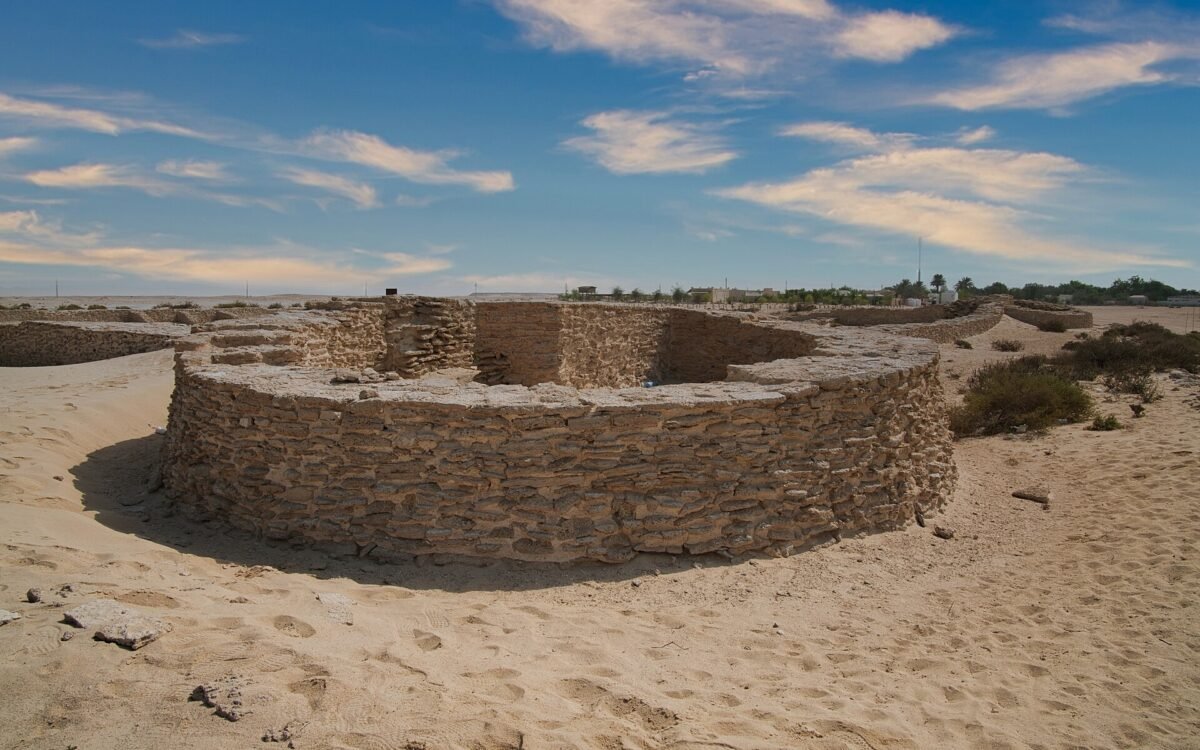
Zekreet Fort and village. The small fort near Zekreet village dates from around 1800 and was uncovered in excavations in the 1970s. It adds a genuine piece of history to a day of fake villages and strange rocks.
Dukhan. The oil town south of the peninsula is where you will find fuel, shops and restaurants on the way home.
Frequently asked questions
Where are the mushroom rocks in Qatar?
They are on the Zekreet Peninsula on Qatar’s west coast, north of Dukhan and about an hour’s drive from Doha. The best-known cluster is near Film City, around 25.5834, 50.8353, with more outcrops scattered across the peninsula.
How were the Zekreet mushroom rocks formed?
By erosion. A harder layer of limestone forms the cap, while wind-blown sand and occasional rain wear away the softer rock beneath it, leaving a flat top on a narrow stem.
Can I visit the mushroom rocks freely?
Some of them. Outcrops in the southern part of the peninsula can be reached along the desert tracks. The northern formations near Film City and the Our Habitas resort have been behind gates for much of the time since around 2020–21, and have been accessible during Visit Qatar’s winter season at Ras Abrouq.
Do I need a 4×4?
It is strongly recommended. The tracks are unpaved, with ruts and soft sand, and can be confusing. If you do not have one, book a west-coast 4×4 tour from Doha.
Is there an entry fee?
No, the open parts of the peninsula are free. Entry to Visit Qatar’s winter event at Ras Abrouq is ticketed; in 2025–26 it cost QAR 50 for adults and QAR 30 for children under 12.
Are the stone huts on the rocks historic?
No. The round huts near Film City, including the one on top of a pillar, were built as part of the film set and are modern.
When is the best time to photograph the rocks?
Between November and March, within an hour of sunrise or sunset, when low light brings out the layers and the colour of the limestone.
Last checked October 2026. Hours, fees and access can change, so confirm with the official source before you go.
More places nearby
All places →
Run a tour, café or stay near Zekreet Mushroom Rocks, Zekreet Peninsula?
List your business free on Companies in Qatar, or get featured on Qatar Unseen in front of people planning their trip.