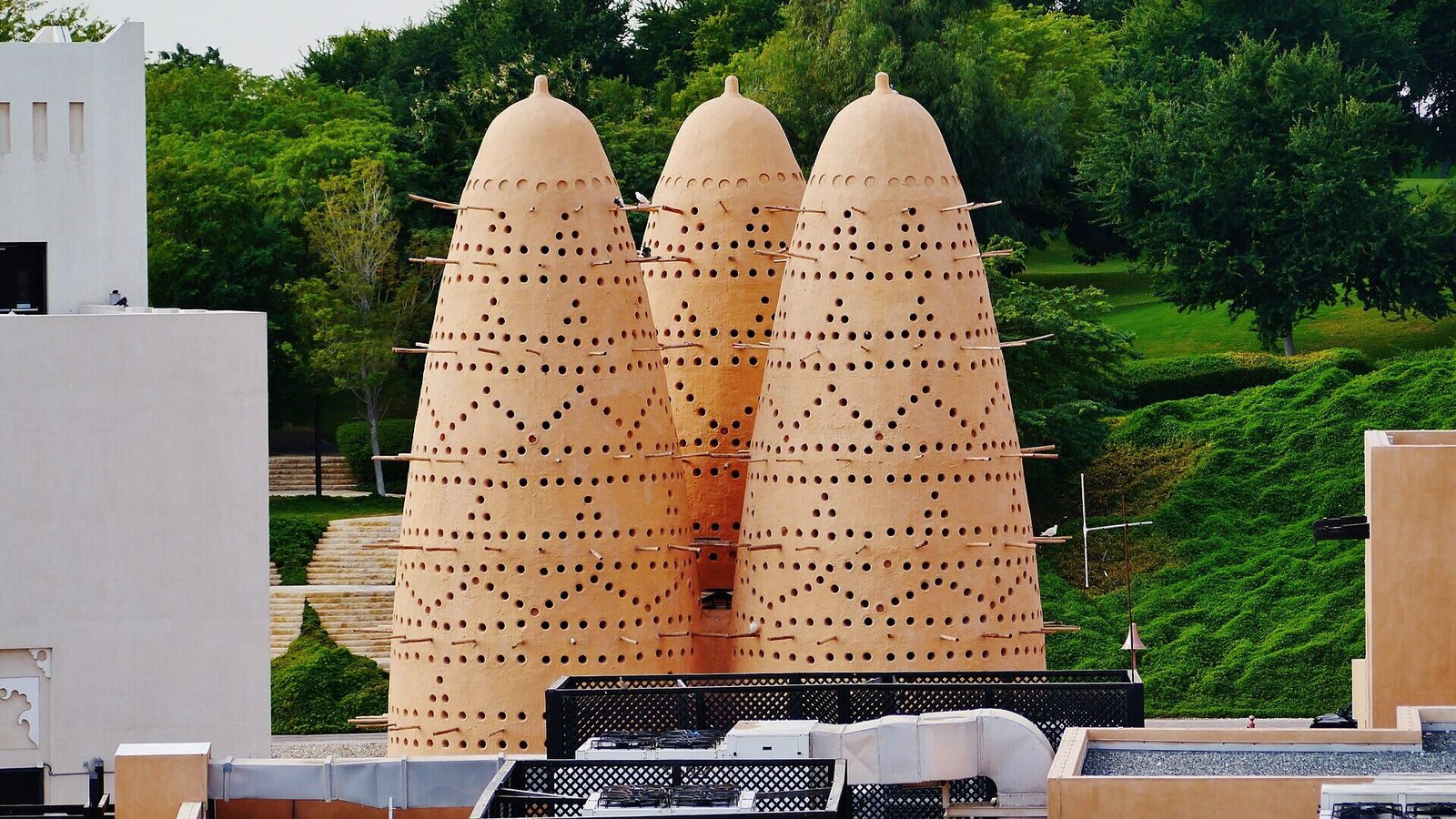
Katara Pigeon Towers, Katara Cultural Village
Tall clay dovecotes beside Katara Mosque: the story of Doha’s pigeon towers, where to find all five and how to photograph them at sunset.
Beside Katara Mosque, Katara Cultural Village, Doha
Overview
On the hillside at the back of Katara Cultural Village, beside the blue-tiled Katara Mosque, stand a group of tall, tapering towers made of clay and brick and bristling with wooden perches. These are the Katara pigeon towers, modern versions of the dovecotes once built across the Middle East to house pigeons. They are among the most recognisable shapes in Doha, yet many visitors to Katara head straight for the beach or the restaurants and never walk up to see them properly.
The towers are worth seeking out for three reasons. They are genuinely striking, especially in the warm light before sunset. They are a doorway into an old and surprisingly important relationship between people and pigeons in the Arab world. And they sit in one of the quietest, most photogenic corners of Katara, with the mosque, the amphitheatre and the green slopes of the hill all close by.
This guide treats the towers as a short sunset and photography stop, explains the story behind them, and suggests how to fit them into an evening at Katara. They suit photographers, families, couples and anyone who wants a calmer side of Katara away from the beachfront.
The story behind the pigeon towers
Pigeon towers, or dovecotes, have a long history in the region. Large towers were built to house hundreds or thousands of birds, and their droppings were collected and used as fertiliser for farming. Pigeons were also valued as messengers. The Peninsula notes that during the Abbasid Caliphate, carrier pigeons were used to send messages alongside horses and camels, and that their homing instinct kept them in service for centuries.
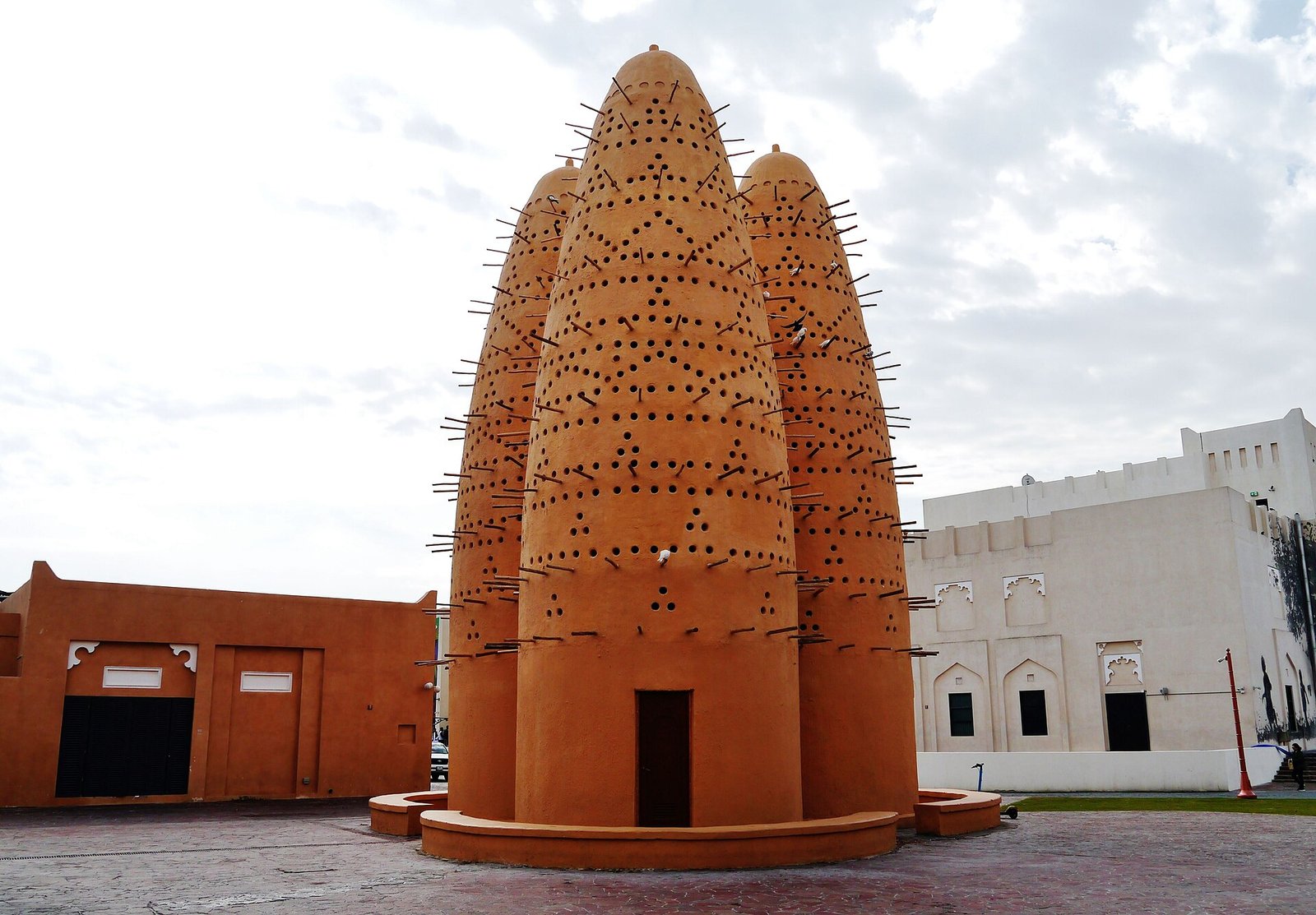
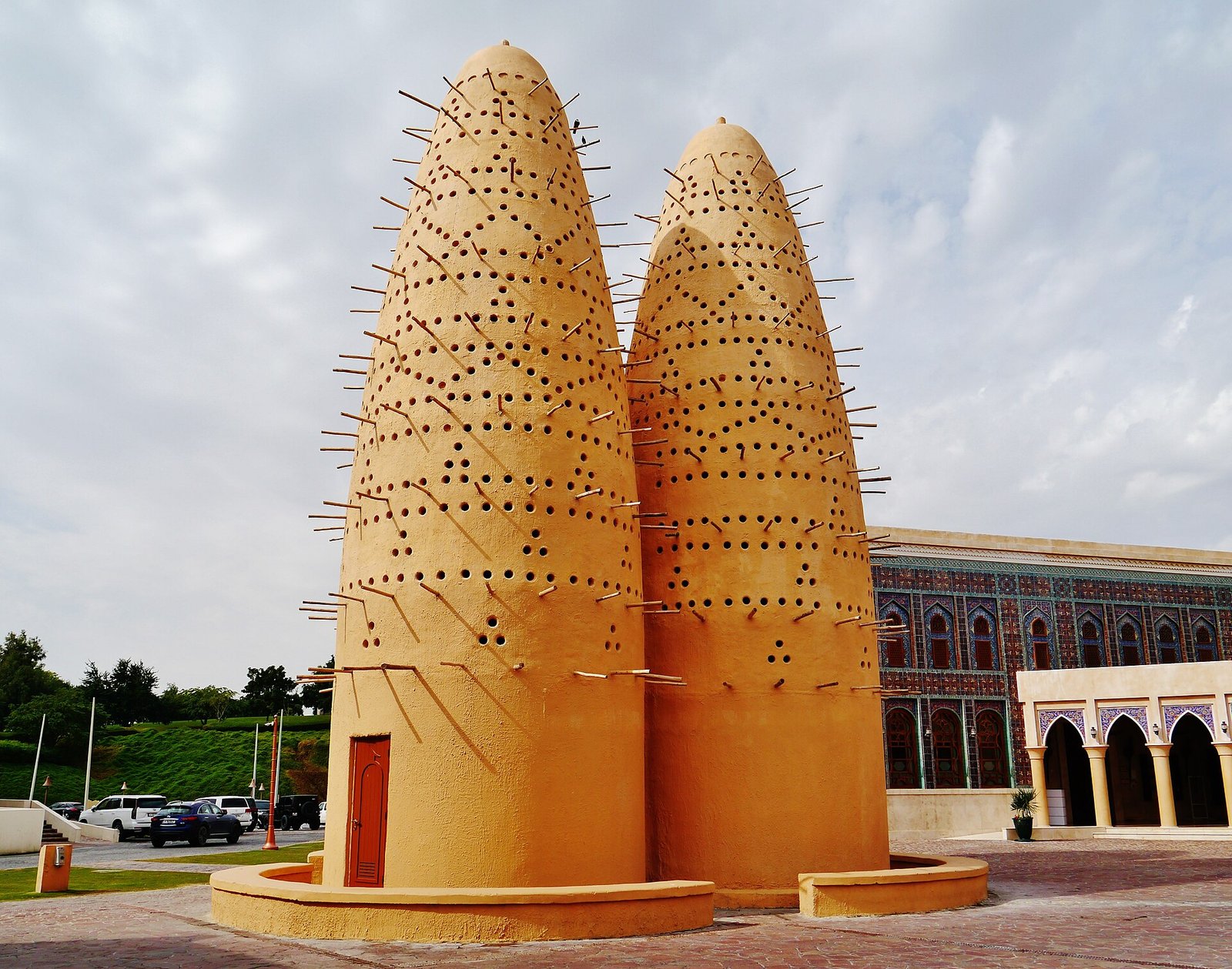
Katara Cultural Village was developed on reclaimed land on the coast between West Bay and The Pearl, and had a soft opening in October 2010 during the Doha Tribeca Film Festival. Its architects drew heavily on traditional regional forms, and the pigeon towers are one of the clearest examples. According to The Peninsula, the original towers were built between 2006 and 2007 from clay and brick, each about 4.25 metres wide and 15 metres tall, with wooden perches arranged in decorative patterns. There were five in all: three on the western side next to the mosque and two on the eastern side towards the sea.
In February 2022 Katara announced that the towers would be demolished and rebuilt to higher engineering standards, The Peninsula reported. Photographs taken in January 2023 show the towers standing in their familiar form, and they remain a fixture of Katara today. Katara has kept the pigeon link alive in other ways too: it has held pigeon races, and in January 2024 it released 5,000 pigeons to launch its programme for the AFC Asian Cup.
What to see and do
Walk round the western group by the mosque
The cluster of three towers beside Katara Mosque is the classic view. Walk all the way round them. From one side they rise against the hill; from another they line up with the mosque’s dome and minaret. Look closely at the small openings and the wooden perches that stick out from the walls in neat rows, which give the towers their spiky silhouette.
Find the eastern pair
Two more towers stand on the eastern side of Katara, closer to the sea. They are often quieter than the western group and frame well against the arched buildings and open plazas nearby. Finding both groups is a good excuse to explore the lanes of the village on foot.
Photograph them at golden hour
The towers are the colour of desert sand, and in the hour before sunset they glow orange against the sky. This is the best time for photographs. For a strong composition, use the vertical lines of the towers, step back so the perches read as a pattern, and include the mosque or the hill for context. After sunset, the blue hour gives a softer, cooler mood.
Look in at Katara Mosque
Next to the western towers, Katara Mosque is covered in turquoise, blue and purple tiles and was designed by the Turkish architect Zainab Fadil Oglu, according to Wikipedia. Non-Muslim visitors should check whether entry is possible outside prayer times and dress modestly; even from outside, the tilework is beautiful at close range.
Climb towards Katara Hills
Behind the towers, Katara rises up a landscaped hill with green slopes, steps and walkways. A short climb gives you a view down over the towers, the mosque and the roofs of the village. It is one of the few places in central Doha where you can look down on a cluster of traditional-style buildings from above.
Have karak by the towers
The towers sit close to Chapati & Karak, the popular stand for sweet spiced tea and warm flatbread, which our guide describes as a favourite stop near the towers at dusk. Expect a queue in the evenings, especially at weekends.
A one-hour sunset walk
- Start at the mosque. Arrive about an hour before sunset and begin at the western group of towers beside Katara Mosque.
- Climb the slope. Walk a little way up the hill behind for the elevated view over the towers and the dome.
- Cross the village. Head down through Katara’s lanes towards the sea to find the eastern pair of towers.
- Pass the amphitheatre. Detour past the marble amphitheatre on the way.
- Finish by the water. End on the seafront promenade for the last of the light, then come back up for karak by the towers.
What first-timers get wrong
Many people see a single cluster of towers and assume that is all. Katara built five, in two groups, and the quieter eastern pair is often the better photo.
Others arrive after dark on a busy weekend, when parking near the mosque is full and the plazas are crowded. The towers are at their best in daylight, and the area is much calmer on a weekday.
Finally, some visitors treat the area around the mosque like any other plaza. It is a place of worship: lower your voice, dress modestly and keep cameras away from people praying.
How to get there
Katara Cultural Village is on the coast north of West Bay, between the city centre and The Pearl. The pigeon towers are at the back of the village, uphill from the beach, next to Katara Mosque.
By metro: Katara station on the Red Line serves the village. From the station, walk or take a short taxi ride to the mosque area; ask for Katara Mosque if you are unsure.
By car: Katara has large car parks, including underground parking with clear signs. Follow signs for the mosque or the amphitheatre for the closest parking to the towers. Parking fills up on weekend evenings and during events.
By taxi: Ask for Katara Cultural Village and then for Katara Mosque or the pigeon towers.
The area is paved and walkable, though the hill behind the towers involves some steps and slopes.
Best time to visit
From November to March the weather is ideal for wandering Katara in the late afternoon and evening. Arrive about an hour before sunset for golden light on the towers, then stay for the lights to come on.
Weekday afternoons are quieter than Thursday and Friday evenings, when families pour into Katara. In summer, the open plazas around the towers get very hot during the day, so come at sunset or later. Remember that the mosque area becomes busy at prayer times; be respectful and avoid taking photos of worshippers.
Tips for your visit
- Come in the hour before sunset for the best light on the towers.
- Look for both groups: three towers by the mosque and two towards the sea.
- Don’t climb on the towers or their bases; they are architectural features, not play structures.
- Be mindful near the mosque, especially at prayer times, and dress modestly.
- Ask before photographing people, particularly families.
- Check Katara’s events calendar before you go; big events change parking and crowd levels.
- Combine the towers with a walk up the hill for a view over the village.
What to bring
- A camera or phone with a wide-angle setting
- Comfortable shoes for the slopes and steps
- Modest clothing if you plan to visit the mosque
- Water in the warmer months
Combine it with nearby places
Katara Mosque and the Golden Mosque. Two very different mosques within a short walk: the tiled Katara Mosque next to the towers and the gold-tiled, Ottoman-style Golden Mosque nearby.
Katara Amphitheatre. The marble open-air theatre, with seating for up to 5,000, is one of Katara’s architectural highlights and a short walk away.
Katara Beach. The beach is about 1.5 km long. According to Years of Culture, entry is QAR 10 for adults, free for under-15s and over-60s, and it opens from 2pm to 11pm.
Kava Koffee. A specialty coffee stop inside Katara for a sit-down break.
Chapati & Karak. Sweet karak and chapati right by the towers.
Frequently asked questions
Where are the pigeon towers in Katara?
At the back of Katara Cultural Village, next to Katara Mosque, with a second pair of towers on the eastern side closer to the sea.
Are the Katara pigeon towers free to visit?
Yes. They are in the open public areas of Katara, which are free to walk around.
Do pigeons actually live in the towers?
The towers are modelled on traditional dovecotes and have openings and perches for birds, and Katara has kept pigeons and organised pigeon events. Whether you see many birds depends on the day; the towers are mainly a heritage and architectural feature today.
Why were the pigeon towers rebuilt?
In 2022 Katara announced that the original towers, built in 2006 and 2007, would be demolished and rebuilt to higher engineering standards. The towers you see today keep the same traditional design.
What is the best time to photograph the pigeon towers?
The hour before sunset, between November and March, when the clay glows in the low sun and Katara is still relatively quiet.
Can I get to Katara by metro?
Yes. Katara station is on the Red Line. From there it is a walk or a short taxi ride to the mosque and the towers.
Last checked October 2026. Hours, fees and access can change, so confirm with the official source before you go.
Read the Companies in Qatar visitor guide ↗
More places nearby
All places →
Run a tour, café or stay near Katara Pigeon Towers, Katara Cultural Village?
List your business free on Companies in Qatar, or get featured on Qatar Unseen in front of people planning their trip.