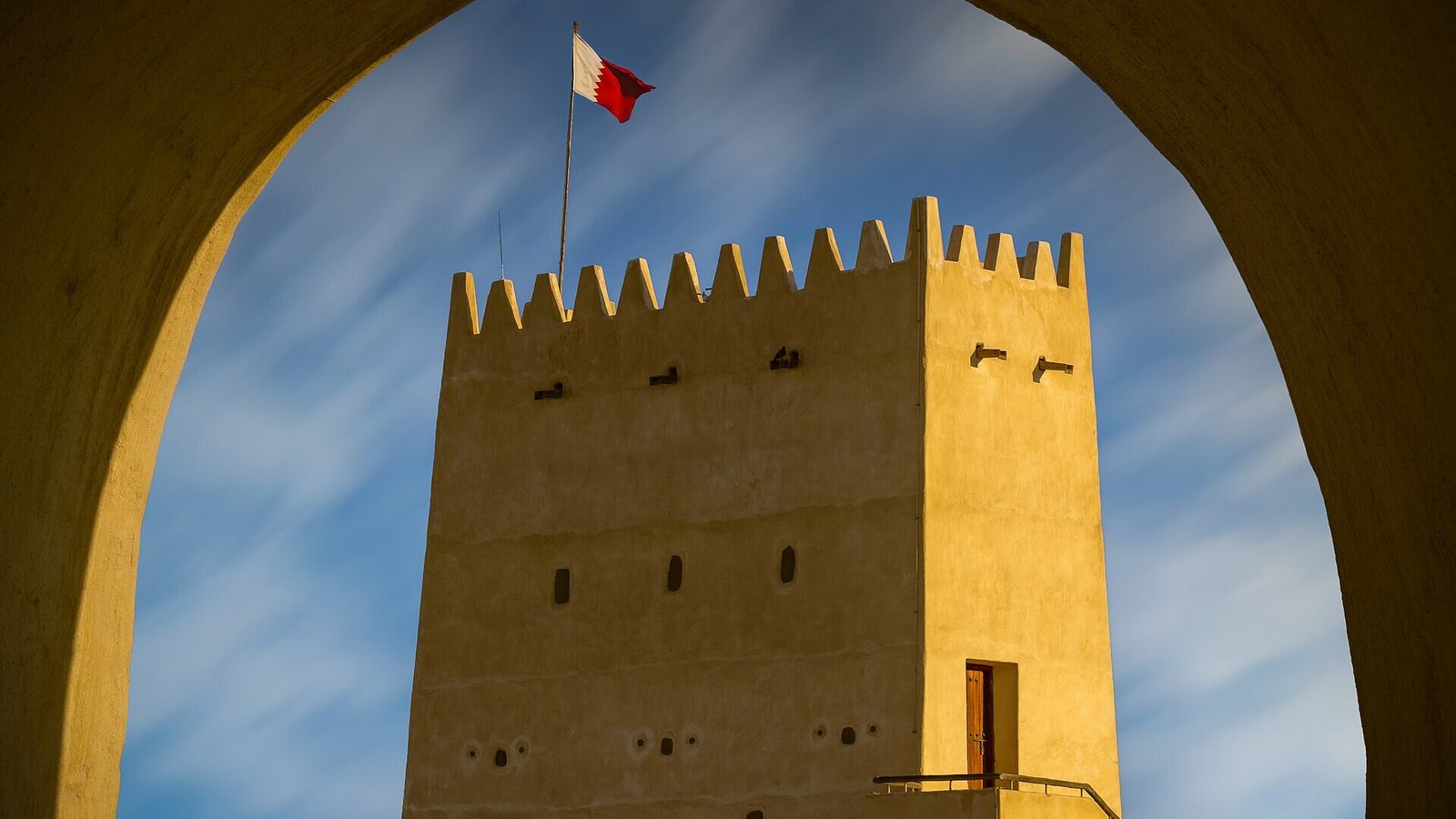
Umm Salal Mohammed Fort, Umm Salal
The fortified winter residence Sheikh Mohammed bin Jassim built around 1910, and the town that grew from it. The story, what you can see and current access.
Umm Salal Mohammed, Umm Salal (20 km north of Doha)
Overview
Umm Salal Mohammed is one of the few towns in Qatar named after the man who built it. Around 1910, Sheikh Mohammed bin Jassim Al Thani chose this patch of farmland and wells about 20 km north of Doha for his winter residence, fortified it, and laid out a settlement around it. The result, known today as Umm Salal Mohammed Fort, is a group of defensive buildings on a low rise that includes the famous Barzan Towers.
This guide looks at the fort as a whole: the sheikh who built it, how a fortified residence of this kind worked, and how the town grew from it. It also untangles a common confusion. Many guidebooks, Wikipedia and even some official listings use “Umm Salal Mohammed Fort” and “Barzan Towers” for the same place, while others use the fort name for the sheikh’s fortified house beside the towers. Both belong to the same historic complex, and together they are what you come to see.
Access status: Qatar Museums currently lists Barzan Towers, the part of the complex it manages, as temporarily closed until further notice, and the fortified residential buildings are not listed as a visitor attraction. For now, this is a place to see from the outside. It suits history lovers, people interested in traditional architecture and anyone heading north who wants a short heritage stop close to Doha.
The story behind the fort
Sheikh Mohammed bin Jassim Al Thani was a son of Sheikh Jassim bin Mohammed Al Thani, the founder of the modern state of Qatar. Early in the 20th century, relations with the Ottoman Empire were still uneasy, even though Sheikh Jassim had defeated Ottoman forces at the Battle of Al Wajbah in 1893. According to local histories, Sheikh Mohammed decided to rebuild the towers on the rise here as his winter residence and as an outpost to watch for approaching troops, and he designed and oversaw the building of the town around them.
The site was chosen for good reasons. Umm Salal Mohammed sits beside a rawda, a shallow depression where rainwater gathers after running off higher ground. The area had farms, date palms and wells, and it still has a large reservoir that fills in the rainy season. The fortifications formed a defensive system around that precious water and farmland. According to Wikipedia’s account of the site, the main towers link to two other fortified buildings to the west and a further tower to the north.
Arabic heritage accounts describe the sheikh’s home as a residential fort that looked like a very large house: rectangular, with walls more than eight metres high topped by crenellations and pierced by firing slits. They list a reception hall (liwan), stores for pottery and grain, women’s quarters, a kitchen and a bath. Like the towers, it was built from limestone and mud and coated inside and out with local gypsum plaster.
Qatar Museums dates the western Barzan tower to 1910–1916 and says the eastern tower was added after 1958. A Danish archaeological team excavated the enclosed site in 1958. The towers were restored in 2003 and again in 2014, together with the mosque and madrasa.
What to see and do
The fortified complex from outside
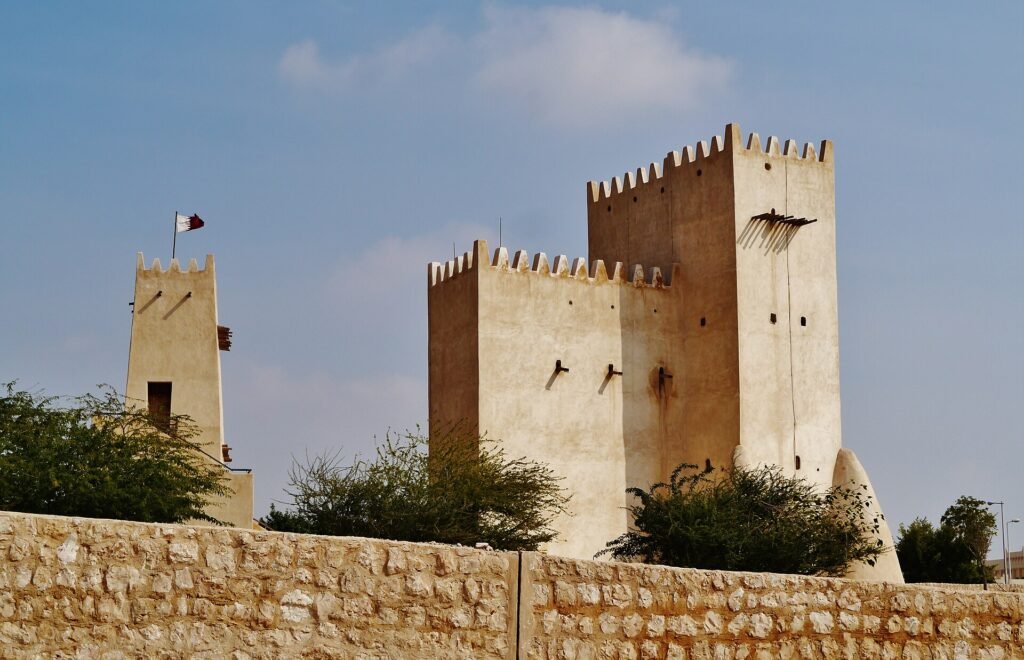
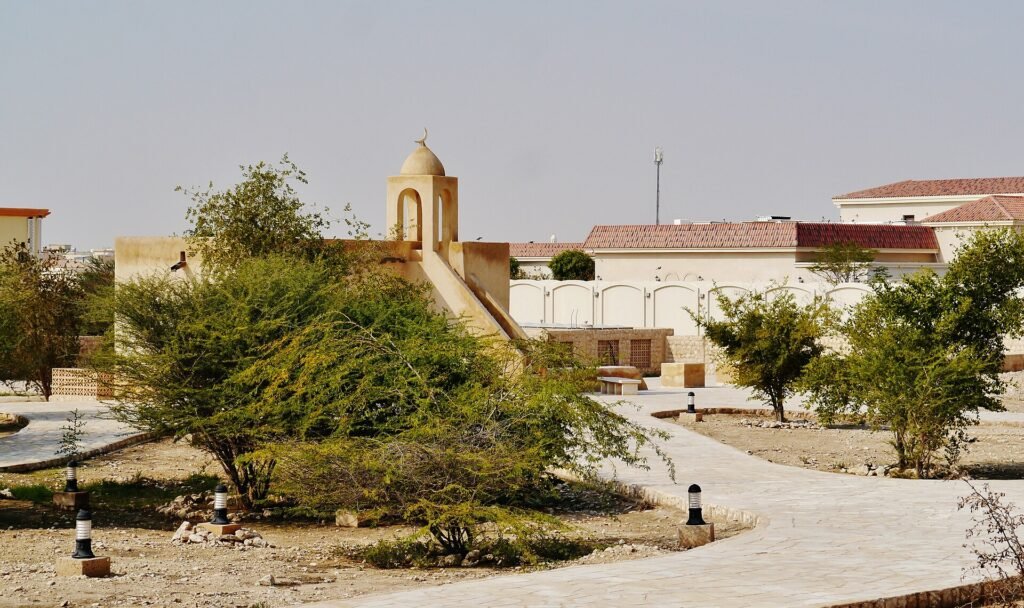
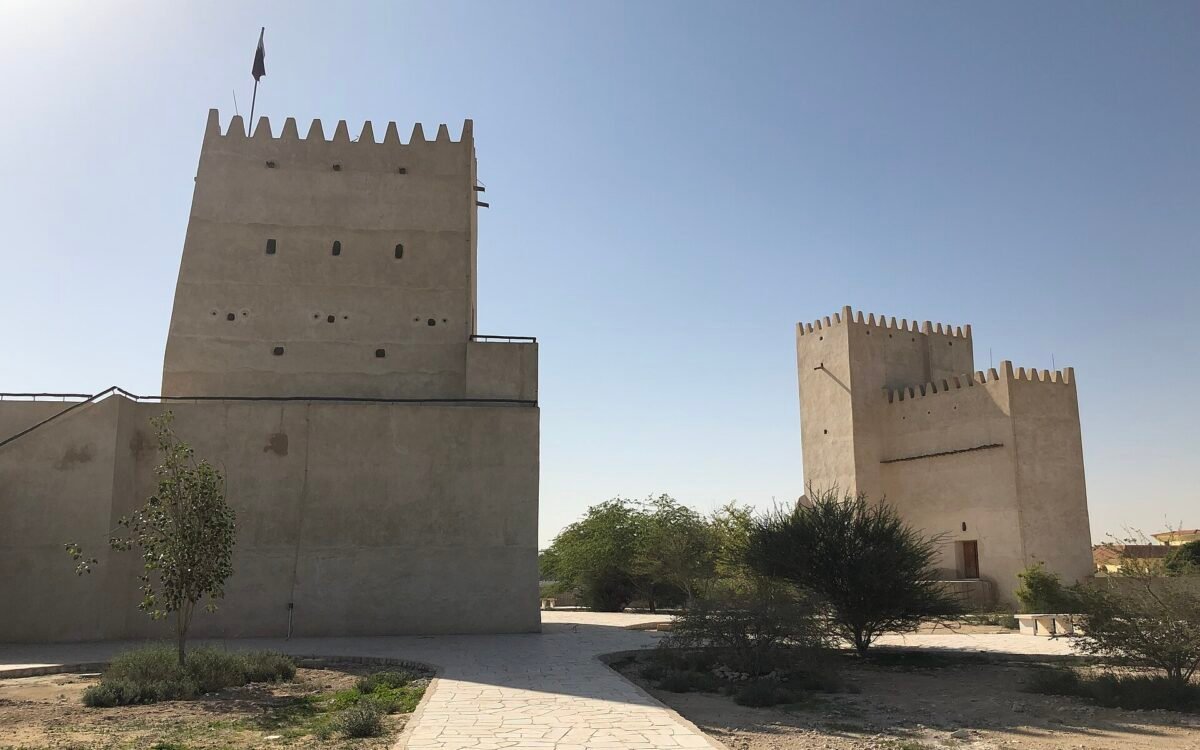
Walk the outside of the complex and you get a clear sense of how it worked. Low stone boundary walls enclose restored grounds, with the two Barzan towers rising above everything around them. Plastered buildings sit at their feet, and a mosque minaret stands nearby. The whole group reads as a compact fortified estate rather than a single castle: a home, a place of prayer and study, reception rooms and lookouts, all within reach of the water supply.
The Barzan Towers
The towers are the most visible part of the fort. The western tower has an unusual T-shaped plan and a broad external staircase, and Qatar Museums describes it as unique in the Gulf. The eastern tower has the rectangular shape seen elsewhere in Qatar. For a closer look at their architecture, see our full guide to the Barzan Towers.
Traces of a winter residence
Look for the features that tell you people lived here, not just soldiers: the majlis pavilion where guests were received, rooms with small windows set high in thick walls to keep out the heat, and the mosque whose prayer room once doubled as a Quran school for the town’s children. Building materials were local and practical: coral rock and limestone for walls, mud mortar, gypsum plaster, and roofs of wooden poles, bamboo, mangrove branches and packed mud.
The landscape the fort protected
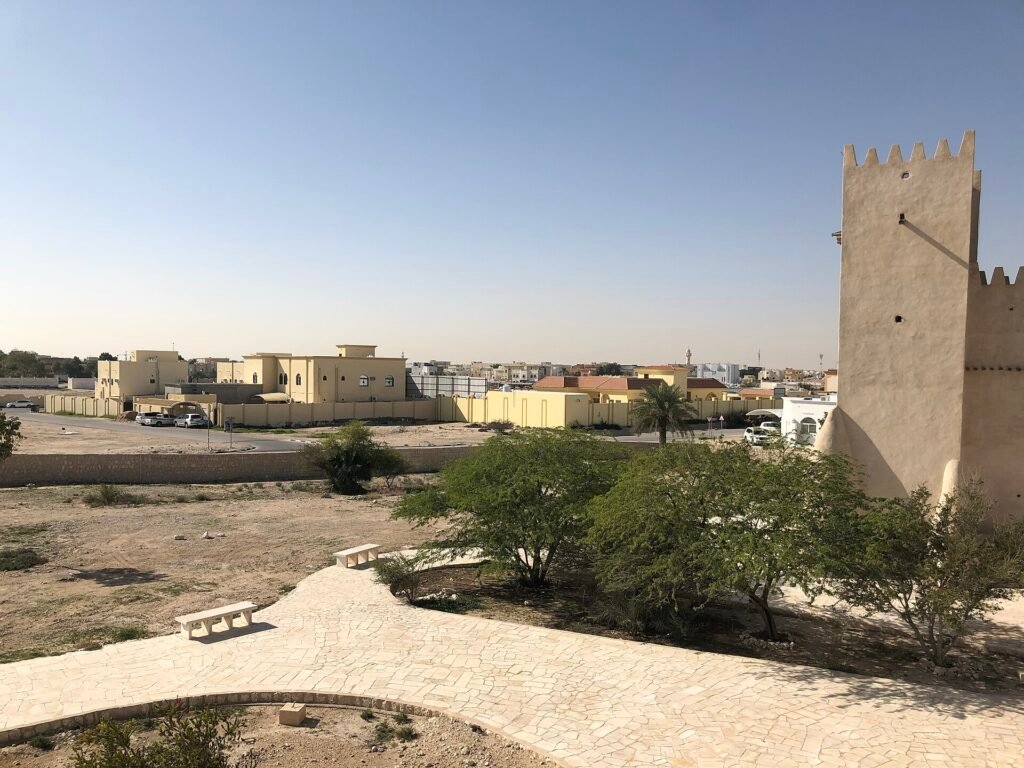
Take a moment to look beyond the walls. The rise the fort stands on was chosen for its view and its breeze, and the land around it was farmland watered by wells and the seasonal rawda. Today much of it is covered by villas and roads, but the town still has farms, wells and a reservoir, and native plants have been used to landscape the grounds around the towers.
Umm Salal Mohammed today
The town that grew from the fort is now a fast-developing suburb. Mohammed bin Jassim Park, opened in 2015, has a children’s play area and a cafeteria, and the large Doha Festival City shopping mall opened in the town in 2017. The municipality’s huge Umm Salal Nursery grew many of the trees and much of the turf used around the FIFA World Cup 2022 stadiums. It is a striking contrast to stand beside a century-old tower and see a modern city spreading around it.
Darb Al Saai in December
Each December the Ministry of Culture’s Darb Al Saai festival takes place at a purpose-built heritage venue in Umm Salal Mohammed in the run-up to Qatar National Day on 18 December. Its name refers to the route taken by Sheikh Jassim’s messengers. Expect flag-raising ceremonies, horse and camel displays, sea music, traditional crafts, workshops and a market selling local food and souvenirs. It is the best time of year to experience the heritage that the fort represents.
How to get there
Umm Salal Mohammed is about 20 km north of central Doha, a drive of roughly 20 to 30 minutes.
- Drive north from Doha on Al Shamal Road.
- Leave the highway at the Umm Salal Mohammed exit and head into the town.
- Navigate to “Barzan Towers” or the coordinates 25.4181, 51.4132, which mark the heart of the fortified complex.
The roads are paved all the way, and you can park on the streets around the site. Keep gates and driveways clear, as this is a residential neighbourhood. There is no metro station in the town. A taxi or ride-hailing car from Doha is the easiest option without your own transport; book the return journey before you set off.
Best time to visit
From October to April the weather is comfortable enough to walk around the complex and the town. The best light for photographs is in the late afternoon, when the plaster walls glow. In summer, keep outdoor time short and visit early or late in the day.
If Qatar Museums reopens Barzan Towers, the normal hours it lists are Saturday to Thursday from 8.30am to 12.30pm and Friday from 3pm to 6pm. Check before you go. Early December, during the Darb Al Saai festival, is the liveliest time of year in Umm Salal Mohammed, though traffic and parking are busier then.
Tips for your visit
- Know which “fort” you mean. Many maps and guides label the Barzan Towers complex as Umm Salal Mohammed Fort. Search for Barzan Towers to reach the right place.
- Check access before you go. Qatar Museums lists Barzan Towers as temporarily closed until further notice.
- Stay outside closed areas. Don’t climb walls or enter buildings that are fenced or locked.
- Respect the neighbours. The complex sits among family homes, so keep noise down and don’t photograph houses or people without permission.
- Dress modestly. There is a working mosque at the site.
- Combine stops. The fort is a short visit, so pair it with Darb Al Saai in December, a meal in town or a drive north to Al Khor.
What to bring
- Water and a sun hat
- A camera with a zoom lens for details high on the walls
- Modest clothing
- A downloaded map, as the streets around the site can be confusing
Combine it with nearby places
Barzan Towers. Our in-depth guide to the two towers at the heart of the complex: the T-shaped western tower, the rectangular eastern tower and how their walls and roofs were built.
Darb Al Saai. The heritage venue in Umm Salal Mohammed hosts the National Day festival each December, with crafts, performances and traditional food.
Simaisma. The old pearling village on the coast north-east of Umm Salal has a mosque built in 1938. Its beach is closed for redevelopment, so treat it as a short heritage stop.
Al Farkiya Beach, Al Khor. About 40 minutes north, Al Khor’s fenced family beach has calm, shallow water, shade and play areas, a good way to end a day of heritage stops.
Frequently asked questions
Is Umm Salal Mohammed Fort the same as Barzan Towers?
Often, yes. Many sources use the two names for the same fortified complex, while some use “fort” for Sheikh Mohammed bin Jassim’s fortified residence beside the towers. They are parts of the same historic site in Umm Salal Mohammed.
Can you go inside Umm Salal Mohammed Fort?
Not at present. Qatar Museums lists Barzan Towers as temporarily closed until further notice, and the residential buildings are not listed as open to visitors. You can view the complex from outside.
Who built Umm Salal Mohammed Fort?
Sheikh Mohammed bin Jassim Al Thani, a son of Qatar’s founder Sheikh Jassim bin Mohammed Al Thani, built it around 1910 as his winter residence and founded the town around it.
Why was it built here?
To protect the wells, farms and rainwater depression (rawda) of Umm Salal Mohammed, to serve as a lookout in a period of tension with the Ottomans, and to provide a comfortable winter home on a breezy rise.
Is there an entrance fee?
No. When Qatar Museums has opened Barzan Towers to the public, entry has been free.
How far is it from Doha?
About 20 km north of central Doha, usually 20 to 30 minutes by car via Al Shamal Road.
Last checked October 2026. Hours, fees and access can change, so confirm with the official source before you go.
Read the Companies in Qatar visitor guide ↗
More places nearby
All places →
Run a tour, café or stay near Umm Salal Mohammed Fort, Umm Salal?
List your business free on Companies in Qatar, or get featured on Qatar Unseen in front of people planning their trip.