Purple Island (Jazirat Bin Ghanim), Al Khor
Walk the footbridge to Al Khor's mangrove island, climb its limestone hillocks and find the site of a 3,000-year-old purple dye industry.
Al Khor Island, east side of Al Khor bay (north-east coast)
Overview
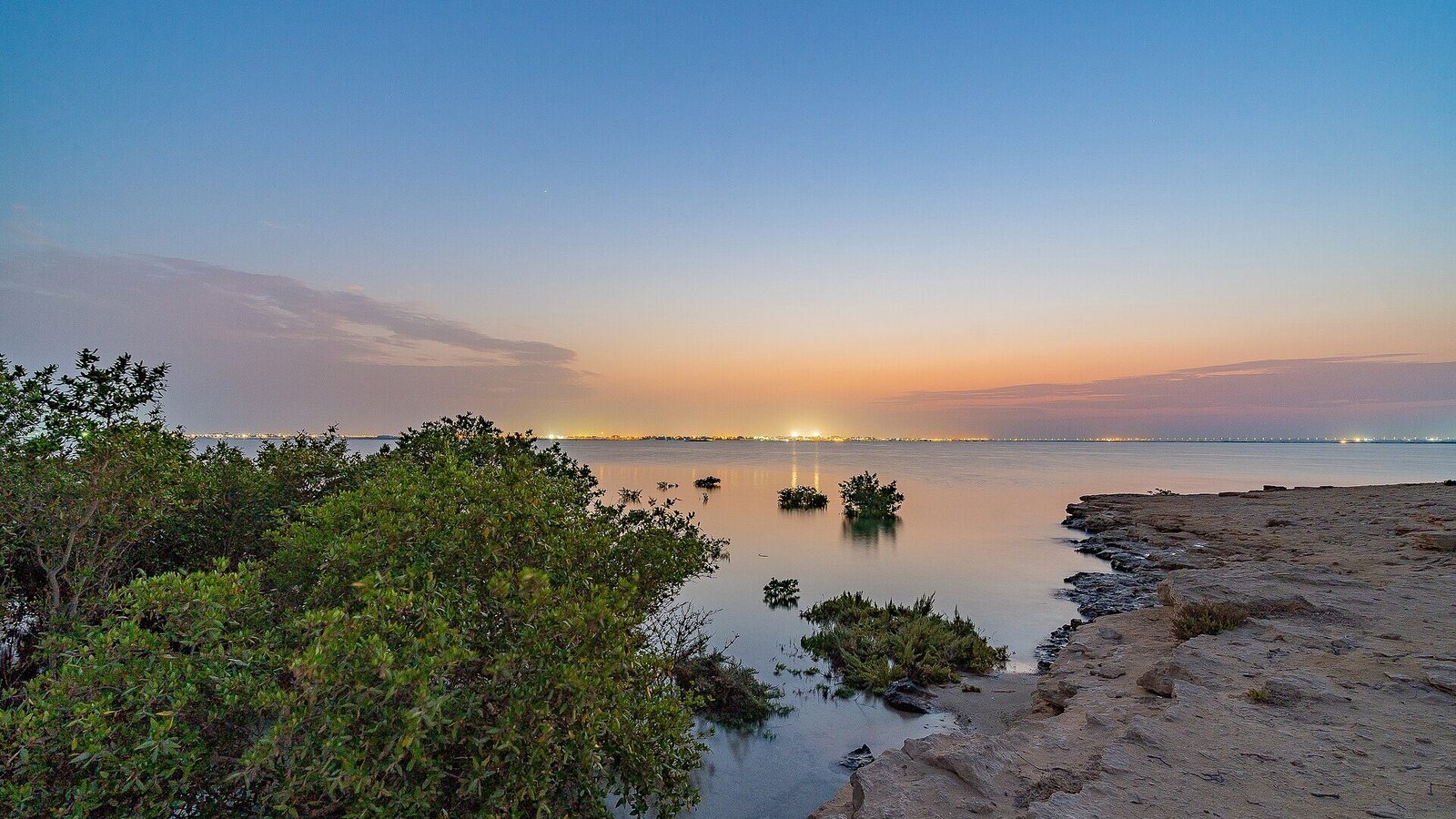
Purple Island is a low, scrubby island on the eastern side of the bay at Al Khor, about 50 km north of Doha. On the map it is called Al Khor Island or Jazirat Bin Ghanim (also spelt Bin Ghannam), and it covers roughly 1.7 square kilometres of salt marsh, beachrock, mangrove creeks and a scatter of small limestone hills. A wooden footbridge links it to the mainland, so you can walk across from where you park.
Most people know it as a mangrove spot, and the greenery is the first thing you notice. What many visitors miss is that this is also one of the oldest archaeological sites in Qatar. More than 3,000 years ago people camped here and crushed millions of sea snails to make purple dye, which is where the island’s English name comes from. Walking it with that story in mind turns a pleasant stroll into something more interesting.
This guide is written for people who want to explore the island on foot: how the tide changes the walk, what to look for on the ground, where the views are, and the mistakes that catch first-timers out. It suits families with children who don’t mind a bit of mud, walkers, birdwatchers, photographers and anyone looking for an easy half-day trip out of Doha. If you mainly want to paddle, see our separate guide to kayaking at Al Thakira, just up the coast.
The story behind the island
Al Khor Island is the only site in Qatar that archaeologists attribute to the second millennium BC, and people have used it on and off for about 4,000 years. It was never a proper village. There is no drinking water on the island, so the people who came here stayed in temporary camps, used it as a stopping point for trade, fished, dived for pearls and, for a period, ran a small industry.
The earliest finds are pottery from the Dilmun civilisation, which was centred on Bahrain. Jars and cooking pots dated to around 2000 to 1750 BC suggest that visitors from Dilmun, perhaps fishermen, pearl divers or traders travelling along the coast, camped here.
The discovery that made the island famous belongs to the Kassite period, roughly 1400 to 1100 BC, when a Kassite dynasty ruled Babylonia and had links with the Gulf. Excavations uncovered huge heaps of crushed sea-snail shells, around 2.9 million according to Qatar Museums, along with Kassite pottery and large ceramic vats that were probably used to process the molluscs. The snails were a murex species, the same family whose glands produced the red-purple dye later made famous in the Mediterranean as Tyrian purple. The Al Khor finds are often described as one of the earliest known examples of shellfish dye production anywhere.
Later visitors left traces too. Finds from the late Sasanian period, around AD 400 to 600, point to use as a pearling camp, and the island was used again between about 1700 and 1900, in the late Islamic period. The site was known before the 1970s, but the first systematic study was made in 1976 by the French Archaeological Mission in Qatar, led by Jacques Tixier. Qatar Museums now lists Jazirat Bin Ghannam among the country’s heritage sites.
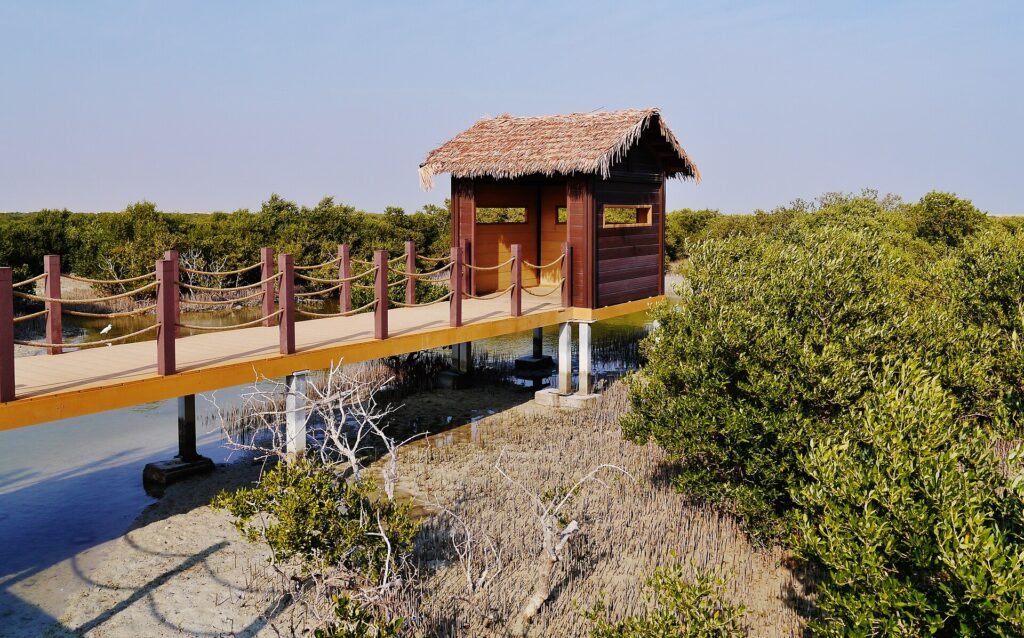
The modern chapter is much simpler. For years the only way across was to wade through the creeks at the right state of the tide. In 2019 a wooden pedestrian bridge was built, and local press reported that visitors could now reach the island on foot without getting wet or needing a boat. Since then it has become one of the most visited natural spots in the north.
What to see and do
Cross the footbridge slowly
The walk begins before you reach the island. The raised wooden path from the parking area crosses creeks and mud lined with grey mangroves (Avicennia marina), the only mangrove species that grows naturally in Qatar. Stop in the middle and look down. At low water the mud is full of small crabs that duck into their holes as your shadow passes, and at high water small fish move through the roots. There are shaded rest points along the way, and this first stretch is where younger children tend to be happiest.
Climb the limestone hillocks
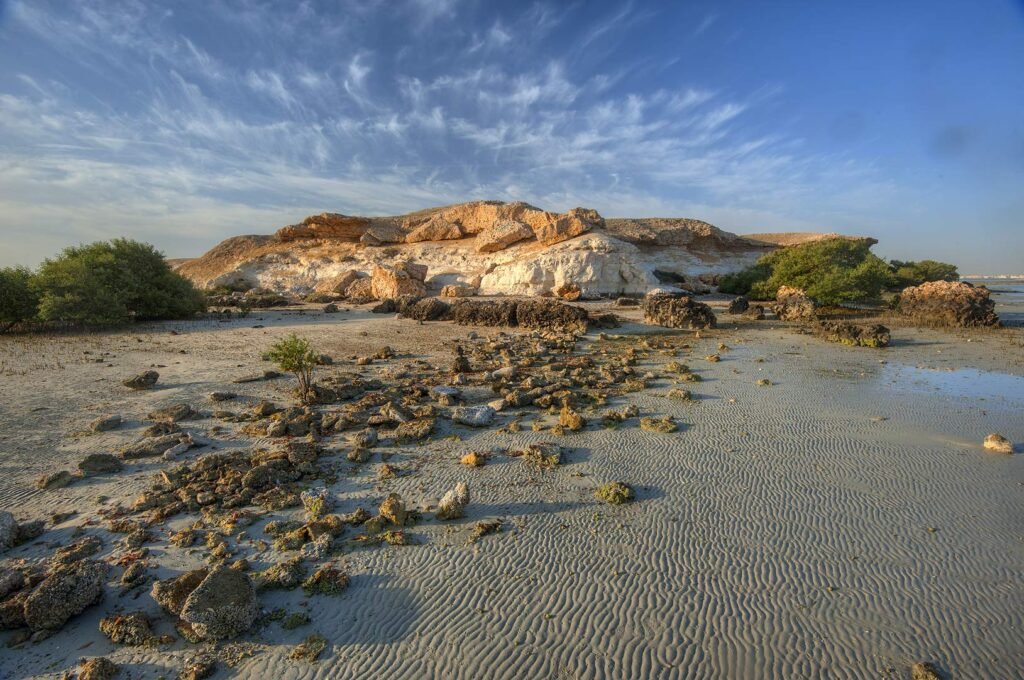
The island is mostly flat, but a handful of limestone outcrops rise above the marsh, the tallest about 8.5 metres high. They are easy scrambles rather than climbs, and from the top you get the best overview: mangroves in one direction, the open water of the bay in another and the towers of Al Khor town across the water. Some of the higher outcrops have traces of old burial mounds, so stay on bare rock and don’t dig or move stones.
Look for the dye works (and keep your expectations realistic)
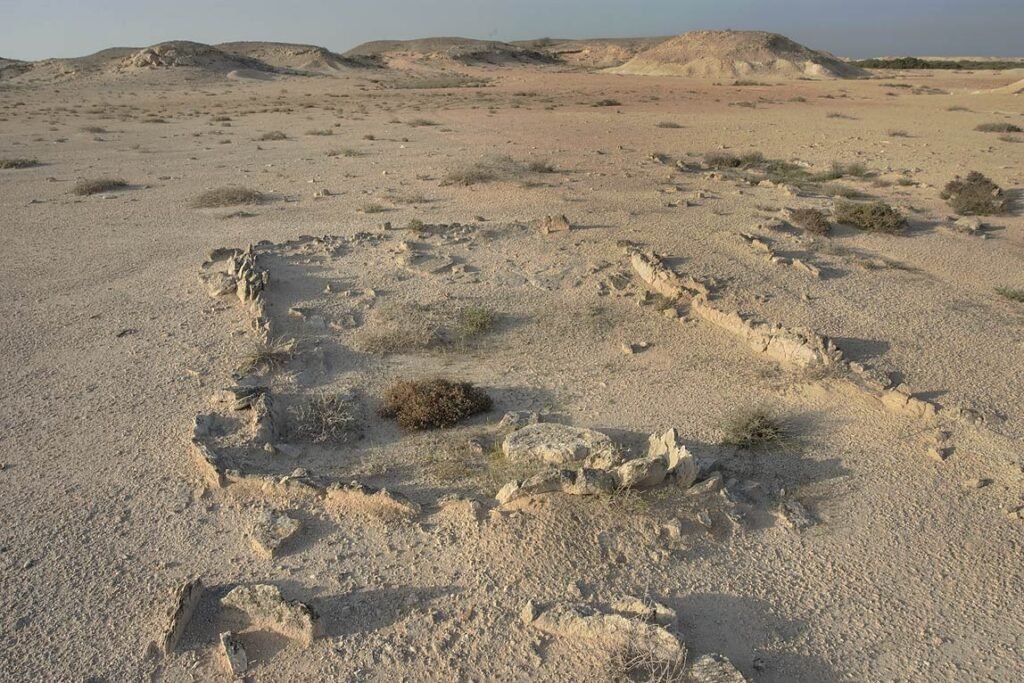
There is no visitor centre, no reconstructed workshop and very little signage. The archaeology is mostly low mounds, faint outlines and scattered shell on the flat ground around the hillocks, which is where most of the finds were made. What you can do is notice how much broken shell lies on parts of the island and imagine the scale of an industry that crushed millions of snails by hand. Treat everything on the ground as part of a protected site: look, photograph, and leave it where it is.
Walk the shoreline and beachrock
The island’s edges are fringed with flat, crumbly beachrock, where early researchers found sea snail shells. At low tide you can walk along these ledges and look into rock pools for crabs, snails and small fish. The rock can be sharp and slippery with algae, so this is a place for proper shoes rather than sandals. The west-facing shore, looking back across the bay towards Al Khor, is the place to be for sunset.
Watch birds in winter
Between November and February, migratory birds use the lagoons around the island, and Qatar Museums mentions flamingos and herons among them. You will also see waders feeding on the mudflats as the tide drops. Birds are most active in the early morning and around the turn of the tide. Stay on the paths, keep noise down and use binoculars or a zoom lens rather than walking towards a flock.
Take the photographs everyone wants
The classic shots are the boardwalk curving through the mangroves, reflections in the creeks at high water, and the sun setting behind low mangrove bushes and beachrock. Go on a calm day if you want reflections, as even a light breeze ruffles the water. As with anywhere in Qatar, flying a drone requires registration and permission from the civil aviation authority, so don’t launch one without it.
How to get there
Purple Island is around 45 minutes to an hour by car from central Doha, depending on traffic and where you start. The drive is straightforward and almost entirely on good roads.
- Drive north out of Doha on Al Shamal Road or the Al Khor Coastal Road towards Al Khor.
- In Al Khor, follow signs for Al Thakhira, heading north through the town.
- North of the town centre, follow your navigation app to the Purple Island parking area. Search for “Purple Island” or enter the coordinates 25.6928, 51.5489. The final kilometre or so leaves the tarmac and follows a dirt track to the start of the footbridge.
Visitors regularly reach the car park in an ordinary saloon. A 4×4 is not necessary in dry weather, but drive slowly on the track and avoid soft sand. After rain the track can become muddy, and that is the one time extra ground clearance really helps.
Parking is free and informal on hard ground near the start of the walkway. There is no public bus to the island. A taxi or ride-hailing car can bring you from Doha, but finding one to take you back from this spot is unlikely, so agree a pick-up time or ask the driver to wait. Several Doha tour companies also run trips here, usually combined with mangrove kayaking.
Best time to visit
The season runs from roughly November to March. Winter mornings are cool and bright, and this is also when migratory birds are around. From May to September the heat and humidity are intense, there is very little shade on the island, and a walk in the middle of the day can be dangerous. If you do go in the warmer months, arrive at sunrise and be back at the car by mid-morning.
Within the day, early morning and the last two hours before sunset are best. Mornings are quieter and better for wildlife. Late afternoon brings the softest light and a sunset over the bay.
The tide matters more here than at most places in Qatar, so check a tide table for Al Khor before you go. Around high tide the creeks fill, the mangroves look their best and kayakers are out on the water, but a few low spots on the island’s paths can be wet. Around low tide the mudflats open up, crabs are everywhere and you can walk the beachrock, but the creeks look drained and muddy. For a walk, the hour or two either side of high water usually gives the best of both.
Friday and Saturday afternoons in winter are the busiest times, when families and kayak groups arrive together. On a weekday morning you may have much of the island to yourself.
Tips for your visit
- Check the tide first. It changes the whole experience, from what you see to how wet your feet get.
- Wear shoes you don’t mind getting muddy. Flip-flops are a poor choice on beachrock and in sticky mud. Old trainers or water shoes are ideal.
- Don’t rely on facilities. There are no shops or cafés on the island, and visitors have reported the toilets near the car park being locked. Stop in Al Khor on the way.
- Stay off the mangrove roots. The pencil-like roots that stick out of the mud help the trees breathe. Stepping on them damages the plants, and the mud around them can be deeper than it looks.
- Leave shells and stones where they are. This is a protected heritage site, and the shell scatters are part of what archaeologists study.
- Keep to the paths near birds. Flamingos and herons will fly off if you approach, and repeated disturbance drives them away from feeding areas.
- Allow more time than you think. The walk out is short, but most people end up spending two hours or more once they start exploring.
- Take your rubbish home. Bins, where there are any, are often full at weekends.
What to bring
- At least 1 litre of water per person, more in warm weather
- Hat, sunglasses and sunscreen, as shade is scarce
- Closed shoes or water shoes that can get muddy
- Binoculars in winter for birdwatching
- Insect repellent for dusk, when mosquitoes can appear near the mangroves
- Snacks and a bag for rubbish
- A small towel and a change of socks for the drive home
Combine it with nearby places
Al Thakira mangroves. A few kilometres north, the mangrove channels at Al Thakhira are the main base for guided kayak trips in the area. If walking Purple Island leaves you wanting to get out on the water, this is the place to do it.
Al Khor Corniche. Across the bay, Al Khor’s seafront promenade has benches, lawns and views of the traditional dhows moored in the harbour. It is a relaxed place to finish the day, and the town has plenty of cafés and restaurants for a meal before the drive back.
Al Khor Towers. Three cylindrical watchtowers along the Al Khor coast, built in the early 20th century when the town was a fishing and pearling centre. Qatar Museums says they guarded the port and the freshwater well at Ain Hleetan. They make a good short heritage stop on the way in or out of town.
Al Farkiya Beach. Al Khor’s fenced family beach, a short drive away on the Farkeh coast, has calm, very shallow water, shaded picnic spots and play areas. It is the easiest place nearby for children to paddle after a muddy walk.
Al Bayt Stadium. On the southern edge of Al Khor, the tent-shaped stadium built for the FIFA World Cup 2022 is worth a look from the road even if there is no match on. Its design is based on the traditional black-and-white tents of the region.
Frequently asked questions
Why is it called Purple Island?
Because archaeologists found evidence of a purple dye industry here from about 1400 to 1100 BC. Millions of crushed sea-snail shells and large pottery vats show that people processed murex snails to make a red-purple dye. The island itself is not purple.
Is Purple Island free to visit?
Yes. There is no ticket and no gate. It is an open-air site with no set hours, although you should visit in daylight. Kayak tours from private operators are paid separately.
Do I need a 4×4 to reach Purple Island?
No. The route from Doha is on paved roads, and the final dirt track to the parking area is usually fine for a normal car in dry weather. Take it slowly and avoid it just after heavy rain.
Can you walk to Purple Island?
Yes. A wooden footbridge, built in 2019, crosses the creeks from the parking area to the island, so you no longer need to wade or take a boat. Some low parts of the island’s paths can still be wet around high tide.
Is Purple Island good for children?
Yes, especially the boardwalk and the crab-spotting at low tide. Keep a close eye on them near the creeks and on the beachrock, and bring a change of clothes for anyone who ends up in the mud.
Can you swim at Purple Island?
It isn’t a swimming beach. The water around the island is shallow and muddy, with mangroves, sharp beachrock and no lifeguards. For a swim, head to one of the beaches further north or south along the coast.
How long do I need at Purple Island?
Plan on two to three hours to cross the bridge, walk to the hillocks and explore the shoreline without rushing. Add time if you are combining it with kayaking or a meal in Al Khor.
Last checked October 2026. Hours, fees and access can change, so confirm with the official source before you go.
Read the Companies in Qatar visitor guide ↗
More places nearby
All places →
Run a tour, café or stay near Purple Island (Jazirat Bin Ghanim), Al Khor?
List your business free on Companies in Qatar, or get featured on Qatar Unseen in front of people planning their trip.