Al Zubarah Fort and Archaeological Site, Al Shamal
Qatar's UNESCO-listed pearling town and its 1938 fort. How to plan the day, read the ruins and avoid the mistakes first-timers make.
Al Zubarah, Al Shamal (north-west coast)
Overview
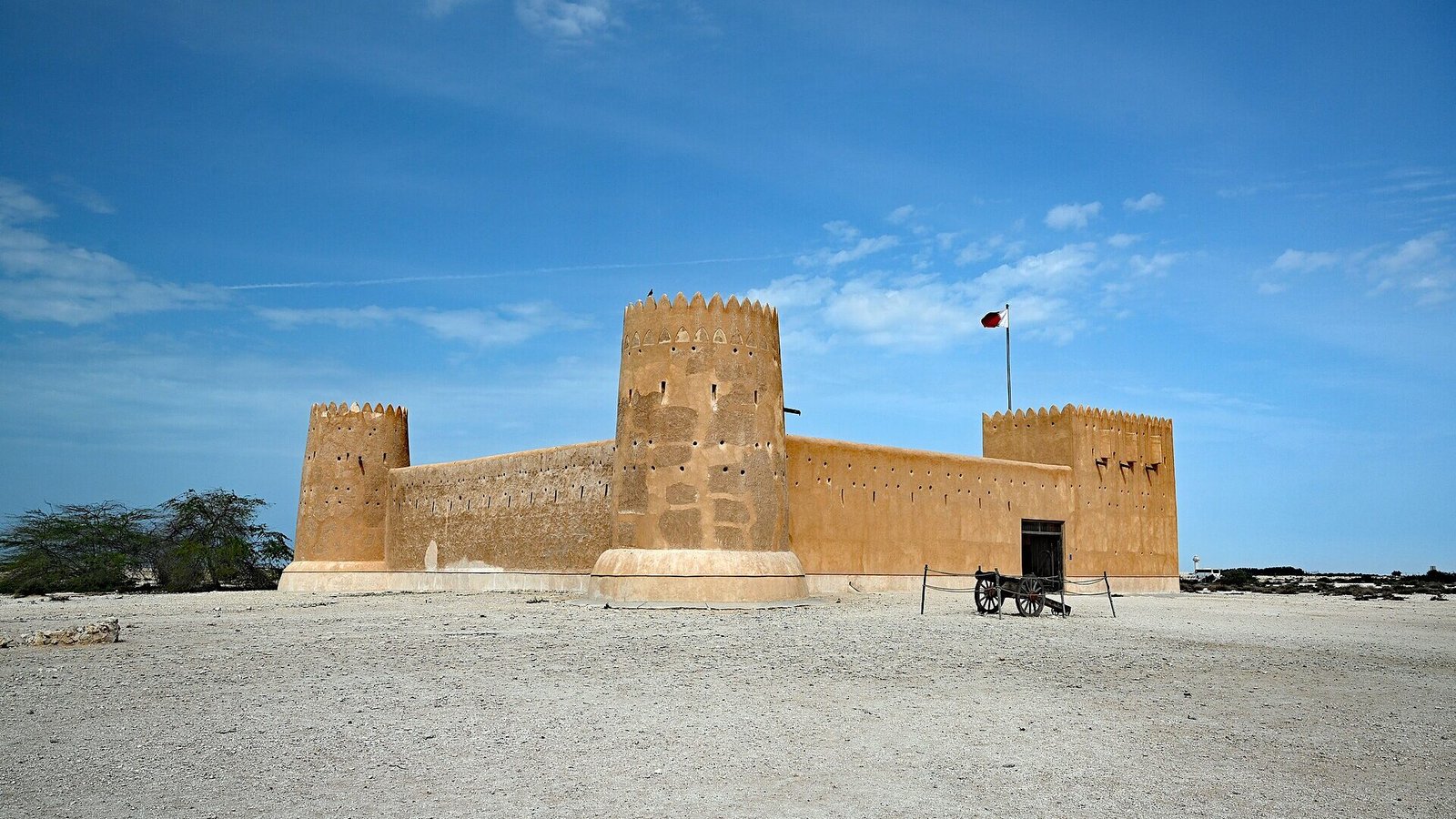
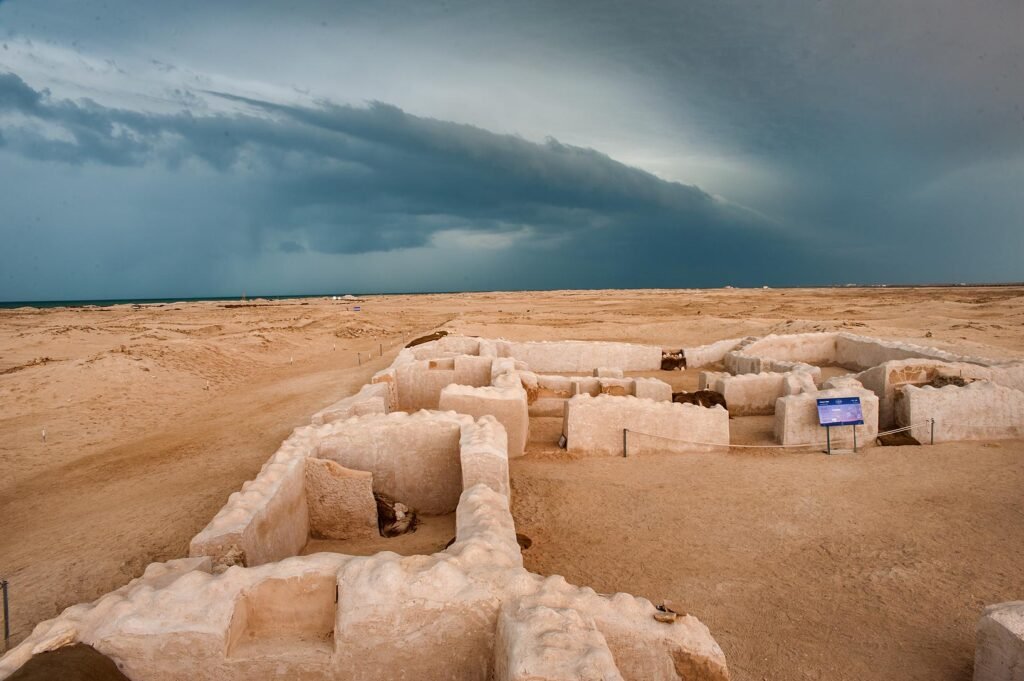
Most people picture Al Zubarah as a fort. The fort is the easy part: a square, sand-coloured building with round towers that you can see from the road and walk around in half an hour. The real reason this corner of Al Shamal is a UNESCO World Heritage Site lies a couple of kilometres further west, where the low outlines of an entire 18th-century town run down to the sea.
That town was once the largest settlement in what is now Qatar, a walled port that lived on pearls and long-distance trade. It was burned in 1811, slowly emptied over the following century and then covered by windblown sand, which is exactly why so much of its street plan survives. Qatar Museums describes it as the best-preserved example of an 18th to 19th-century pearling and trading town in the Gulf.
This guide is written for the visitor who wants to get more out of the day than a photo of the fort. It suggests an order for your visit, explains how to read ruins that are often only knee-high, and points out what first-timers tend to miss. It suits history fans, curious families with older children, photographers and anyone planning a proper day trip to the north.
The story behind Al Zubarah
A merchant town on the edge of the desert
Al Zubarah was founded in the mid-18th century, most likely in the 1760s, by merchant families of the Bani Utbah confederation who had moved south from Kuwait. Among them were the Al Khalifa and the Al Jalahma. The site made sense for traders: it faced the pearl banks and the shipping lanes of the Gulf, and it sat outside the direct control of the Ottoman, Persian and European powers of the day.
The town grew quickly. A wall roughly 2.5 km long was built in an arc from shore to shore, defended by 22 semi-circular towers, and it enclosed about 60 hectares. Estimates of the population at its peak range from 6,000 to 9,000 people. Excavated finds include ceramics and coins from East Asia, Persia, the Ottoman world, Africa and Europe, a sign of how far its trade reached.
Fresh water was the weak point of any coastal town in Qatar. Inland, the fortress of Qal’at Murair was completed around 1768 to guard the wells, and screening walls linked it to the town so that water could be carried in safely. In December 1783 a Persian force landed on the coast between Al Zubarah and neighbouring Freiha and attacked, but it was driven back by a coalition of local tribes.
Fire, decline and sand
The early 19th century was violent. After a period of Wahhabi control, the town was attacked in 1811 and, in the words of Qatar Museums, burned to the ground. People returned from the late 1820s, but on a much smaller scale. In 1878 forces of Sheikh Jassim bin Mohammed Al Thani took the town after a piracy incident, and most of the remaining residents were moved to Doha. By the early 20th century Al Zubarah was deserted.
Because no modern town was built on top of it, the old streets, courtyard houses, mosques, market and harbour walls stayed where they were, slowly buried by sand. That accident of history is what made the site so valuable to archaeologists.
The fort, the dig and UNESCO
The fort you see today is much younger than the town. It was built in 1938 under Sheikh Abdullah bin Jassim Al Thani, partly with stone taken from the ruins of Qal’at Murair, and it served as a coastguard or police post until the mid-1980s. It was restored in 1987 and later turned into a small museum.
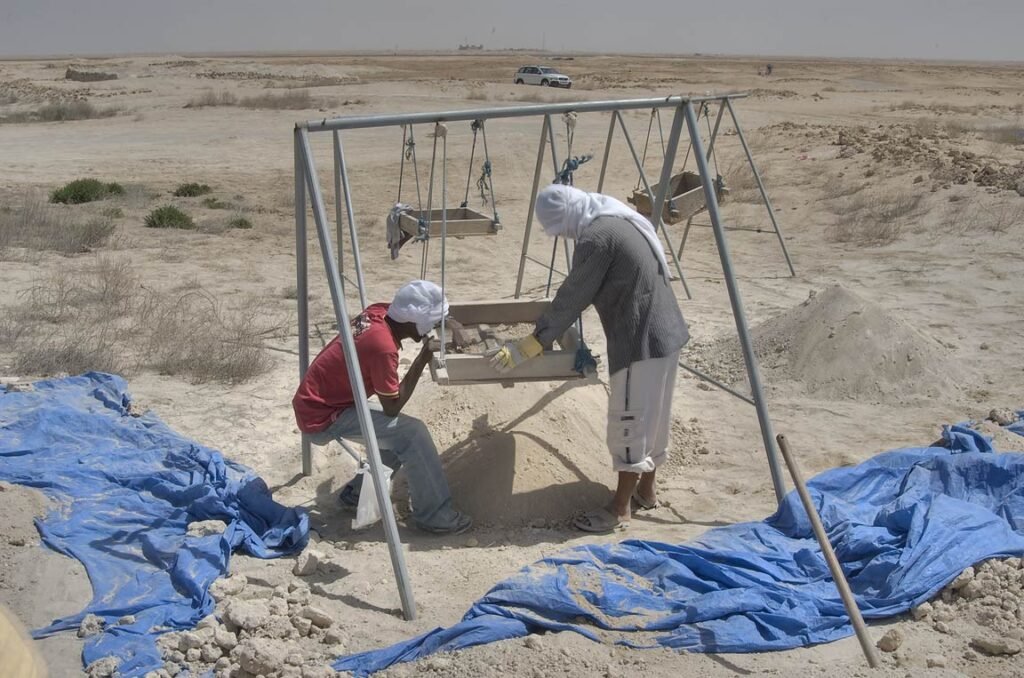
From 2009 the Qatar Islamic Archaeology and Heritage Project, a partnership between Qatar Museums and the University of Copenhagen, carried out a long programme of excavation and conservation. On 22 June 2013 UNESCO inscribed Al Zubarah Archaeological Site on its World Heritage List, recognising the town, its harbour, the canal and screening walls, the cemeteries, Qal’at Murair and the 1938 fort as a single landscape.
What to see and do
Start inside the fort
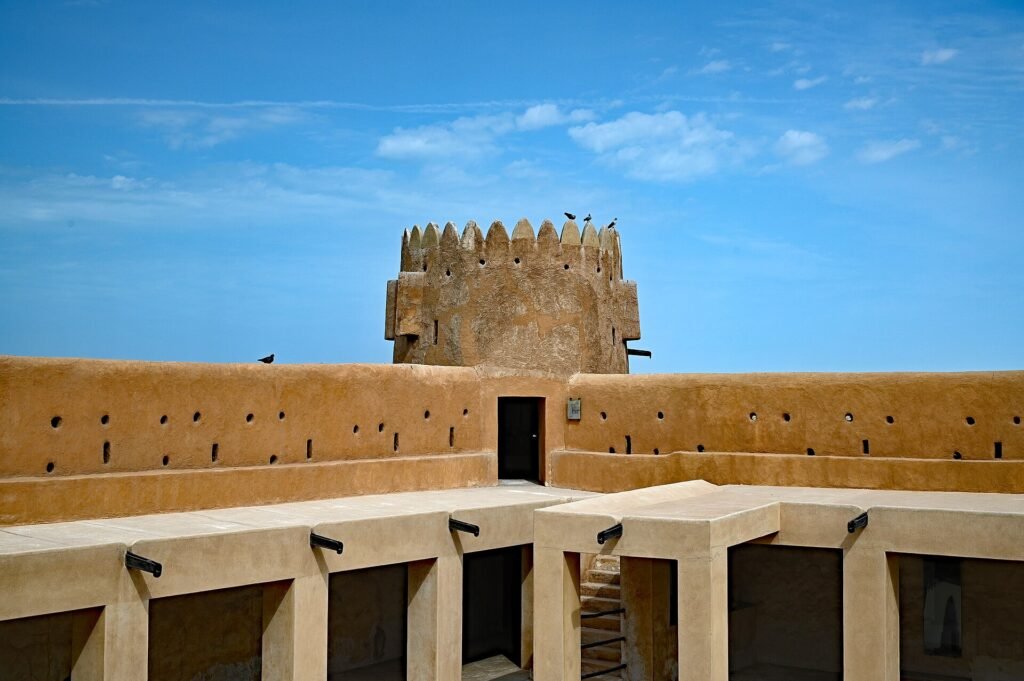
Begin at the fort, even if the ruins are what you came for. It is a square courtyard building with walls around a metre thick, made of coral rock and limestone bound with mud and finished in gypsum plaster. Three of its corner towers are round; the fourth, on the south-east corner, is rectangular and has machicolations, the overhanging slots through which defenders could drop things on attackers.
The ground-floor rooms around the courtyard, once soldiers’ quarters, now hold bilingual displays on the excavations, pearling, the sea and the plants and animals of the north. Look for the cases of finds from the town: pottery, tools, trade weights and everyday objects. Ten minutes here gives you the vocabulary you need to make sense of the ruins later. There is also an old well in the courtyard, now dry and closed off.
Climb for the view
Stairs lead up to the roof and towers. From the top you get the best overview of the landscape: flat gravel desert in every direction, a thin line of sea to the west and, if you know where to look, the pale scar of the old town between you and the coast. It helps to see this before you go down to the town, because at ground level the scale is hard to judge.
Take the shuttle to the old town
The archaeological town is a separate area towards the coast, and Qatar Museums runs a shuttle between the fort and the town. Visitors have reported it leaving roughly once an hour, so ask at the fort when the next one goes and plan your time around it. Some areas have boardwalks, which make it easier to get around on foot and keep people off the fragile walls.
At first sight the town can look like nothing more than rubble. Slow down and it starts to organise itself. You are looking at the footings of courtyard houses, some large enough to have been merchants’ compounds, narrow lanes between them, small mosques, market areas and date presses where sticky date syrup was pressed out and collected. Only a part of the town has been excavated, and some trenches were deliberately reburied after study to protect them.
Trace the town wall and the shore
The line of the outer town wall can still be followed on the ground, with the bumps of its round towers at intervals. Standing on it gives you a feel for the size of the place: most of what lies inside the curve was once built up. On the seaward side, the UNESCO listing includes the harbour and its double defensive walls, a reminder that the town’s wealth came in by boat.
Look inland for Qal’at Murair
East of the town lie the remains of Qal’at Murair, the 18th-century fortress that protected the wells. Excavations found a mosque, houses and at least one large well inside it, along with enclosures that may have held animals or crops. It is part of the World Heritage property, but it is less developed for visitors than the fort and town, so ask the staff what you can see on the day rather than wandering off across the desert.
Photograph the fort at the right angle
The fort photographs best from the outside, with the round towers in profile and a clean sky behind them. Mid-morning and mid-afternoon light is kinder to the pale walls than the flat glare of midday. Remember that the site closes at 5pm, so in winter you can catch warm late light, but not a full sunset from inside the grounds. Drones need prior permission from the Qatari aviation authorities.
How to get there
Al Zubarah is on Qatar’s north-west coast, about 100 km from central Doha. Allow roughly 75 to 90 minutes each way by car. The roads are paved all the way to the car park, and a normal saloon car is fine.
- From Doha, drive north on Al Shamal Road, the main highway to the north.
- Follow the signs for Al Zubarah and turn west onto the road that crosses the interior towards the coast. It is long, straight and quiet, with very few services.
- Signs lead you to the fort shortly before the coast. Park at the fort, where the service centre and the shuttle stop are.
If you are also visiting Al Ruwais or Al Jumail, you can return a different way, heading north along the coast road towards Madinat Al Shamal and then back down Al Shamal Road. For the map pin, use 25.9769, 51.0454, the position of the fort.
There is no public transport to Al Zubarah. A taxi or ride-hailing car from Doha is possible but expensive for the round trip, and you are unlikely to find a car for the return, so agree a waiting fare in advance. Several Doha tour companies run northern day trips that include the fort, which is the easiest option if you do not want to drive.
Best time to visit
The comfortable season is roughly November to March. Temperatures climb steeply from April, and from May to September the exposed town site is punishingly hot with almost no shade. Even in winter, the sun on the pale gravel is strong.
Opening hours are Saturday to Thursday 9am to 5pm, and Friday 12.30pm to 5pm. The best plan on most days is to arrive around opening time: the light is softer, the air is cooler and you have the whole day for the drive and any stops further north. On Fridays you cannot get in before 12.30pm, which makes it hard to see both the fort and the town without rushing, so a weekday or Saturday works better.
Winter weekends bring more families and tour groups, but the site is big enough that it rarely feels crowded. Check the Qatar Museums website for public holiday hours and any temporary closures before you set off.
Tips for your visit
- Get a ticket. Qatar Museums asks visitors to book through its ticketing page. Heritage sites were made free for residents and non-residents in 2023, but a ticket is still issued, so check the booking page for the current arrangement.
- Do the fort first, then the town. The displays explain what you are looking at, and the view from the top shows you where the town lies.
- Time the shuttle. Ask about the next departure as soon as you arrive. Missing one can cost you an hour.
- Give yourself two to three hours. Rushing the town is the most common regret. The fort alone takes 30 to 60 minutes.
- Stay on paths and boardwalks. The walls are fragile and many are original 18th-century fabric. Do not climb, sit on or move stones.
- Leave the finds on the ground. Shards of pottery and glass are part of the archaeological record, and removing anything from a World Heritage Site is not allowed.
- Fuel and food before you turn west. There is no restaurant on site and very little along the Al Zubarah road.
- Dress for a heritage site. Modest clothes that cover shoulders and knees, and closed shoes for gravel.
- Accessibility. For help with mobility needs, Qatar Museums asks visitors to email infoheritage@qm.org.qa before the visit.
What to bring
- At least a litre of water per person, more in warmer months
- Hat, sunglasses and sunscreen
- Comfortable closed-toe shoes
- Snacks or a packed lunch
- A downloaded map and the Qatar Museums visitor guide
- Binoculars or a zoom lens for the wall line and the coast
Combine it with nearby places
Al Jumail Abandoned Village. A short drive north along the coast, this empty pearling village with its standing minaret is closed to the public but can be seen from outside the fence. It shows what a small neighbour of Al Zubarah looked like in the last century.
Shadows Travelling on the Sea of the Day. Olafur Eliasson’s 2022 installation of mirrored circular shelters stands in the desert just north of Al Zubarah Fort. The contrast between 18th-century stone and contemporary mirrors makes the two a natural pair.
Al Ruwais. The small port at the northern tip of Qatar has a working fishing harbour and a historic mosque. It is the best place in the area to find a café or a meal after your visit.
Al Rakiyat Fort. A small, square 19th-century fort a short way inland from the coast, built to protect a freshwater supply and restored by Qatar Museums in 2022. It gives you a second, much more intimate fort to compare with Al Zubarah.
Frequently asked questions
Is Al Zubarah free to visit?
Qatar Museums announced in 2023 that its heritage sites, including Al Zubarah, would be free for residents and non-residents. You still need a ticket, which you can book through the Qatar Museums website. Check the booking page before you go, as pricing can change.
What are the opening hours?
Saturday to Thursday 9am to 5pm, and Friday 12.30pm to 5pm. Hours can change during Ramadan and on public holidays.
Why is Al Zubarah a UNESCO World Heritage Site?
UNESCO listed it in 2013 as an exceptionally complete example of a Gulf pearling and trading town of the 18th and 19th centuries. Because it was abandoned and covered by sand rather than built over, its streets, houses, harbour, walls and water defences survive as a single landscape.
Is the fort as old as the town?
No. The town dates from the 1760s, while the fort was built in 1938 and used as a coastguard or police post until the 1980s. The older fortress, Qal’at Murair, lies inland and dates from the 18th century.
How far is the fort from the ruins?
The archaeological town lies between the fort and the coast, and the whole site stretches about 2.5 km from the fort to the shore. Qatar Museums runs a shuttle between the two areas.
Can I visit without a car?
There is no public transport. Your options are a taxi or ride-hailing car with an agreed waiting fare, or a guided day tour from Doha.
How long should I plan for?
Allow two to three hours on site, plus around 75 to 90 minutes’ driving each way from Doha. Adding Al Ruwais or Al Jumail turns it into a comfortable full day.
Last checked October 2026. Hours, fees and access can change, so confirm with the official source before you go.
Read the Companies in Qatar visitor guide ↗
More places nearby
All places →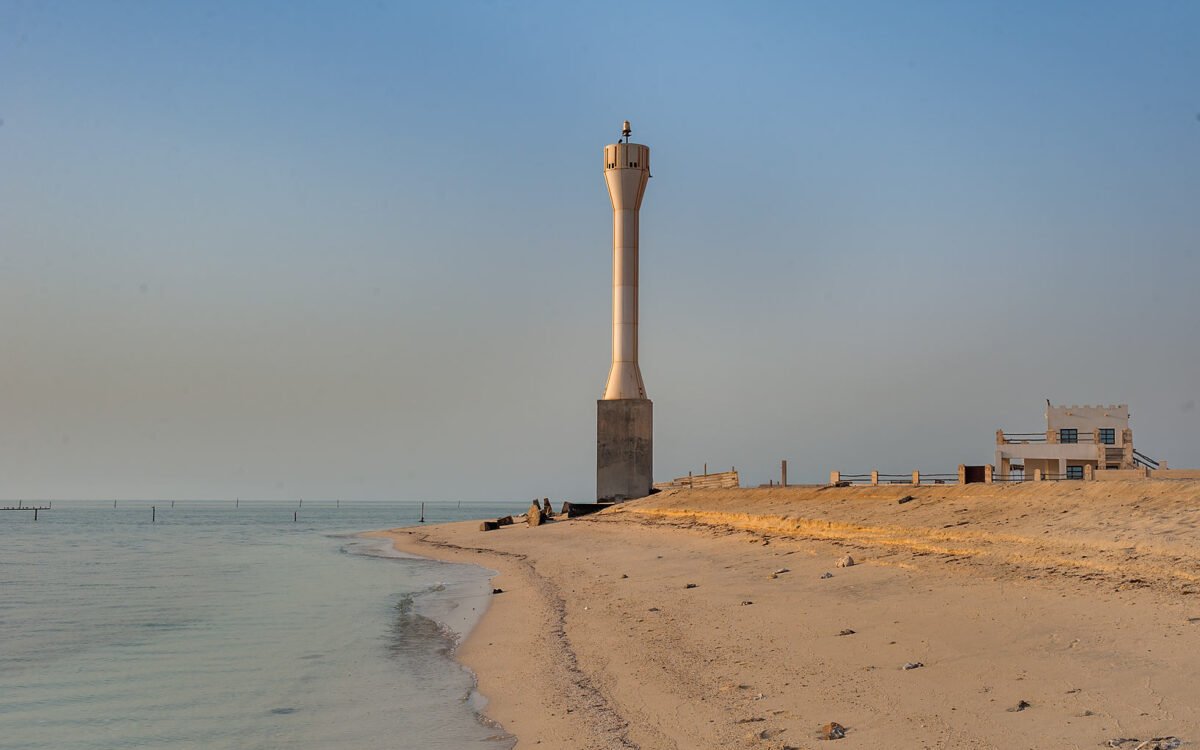
Run a tour, café or stay near Al Zubarah Fort and Archaeological Site, Al Shamal?
List your business free on Companies in Qatar, or get featured on Qatar Unseen in front of people planning their trip.