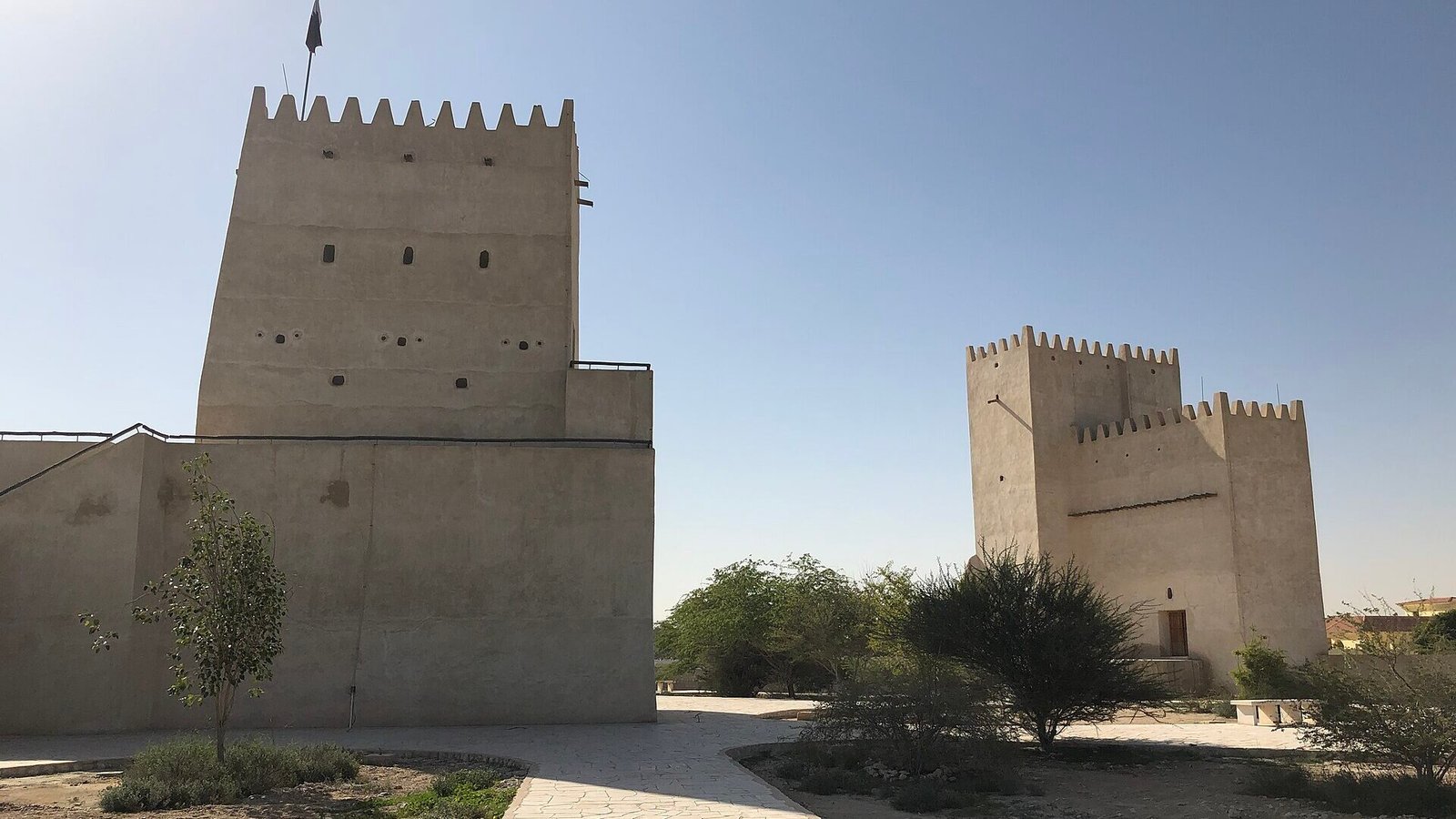
Barzan Towers, Umm Salal
Two century-old watchtowers north of Doha, one with a rare T-shaped plan. How to read their architecture, photograph them and plan around the current closure.
Umm Salal Mohammed, Umm Salal (20 km north of Doha)
Overview
The Barzan Towers are two tall, pale watchtowers standing on a low rise in Umm Salal Mohammed, a town about 20 km north of central Doha. With their crenellated tops, narrow slit windows and thick plastered walls, they are among the most recognisable pieces of traditional architecture in Qatar, and one of the few that you can reach in half an hour from the city.
Look closely and you realise they are not a matching pair. The western tower has a rare T-shaped plan with a broad external staircase, while the eastern tower is the plain rectangular type seen across the country. Reading those differences, and the building techniques behind them, is what makes a visit here interesting, and it is the focus of this guide.
Access status: Qatar Museums, which manages the site, currently lists Barzan Towers as temporarily closed until further notice. When the site is open, entry is free. While it is closed you can still see and photograph the towers from the surrounding streets, and this guide is written with that in mind. It suits architecture and history lovers, photographers, and anyone heading north who wants a short, worthwhile stop.
History and background
Barzan means “high place” in Arabic, and the towers stand on a low hill, sometimes called Jebel Lusail, that gives a view across the surrounding land and catches the breeze. The town around them takes its name from Sheikh Mohammed bin Jassim Al Thani, a son of Sheikh Jassim bin Mohammed Al Thani, the founder of modern Qatar. He established Umm Salal Mohammed around 1910 and made it his winter residence.
Sources differ on the exact dates. Qatar Museums says the western tower was built between 1910 and 1916 by Sheikh Mohammed bin Jassim, as part of a defensive wall around the village, and that the eastern tower was added after 1958. Other accounts say an older tower from the late 19th century was rebuilt in 1910. The towers belonged to a wider defensive system protecting the rawda, a shallow depression where rainwater collects, along with the wells and arable land around it.
The towers had several jobs. Their main purpose, according to Qatar Museums, was to watch over the farmland and wells. They are also said to have served as a lookout at a time when relations with the Ottoman Empire were still tense, a few years after Sheikh Jassim’s victory at the Battle of Al Wajbah in 1893, and as a place to watch for the new moon that marks the start of each month in the Islamic calendar, most importantly Ramadan.
A Danish archaeological team excavated the enclosed site in 1958. The towers were restored in 2003 and again in 2014, when Qatar Museums also restored the adjoining mosque and religious school.
What to see and do
The T-shaped western tower
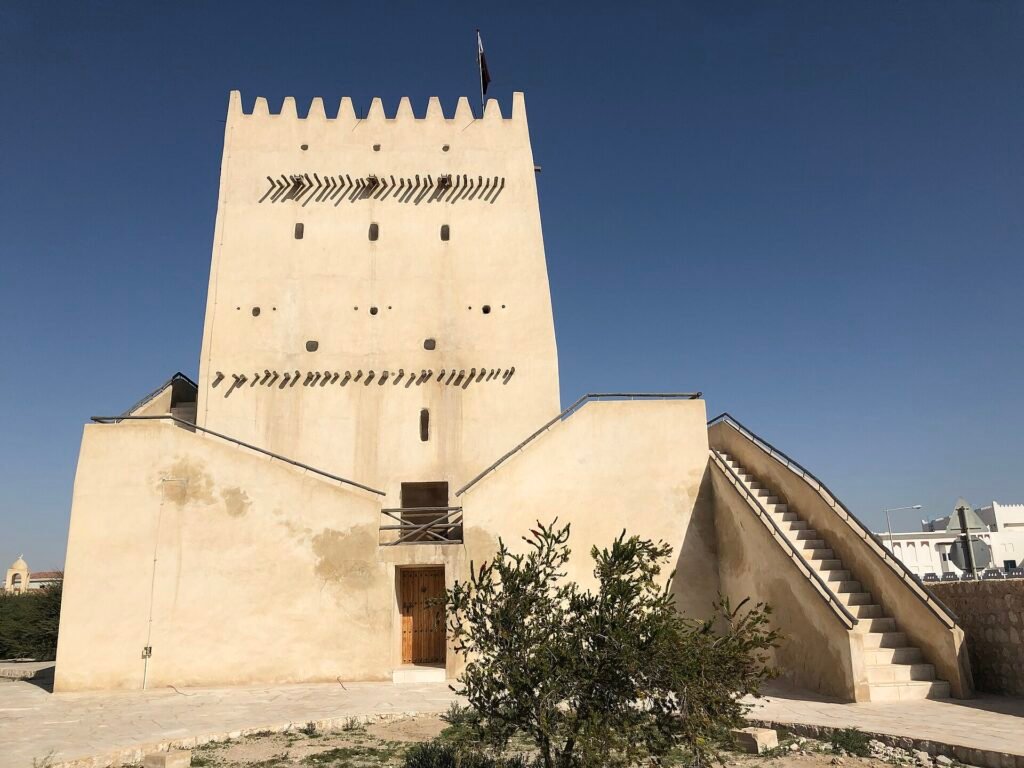
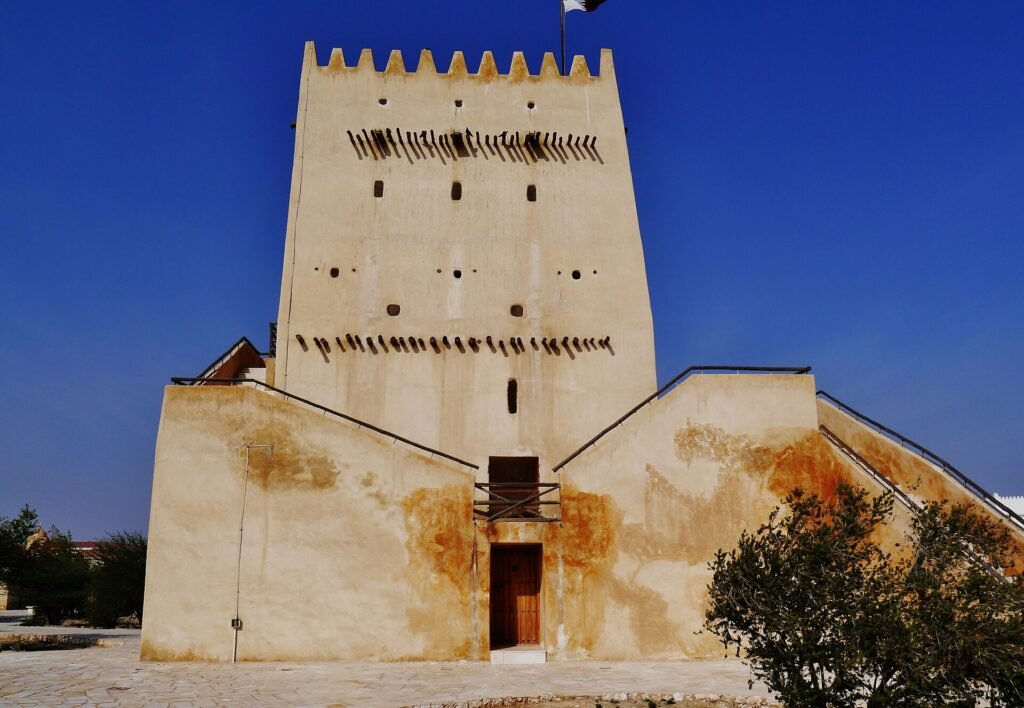
Start with the western tower, the older of the two and the reason the site is famous. Qatar Museums describes it as having three levels and a T-shaped plan that is unique in the Gulf region. From the right angle you can see how a wide stair rises along the outside of the building to the upper floors, with sloping buttresses bracing the base. It looks less like a simple tower and more like a small fortified house pulled upwards.
The eastern tower
The eastern tower, known as Al Burj Al Sharqi, follows the rectangular form typical of Qatari watchtowers. Qatar Museums gives both towers a height of about 14 metres; other sources quote 16 metres. Compare the two side by side: the same materials, the same crenellations and slit openings, but a different plan, built decades apart. It is a neat lesson in how a local building tradition carried on into the second half of the 20th century.
How the walls were built
The walls are about a metre thick at the base. Builders mixed rough pieces of coral rock with limestone, bound them with mud mortar and, once the wall had dried, covered it with a gypsum-based plaster. It is the same method used at Al Zubarah Fort. The thick walls and small openings kept the interior cool and made the structure hard to attack. Where plaster has been renewed you see smooth, creamy surfaces; in low sun you can pick out the uneven stone underneath.
Roofs, rainspouts and small details
Qatari roofs of this period were built in four layers: wooden poles called danchal, sometimes coated in bitumen, then a layer of split bamboo strips (basgijl), a mesh of mangrove branches, and finally a thick layer of compressed mud to keep out the sun. From the outside, look for the marazim, the wooden spouts that stick out near the roofline to throw rainwater clear of the walls during storms. Also notice the triangular crenellations along the parapets and the tall, narrow openings, which let in air and light while protecting whoever stood inside.
The majlis, mosque and madrasa
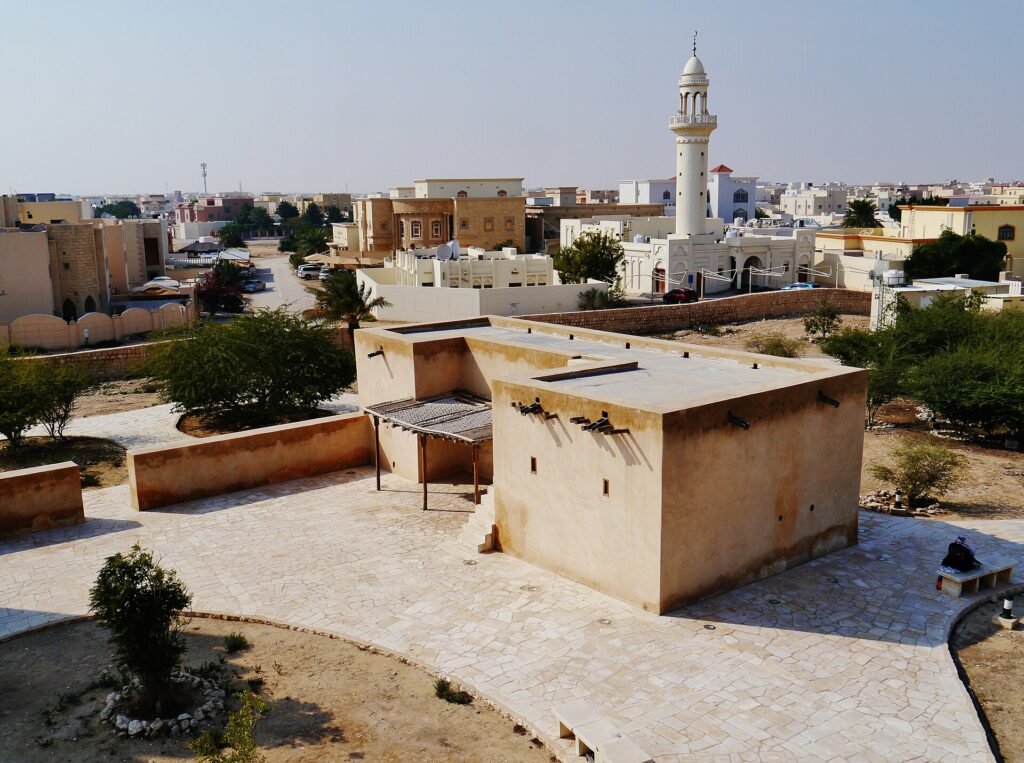
The towers are not alone. The site includes an L-shaped majlis pavilion for receiving guests, with openings for ventilation, and a small mosque whose prayer room was also used as a madrasa to teach children the Quran. Qatar Museums restored the mosque and school in 2014. Together they show that this was a lived-in place, not just a military post.
The native plant garden
Around the towers, landscaped grounds planted with species native to Qatar recall the farmland and wells the towers once guarded. When the site is open, the shaded paths are a pleasant place to walk. While it is closed, you can see some of the greenery over the boundary wall.
Photographing the towers from outside
The towers are tall enough to photograph well from the street, and the low boundary wall rarely gets in the way. The eastern and western towers line up nicely from the north and south sides, and a longer lens lets you pick out details such as the rainspouts and crenellations. Late afternoon light warms the plaster and brings out the texture of the walls. Keep to public pavements, don’t climb on walls and be considerate of the homes nearby.
How to get there
Barzan Towers are about 20 km north of central Doha, usually a 20 to 30 minute drive depending on traffic.
- From Doha, head north on Al Shamal Road (the main highway to the north).
- Take the exit for Umm Salal Mohammed and follow signs into the town.
- Use the coordinates 25.4181, 51.4132 or search for “Barzan Towers” in your map app for the final approach through the residential streets.
Parking is on the street near the site. Any car will do, as the roads are paved throughout. There is no metro station in Umm Salal Mohammed, so without a car the easiest option is a taxi or ride-hailing app. Arrange your return trip before you leave, because cars rarely wait near the towers.
Best time to visit
When the site is open, Qatar Museums’ normal hours are Saturday to Thursday from 8.30am to 12.30pm and Friday from 3pm to 6pm. These are the only hours you will get inside the grounds, so check the Qatar Museums website first to confirm the site has reopened.
From outside, you can visit at any reasonable time of day. The best light is in the late afternoon, and the cooler months from October to April are far more comfortable for walking around. In summer, make it a quick stop in the early morning or just before sunset.
In early December, the Darb Al Saai venue in Umm Salal Mohammed hosts the Ministry of Culture’s National Day heritage festival, which runs in the days leading up to Qatar National Day on 18 December. It is a busy time in town, but a good moment to combine the towers with traditional crafts, food and performances.
Tips for your visit
- Check the status first. Qatar Museums lists the site as temporarily closed until further notice. Look at the Barzan Towers page on qm.org.qa before you set off.
- Plan for an outside view. While the site is closed, allow 15 to 20 minutes to walk around the outside and take photos.
- Don’t climb the boundary walls. Even a low wall is part of a protected heritage site.
- Dress modestly. The site includes a mosque, and the towers stand in a residential area.
- Park considerately. Keep driveways and gates clear, and don’t park on sand verges in front of homes.
- Bring a longer lens. The best details, from the rainspouts to the crenellations, are high up.
- Make it part of a longer trip. The towers are a short stop on their own, so pair them with Al Khor or a drive north.
What to bring
- Water and a hat, as there is little shade outside the site
- A camera, ideally with a zoom lens
- Modest clothing that covers shoulders and knees
- Sunglasses for the bright plaster walls
Combine it with nearby places
Umm Salal Mohammed Fort. Learn how Sheikh Mohammed bin Jassim built a fortified winter residence and a whole town around the towers, and why “Umm Salal Mohammed Fort” and “Barzan Towers” are often used for the same place.
Darb Al Saai. The large heritage venue in Umm Salal Mohammed comes alive in early December for the National Day festival, with traditional crafts, performances and a market selling local food and souvenirs.
Simaisma. About 25 minutes to the north-east on the coast, the old pearling village of Simaisma has a 1938 mosque. Note that its beach closed in June 2025 for a major redevelopment.
Purple Island, Al Khor. Continue north for about 40 minutes to walk the mangrove footbridge to Purple Island, one of Qatar’s oldest archaeological sites.
Frequently asked questions
Are Barzan Towers open?
Qatar Museums currently lists Barzan Towers as temporarily closed until further notice. You can see and photograph them from outside. Check the Qatar Museums website for reopening news.
How much does it cost to visit Barzan Towers?
Nothing. When the site is open, entry is free and no ticket is needed.
What are the normal opening hours?
When open, Qatar Museums lists Saturday to Thursday from 8.30am to 12.30pm and Friday from 3pm to 6pm. Hours may change on reopening, so always check.
What does Barzan mean?
Barzan means “high place” in Arabic. The towers stand on a low hill with views over the surrounding land.
How old are the Barzan Towers?
Qatar Museums dates the western tower to 1910–1916 and says the eastern tower was added after 1958. Some sources describe an earlier tower from the late 19th century that was rebuilt around 1910.
What were the towers used for?
Mainly to watch over the farmland and wells of Umm Salal Mohammed. They are also said to have served as a lookout at a time of tension with the Ottomans and as a place to observe the new moon for the Islamic calendar.
How do I get to Barzan Towers without a car?
Take a taxi or ride-hailing car from Doha, which usually takes 20 to 30 minutes. There is no metro station in Umm Salal Mohammed. Book your return ride in advance.
Last checked October 2026. Hours, fees and access can change, so confirm with the official source before you go.
Read the Companies in Qatar visitor guide ↗
More places nearby
All places →
Run a tour, café or stay near Barzan Towers, Umm Salal?
List your business free on Companies in Qatar, or get featured on Qatar Unseen in front of people planning their trip.