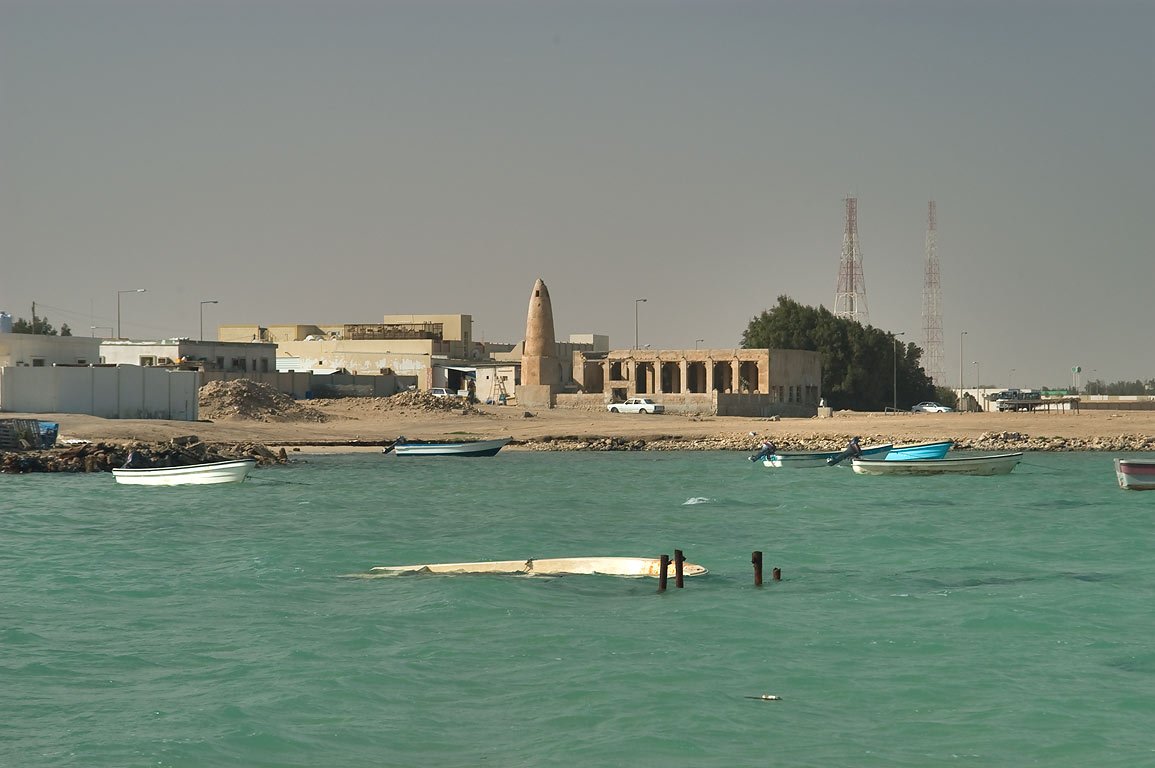
Al Ruwais Mosque and Old Port, Al Shamal
A centuries-old mosque with a conical minaret, a 1950s police station and a working harbour at the very end of Al Shamal Road.
Old town waterfront, Al Ruwais, Al Shamal (northern tip)
Overview
Al Ruwais is where Al Shamal Road runs out of land. At the very top of the Qatar peninsula, the highway from Doha ends in a small town with a fishing harbour, a commercial port, a few cafés and, right on the water’s edge, one of the country’s most important historic mosques.
The old mosque, with its unusual conical minaret on a square base, is believed to have been founded in the late 17th century. It is often described as the oldest standing mosque in Qatar. Around it, Qatar Museums has restored a small cluster of heritage buildings, including a 1950s police station, and a seafront walkway leads out along a low headland with the remains of an old communal kitchen.
None of this takes long to see, and that is part of the charm. Al Ruwais is a place to slow down after the drive north: watch the boats come in, look at a mosque that has served this coast for more than three centuries, have a coffee by the bay, and then carry on to the heritage sites of the north-west. It suits anyone on a northern road trip, heritage and architecture enthusiasts, and photographers who like working harbours.
History and background
A northern harbour
The northern tip of Qatar has always looked out to sea. The coast here is lined with shallow bays, reefs and old stone fish traps, and the settlements along it lived from fishing, pearling and trade with the islands and ports across the Gulf. Archaeology shows how old those links are: at Al Ruwayda, a large ruined site on the coast west of Al Ruwais, excavations have found a fort that grew and shrank over several phases, mosques, a warehouse and objects that include glazed ceramics, Chinese porcelain and carnelian and agate beads from far to the east.
Al Ruwais itself grew into the main harbour of the far north. Today it has a commercial port as well as its fishing harbour, and the new port area has changed the shape of the waterfront. The older part of the town, around the mosque and the old police station, keeps a much smaller scale.
The mosque
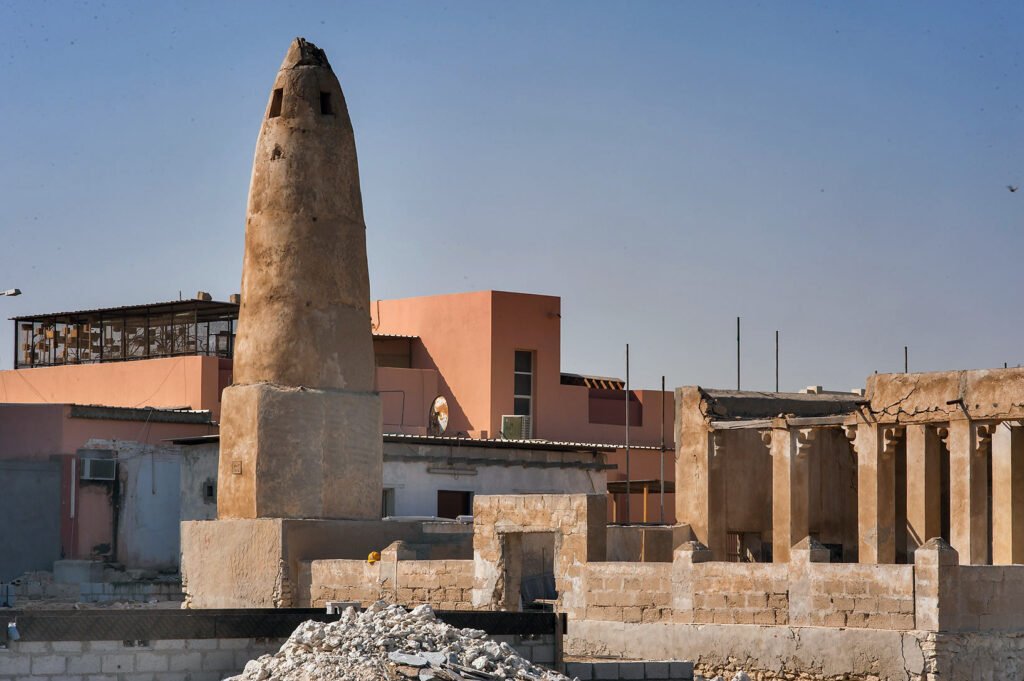
According to the Arab League’s cultural organisation ALECSO, which documented the building, the mosque was probably founded at the end of the 17th century and is the oldest existing mosque in Qatar. What you see today is mainly a rebuilding from the 1940s by a local benefactor of the Al Rifai family. The minaret was damaged by lightning in the 1970s, and the building suffered badly from humidity, salt and seawater, which is a constant problem for any structure this close to the shore.
Qatar Museums carried out a full restoration in the mid-2010s using traditional materials. The work also protected the surroundings: a road beside the mosque was turned over to pedestrians, and the plots on its eastern and western sides were kept free of new building. Qatar Museums describes the mosque as having a single entrance in the eastern wall of its courtyard, an octagonal minaret on a square base topped with a cone in the south-east corner, and a square mihrab with a rounded arch in the prayer hall.
The police station
The other historic landmark by the water is the Al Ruwais Police Station, built in 1955. It originally stood on its own to the east of the village, a small defensive building with thick walls, narrow slits for firing through, a square guardroom and an observation tower. It even had a holding cell. Qatar Museums restored it, and it has been used to display finds from the Al Ruwayda excavations, with a café in its annex.
What to see and do
The old Al Ruwais Mosque
The mosque is small and plain, built of stone with a traditional wooden roof, and that simplicity is what makes it interesting. Look at the minaret first: an octagonal shaft rising from a square base and finishing in a cone, a shape quite different from the tall, slim minarets of modern Doha. Walk around the outside to see the courtyard wall with its single eastern entrance and the bulge of the mihrab on the qibla side.
The restored mosque is used for prayers. Non-Muslim visitors are generally welcome to look around outside prayer times if they dress modestly. If you would like to go in, ask anyone present, remove your shoes and keep your visit short and quiet.
The restored police station
A few minutes’ walk along the shore, the 1955 police station is one of the more unusual heritage buildings in the country: a compact mid-century outpost built to be defended, with a guardroom, observation tower and thick walls. It shows how recently this corner of Qatar was a remote frontier. When it is open, it is worth stepping inside for the displays on the archaeology of the north.
Coffee by the bay
The annex of the police station has been home to a café, Arsan, since around 2019, and it has become a weekend stop for families and day-trippers heading north. Sitting outside with a karak or an Arabic coffee, looking over the boats and the old minaret, is one of the simplest pleasures of a northern trip. Opening times vary, so do not rely on it as your only food stop.
Fish traps in the shallows
At low tide, look out into the shallow water near the police station. You may be able to make out V-shaped and semi-circular lines of stone. These are traditional fish traps, known in Qatar as maskar, which worked with the rise and fall of the tide: fish swam in over the walls at high water and were caught behind them as it went out. Similar traps are found along the Qatari coast.
The Ras bu Omran walk
Next to the old town, the low headland of Ras bu Omran has a coastal walking path built by Ashghal, the Public Works Authority, in 2018. Along it are the excavated remains of a building with three clay ovens, thought to have been a communal kitchen around 250 years ago. There are sea views and shaded places to rest, which makes it a pleasant short stroll before or after the mosque.
The harbour and the port
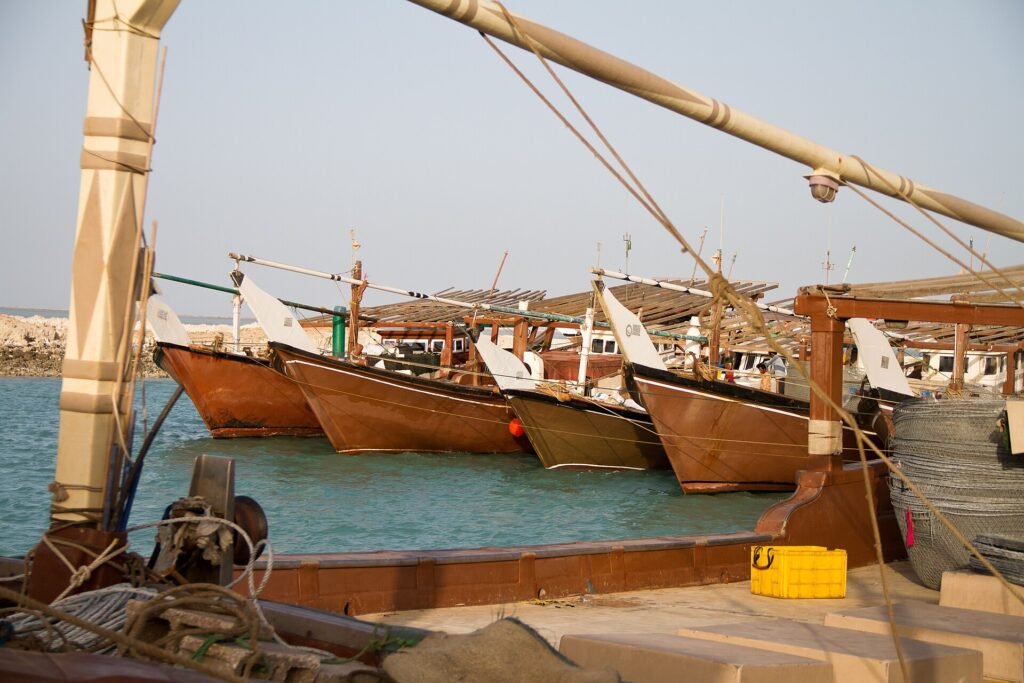
The fishing harbour is at its liveliest in the morning, when boats come in and catches are unloaded. Please ask before photographing people at work. Beyond it, Al Ruwais Port handles commercial shipping and has a market area, Al Mina Market, selling spices, dried fruit, nuts, household goods and decorative items. Check current opening times locally before making a special trip to it.
How to get there
Al Ruwais is at the northern end of Al Shamal Road, roughly 110 km from Doha. The drive takes around an hour and a quarter to an hour and a half, all on paved dual carriageway and town roads, so any car will do.
- From Doha, take Al Shamal Road north past Umm Salal, Al Khor and the Al Ghuwariyah turn-offs.
- Continue to the roundabouts at Madinat Al Shamal and follow the signs for Al Ruwais and the port.
- In Al Ruwais, head for the waterfront by the old town. The mosque sits close to the shore, at approximately 26.1424, 51.2133.
Parking is easy in the old town and along the seafront. Keep clear of the mosque entrance at prayer times and do not park on the pedestrian area beside it.
There is no practical public transport from Doha for a day trip. Taxis and ride-hailing cars will take you, but finding one for the way back is hard, so agree a return. Most northern heritage tours from Doha include Al Ruwais as a stop, often combined with Al Zubarah and Al Jumail.
Best time to visit
From November to March the weather is comfortable for walking around the town and along the headland. From May to September the humidity on this coast is heavy, and you will want to keep outdoor time short and early.
Morning is the best time for the harbour, when the fishing boats are active and the light falls on the mosque from the east. Late afternoon is lovely too, as the sun drops towards the Gulf and the café fills up. Avoid arriving at the mosque just as prayers are about to begin.
Weekends, especially Friday afternoons and Saturdays in winter, bring more visitors from Doha. On weekdays the old town is very quiet. If you want to see the fish traps, check a tide table for Al Ruwais and aim for low water.
Tips for your visit
- Dress for a working mosque. Cover shoulders and knees; women should bring a scarf in case they are invited inside.
- Check prayer times. Plan your mosque visit between prayers, and avoid Friday midday prayers entirely.
- Be discreet with the camera. Photograph the buildings freely from outside, but ask before taking pictures of worshippers or fishermen.
- Do not climb on the old walls. The restored buildings are fragile and are protected heritage sites.
- Go at low tide for the fish traps. They are almost invisible at high water.
- Use Al Ruwais as your refuelling stop. It is the best place in the far north for petrol, groceries and a meal before heading west to Al Zubarah.
- Keep the pedestrian zone clear. The road beside the mosque was closed to cars to protect the building.
What to bring
- A scarf or light cover-up for the mosque
- Sun hat and sunscreen for the headland walk
- Water, even in winter
- Comfortable shoes you can slip off easily
- A camera, ideally with a short zoom for the harbour
Combine it with nearby places
Al Jumail Abandoned Village. A few kilometres west, this ruined pearling village and its standing minaret are closed to the public but can be seen from outside the fence. It makes a striking contrast with the living mosque at Al Ruwais.
Al Zubarah Fort and Archaeological Site. Qatar’s UNESCO World Heritage Site lies down the north-west coast: a 1938 fort with a small museum and the excavated remains of an 18th-century pearling town. Allow two to three hours.
Abu Dhalouf. The neighbouring coastal village has a small park and the Bahar Mosque, which dates from 1940 and has been restored by Qatar Museums. It adds another historic mosque to your day in a few minutes’ drive.
Shadows Travelling on the Sea of the Day. Olafur Eliasson’s mirrored desert installation stands just north of Al Zubarah Fort, so it fits neatly into a loop that starts at Al Ruwais.
Frequently asked questions
Is Al Ruwais Mosque really the oldest mosque in Qatar?
It is widely described that way. ALECSO’s documentation says it was probably founded at the end of the 17th century and calls it the oldest existing mosque in Qatar, although the building you see today was largely rebuilt in the 1940s and restored in the 2010s.
Can non-Muslims visit the mosque?
Generally yes, outside prayer times and in modest dress. It is an active place of worship, so behave quietly, remove your shoes if you go inside and follow any instructions from people at the mosque.
Is there an entrance fee?
No. The mosque, the seafront and the Ras bu Omran path are free to visit.
How far is Al Ruwais from Doha?
Around 110 km, at the northern end of Al Shamal Road. Allow about an hour and a quarter to an hour and a half each way by car.
Is there anywhere to eat?
Yes. Al Ruwais and neighbouring Madinat Al Shamal have cafés, restaurants and shops, and a café has operated in the annex of the old police station. It is the most convenient place in the far north for a meal.
How long do I need?
An hour is enough for the mosque, the police station and a short walk on the headland. Add time for coffee or a meal, and combine it with Al Jumail and Al Zubarah for a full day.
Last checked October 2026. Hours, fees and access can change, so confirm with the official source before you go.
More places nearby
All places →
Run a tour, café or stay near Al Ruwais Mosque and Old Port, Al Shamal?
List your business free on Companies in Qatar, or get featured on Qatar Unseen in front of people planning their trip.