Shadows Travelling on the Sea of the Day, Al Shamal
Olafur Eliasson's mirrored shelters in the desert north of Al Zubarah. How to find them, when the shadows look best and what to expect.
Desert north of Al Zubarah Fort, near Ain Mohammed, Al Shamal
Overview
In the stony desert just north of Al Zubarah, far from any town, a cluster of white circles rises out of the ground. Some are flat, round roofs held up on curved legs; others are simple rings standing on their edge. Walk underneath one of the roofs and look up, and you find yourself staring at a mirror: the sand, the sky and your own upside-down figure, with the curved supports doubled into perfect circles.
This is Shadows Travelling on the Sea of the Day, a large site-specific installation by the artist Olafur Eliasson, commissioned by Qatar Museums in 2022. It is one of the most unusual places to experience contemporary art in the Gulf: there is no gallery, no ticket desk and no wall text, just the artwork, the landscape and the changing light.
It rewards people who are happy to slow down. Children love the mirrors, photographers love the geometry and the shadows, and anyone on a day trip to Al Zubarah can add it with only a short detour. It is at its most atmospheric in the low light of early morning and the hour before sunset.
The story behind the artwork
The artist
Olafur Eliasson, born in 1967, is an Icelandic-Danish artist based in Berlin. He is known worldwide for large works about light, perception and the environment, such as The Weather Project at London’s Tate Modern, where a vast artificial sun filled the Turbine Hall. Much of his work sets up a situation and then asks the visitor to complete it by moving, looking and noticing.
A commission for Qatar’s north
Qatar Museums commissioned the installation as part of a programme of more than 100 public artworks installed across the country around the FIFA World Cup in 2022. It opened in October 2022. Rather than placing it in Doha, the commission took it to the heritage landscape of the north-west, near the UNESCO World Heritage Site of Al Zubarah and the abandoned village of Ain Mohammed. Eliasson has said that the work was meant to draw attention to this landscape, and that to see it, “you have to make some effort”.
How it is made
According to Qatar Museums, the work is made of painted steel, fibreglass and chromium-silvered glass mirrors. There are twenty circular shelters of different sizes, plus three single rings and two double rings set into the ground. They are laid out along the axes of a fivefold symmetrical pattern, and the ten shelters at the centre form a pentagram, a five-pointed star that echoes the geometry of Islamic art.
The underside of every shelter roof is mirrored. Each roof rests on a curved segment of pipe, and in the mirror that half-circle is reflected into a complete ring. The effect links the real ground with the reflected space above your head, so that looking up becomes, strangely, a way of looking down at the earth and at yourself.
The meaning of the title
The title describes what happens through the day. As the sun moves across the sky, the circular shadows of the shelters slide across the sand, a cool, moving refuge in an open landscape. Eliasson has described the work as an invitation to reconnect with the planet, and Qatar Museums presents it as a work about how our perception shapes our relationship with reality.
What to see and do
Stand under a mirror and move
The work only really comes alive when you are inside it. Step under one of the shelters, look straight up and then move your arms, lift a foot or turn slowly. Eliasson himself has suggested moving your limbs to feel the effect. You will see yourself upside down, standing on a sand floor that seems to hang in the sky.
Find the five-pointed star
From the ground, the pentagram at the centre is not obvious. Walk around the outer edge and try to line up the shelters along their axes. When a row of circles snaps into alignment, you begin to sense the underlying symmetry that ties the whole layout together.
Watch the shadows travel
Spend at least a few minutes in one spot and watch how the circular shadows move and stretch. In the morning and late afternoon they become long ellipses racing across the gravel; around midday they shrink into pools directly beneath the roofs. Coming back to the same shelter at different times shows you why the work is named after its shadows.
Look for the rings
Beyond the shelters, the single and double rings stand on the ground like giant hoops. They frame the desert, the sky and the other structures, and they make good viewing points for photographs that play with circles within circles.
Photograph at golden hour
The installation is at its most photogenic when the sun is low. The white structures turn gold, the shadows lengthen and the mirrors pick up the colours of the sky. A wide lens is useful under the shelters, and a longer lens from a distance compresses the rows of circles. Drones need permission from the Qatari aviation authorities.
Take in the landscape
Do not forget the setting. The ground around the work is open, stony desert with low plants and animal tracks, and the horizon runs uninterrupted in almost every direction. The installation is designed as much to make you notice this landscape as to be looked at itself.
How to get there
The installation stands in the desert of Al Shamal, a short distance north of Al Zubarah Fort, around 100 km from central Doha. Allow roughly 1 hour 15 minutes to 1 hour 30 minutes each way.
- From Doha, drive north on Al Shamal Road and follow the signs west towards Al Zubarah.
- Continue past Al Zubarah Fort and head north on the road towards Al Areesh and Madinat Al Shamal, which passes close to the abandoned village of Ain Mohammed.
- Use a map pin for the final approach. OpenStreetMap places the artwork at approximately 26.0204, 51.0549, and Qatar Museums links a Google Maps location from its public art page.
The main roads are paved. Visitors report an open gate on the east side, where you leave the car and continue on foot across the desert to the structures. Do not drive in among them. A normal car is fine on the paved roads, but keep off soft sand and avoid the approach after rain.
There is no public transport, and a taxi from Doha would need to wait for you. Several Doha tour operators run northern day trips that combine the installation with Al Zubarah Fort and Al Jumail, which is the easiest option if you do not want to drive.
Best time to visit
November to March is the comfortable season. From May to September, walking across open desert at any time other than early morning is unpleasant and potentially dangerous.
For the artwork itself, time of day matters. The shadows are longest and most dramatic in the first two hours after sunrise and the last two before sunset, and the mirrors glow with warm colour. There are no published opening hours for the site, but plan to arrive and leave in daylight so that you can see the ground and find your car easily.
A clear day is best, as bright sun creates the sharp shadows that give the work its name. Winter weekends bring more visitors from Doha, but the site is large enough that you can usually find a quiet shelter to yourself.
Tips for your visit
- Treat it as an artwork, not a climbing frame. Do not climb on the rings or hang from the shelters, and never touch or mark the mirrors.
- Walk, do not drive. Leave your car at the gate and approach on foot.
- Remember where you parked. The desert looks the same in every direction. Drop a pin on your phone before you walk in.
- Protect your eyes. Mirrors and pale ground reflect a lot of glare. Sunglasses help, but do not use the mirrors to look at the sun.
- Keep expectations realistic. One reviewer noted that the mirrors have lost some of their shine since the work was installed. The illusion still works, but it is not a pristine gallery piece.
- Go slowly. Most people rush through in ten minutes. Give it at least half an hour and try standing under several different shelters.
- Take all rubbish with you. There are no bins or facilities on site.
- Fuel up first. Services are sparse in this part of Al Shamal; Al Ruwais and Madinat Al Shamal are the nearest places for fuel and food.
What to bring
- Plenty of water
- Sunglasses, hat and sunscreen
- Comfortable closed shoes for walking on gravel
- A wide-angle lens or phone camera for shots under the mirrors
- A torch if you stay for the dusk walk back
- A light jacket in winter; the desert cools quickly after sunset
Combine it with nearby places
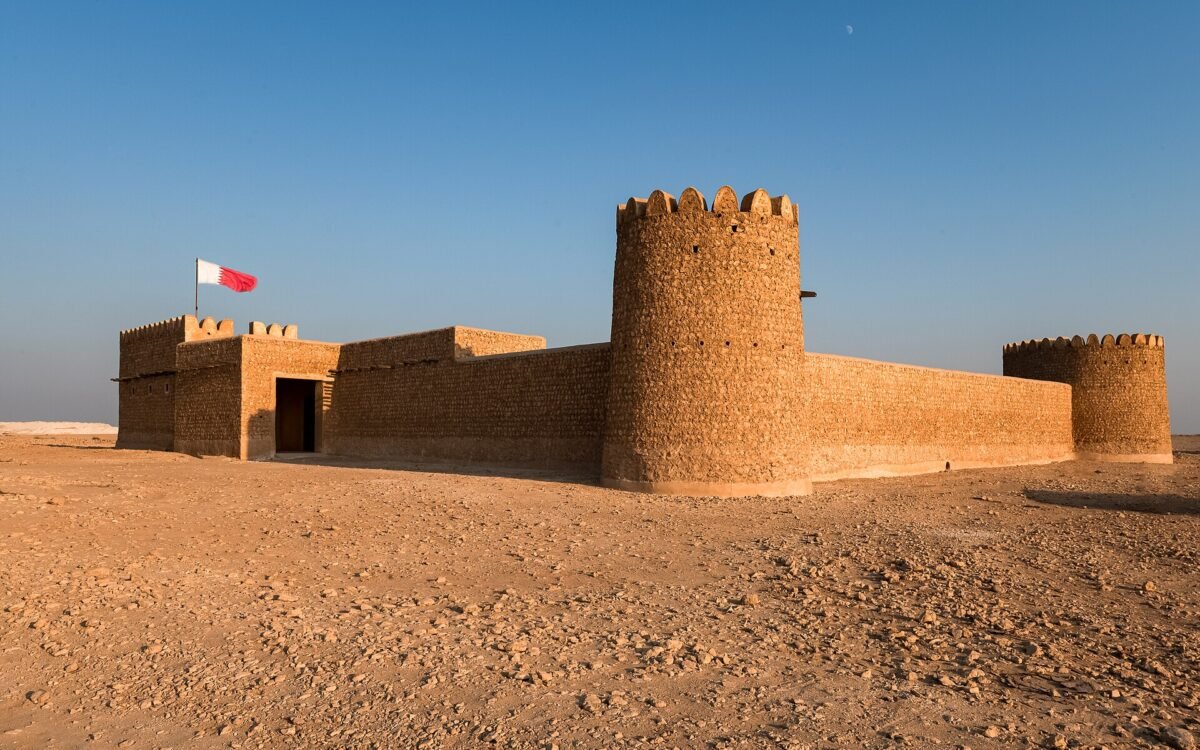
Al Zubarah Fort and Archaeological Site. Just to the south, Qatar’s UNESCO World Heritage Site combines a 1938 fort museum with the excavated streets of an 18th-century pearling town. Its 5pm closing time pairs well with a sunset visit to the installation.
Al Jumail Abandoned Village. A ruined fishing village with a standing minaret on the coast to the north-east. It is closed to the public, but you can see it from outside the fence.
Al Rakiyat Fort and Al Thaqab Fort. Two small restored desert forts a short drive inland, built to protect wells. Both are currently closed or not open to the public, but their exteriors are striking in low light.
Al Ruwais Mosque and Old Port. At the northern tip of Qatar, the historic mosque, harbour and café make a good place to start or end your loop.
Frequently asked questions
Where exactly is Shadows Travelling on the Sea of the Day?
In the desert of Al Shamal in north-west Qatar, just north of Al Zubarah Fort and near the abandoned village of Ain Mohammed. The approximate coordinates are 26.0204, 51.0549.
Is it free to visit?
Yes. It is an open-air public artwork managed by Qatar Museums, with no ticket required.
Are there opening hours?
No hours are published. Visit in daylight, and check the Qatar Museums public art page for any updates before you travel.
Do I need a 4×4?
No. The roads from Doha are paved, and visitors leave their cars at the gate and walk in. Take care on any sandy patches near the entrance.
How long should I spend there?
Plan on 30 to 60 minutes to walk among the structures, try the mirrors and watch the shadows. Photographers may want longer around sunset.
What is the artwork made of?
Painted steel, fibreglass and chromium-silvered glass mirrors. There are twenty circular shelters, three single rings and two double rings, arranged in a fivefold symmetrical pattern.
Is it suitable for children?
Yes, most children enjoy the mirrors and the space to explore. Keep them from climbing on the structures, and bring shade and water, as there is none on site apart from the shelters themselves.
Last checked October 2026. Hours, fees and access can change, so confirm with the official source before you go.
More places nearby
All places →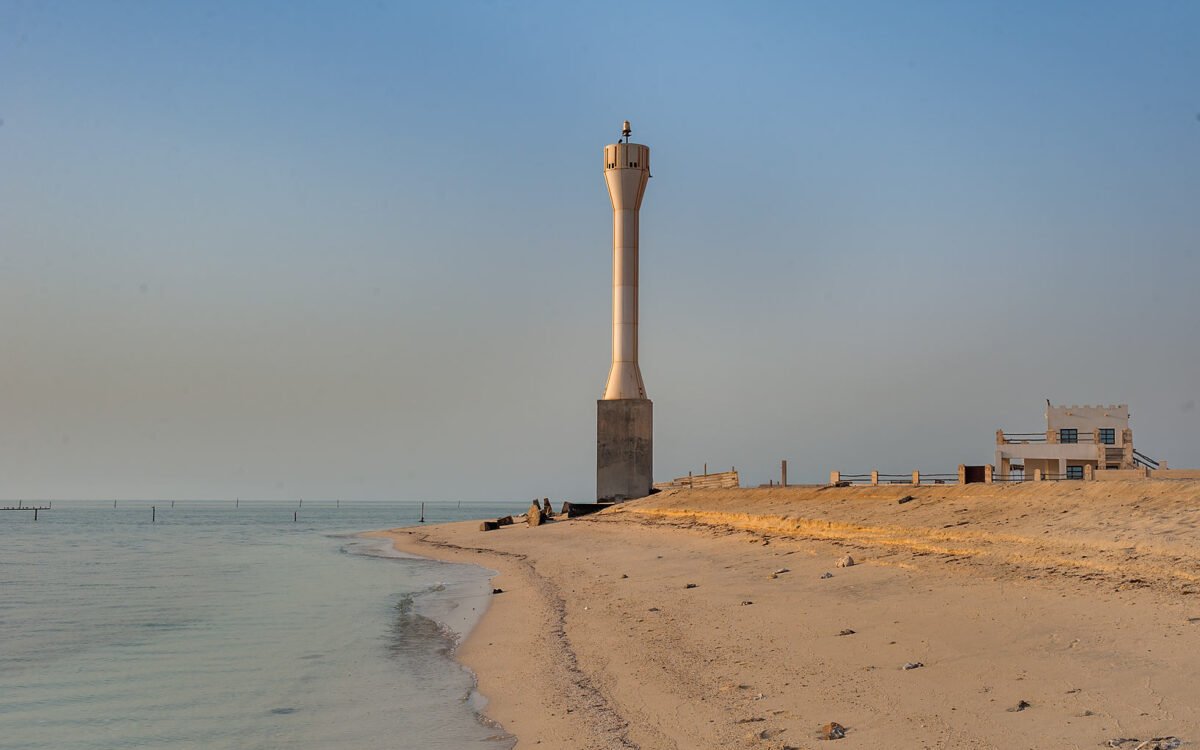
Run a tour, café or stay near Shadows Travelling on the Sea of the Day, Al Shamal?
List your business free on Companies in Qatar, or get featured on Qatar Unseen in front of people planning their trip.