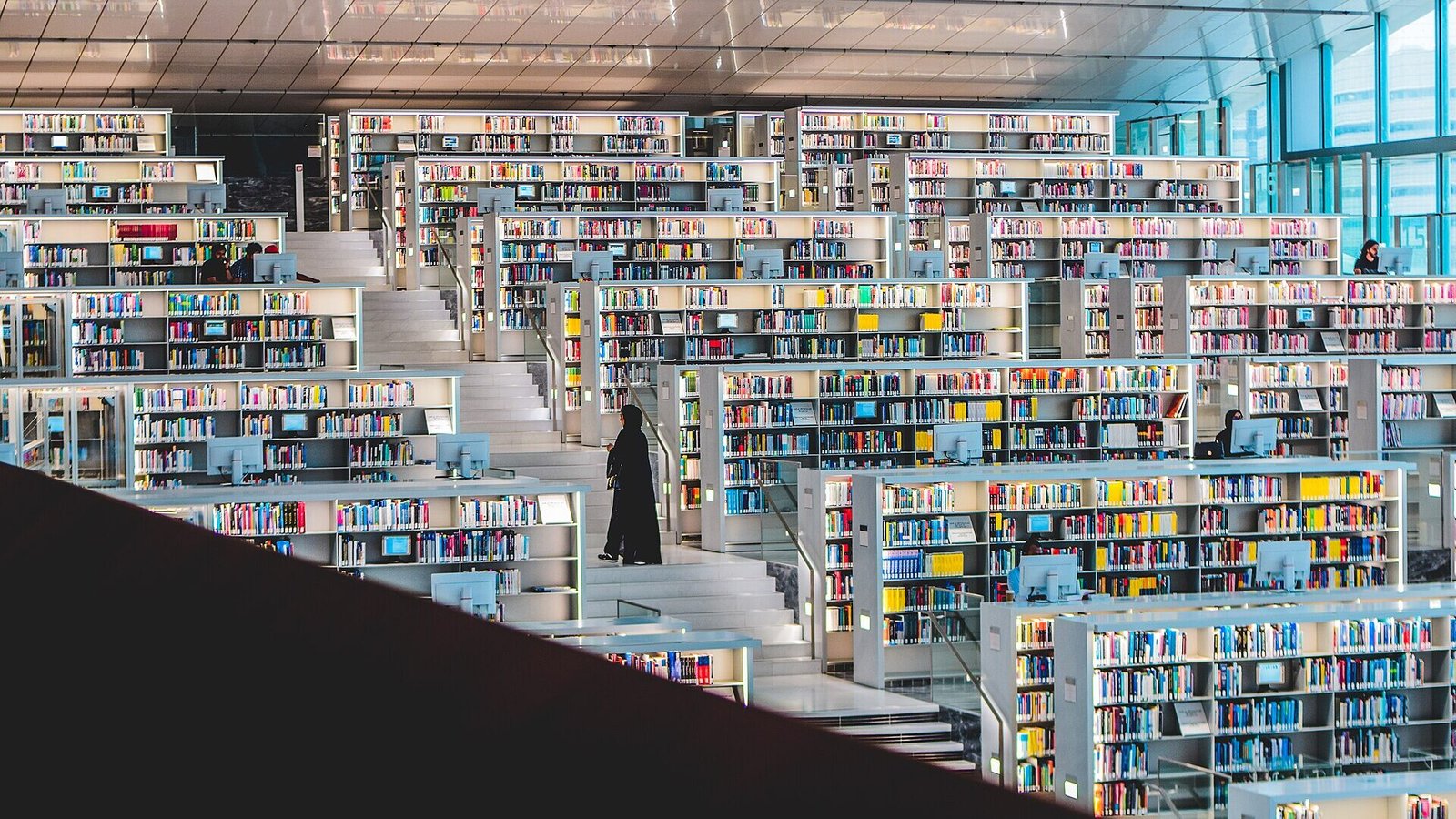
Qatar National Library, Education City
Rem Koolhaas's free library of a million books, with a sunken Heritage Library of manuscripts and maps. How to make the most of a first visit.
Education City, Al Rayyan (beside Qatar National Library metro station)
Overview
Qatar National Library is a library you visit the way you would visit a cathedral: first to stand in the doorway and stare, then to find a quiet corner and stay longer than you planned. Designed by Rem Koolhaas and his firm OMA, it sits in Education City in Al Rayyan, beside its own metro station, and holds more than a million books in one enormous, light-filled room. Entry is free, and visitors to Qatar are welcome to come in and explore.
It is three libraries in one: Qatar’s national library, a research library for the universities around it and a public library for everyone in the country. For a visitor, that translates into a striking building, a sunken Heritage Library of rare manuscripts, maps and early printed books, a big children’s library and a steady calendar of talks, workshops and concerts.
This guide is written for first-timers who want to get more out of it than a quick photo of the shelves: how to read the building, what to look for in the heritage collection, how to fit it into an afternoon in Education City and the small mistakes that trip people up. It suits architecture fans, families, students, remote workers and anyone looking for a cool, calm escape on a hot Doha day.
History and background
The library was announced on 19 November 2012 by Her Highness Sheikha Moza bint Nasser, during celebrations marking 50 years since Qatar’s first public library opened. It was set up under Qatar Foundation with a dual mission: to collect and preserve the heritage of Qatar and the wider region, and to serve as a modern public and university library.
In August 2015, before the building had even opened, the library was appointed the preservation and conservation centre for the Middle East and North Africa, a role that reflects how seriously it takes its heritage collection. The doors opened in stages: a soft opening in November 2017, followed by the official inauguration on 16 April 2018.
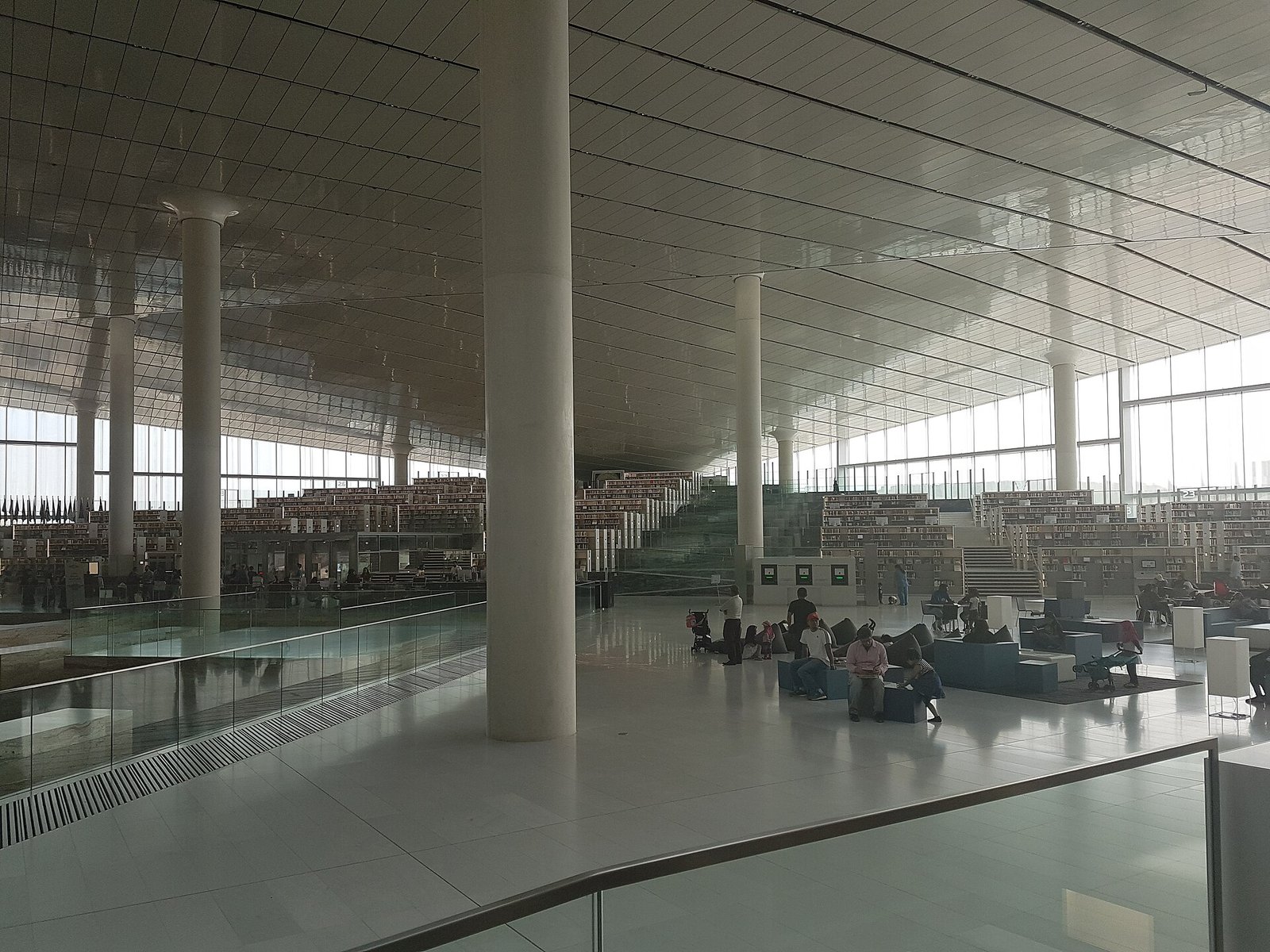
Koolhaas’s idea was simple and radical. Instead of hiding books in stacks, the whole collection is laid out in the open, so that you emerge into the building already surrounded by every book. The square structure looks as if its edges have been lifted, giving it a diamond-like profile, and inside three great terraces of shelving rise around a central space. The building covers about 42,000 square metres, and it has become one of the most recognisable modern interiors in the Gulf.
The library has not been immune to events. In 2026 it closed temporarily at short notice in late February and again in late March on the instructions of the authorities, before reopening fully on 12 April 2026. It also closed for a few days in July 2026 during a national mourning period. It is open with regular hours as of October 2026, but it is worth glancing at the library’s homepage on the day you go.
What to see and do
Read the building before the books
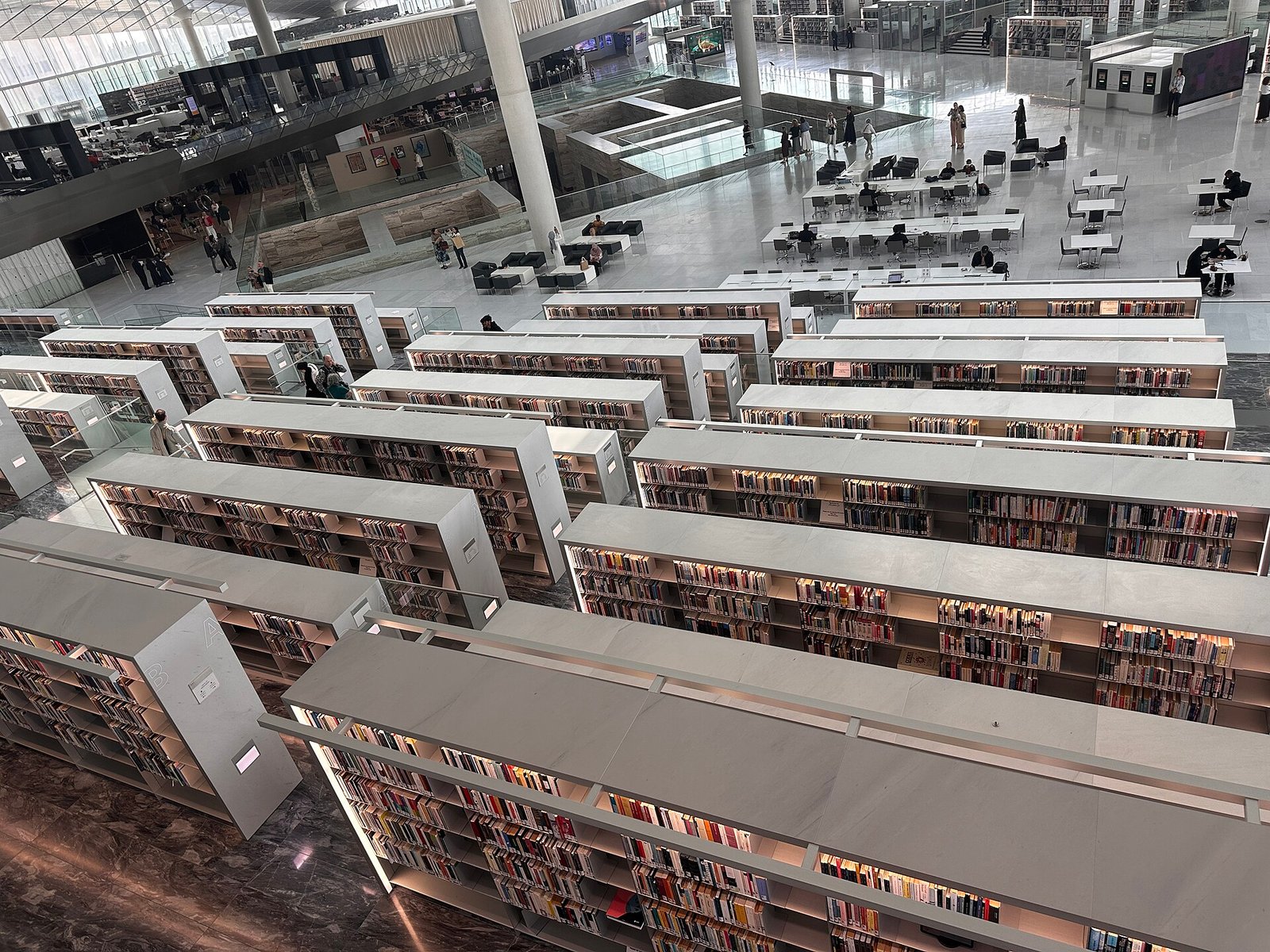
Give yourself ten minutes just to look. The shelves are made from white marble, the same material as the floors, and they are more than furniture: lighting, ventilation and the book-return system are built into them, so the whole interior reads as one continuous landscape. The façade is corrugated glass and the ceiling is reflective aluminium, a combination designed to soften Doha’s harsh sun into even reading light. Notice how a column-free bridge crosses the main hall; it carries study areas, reading rooms and exhibition space, and gives you the best elevated view back over the terraces.
The Heritage Library
At the centre of the building the floor drops away. About six metres below the main level lies the Heritage Library, lined in beige travertine so that it feels like an excavation, a deliberate contrast with the white marble above. This is where the library keeps its most precious material on Arab and Islamic civilisation: around 2,400 manuscripts, including Qur’anic texts and works on astronomy, geography and mathematics, plus early printed books, maps, atlases, globes and historic photographs. Among the treasures are early Latin translations of Avicenna’s Canon of Medicine. Visitors to Qatar are explicitly welcome to see the Heritage Library and its exhibitions, so do not skip it.
Maps of the Gulf
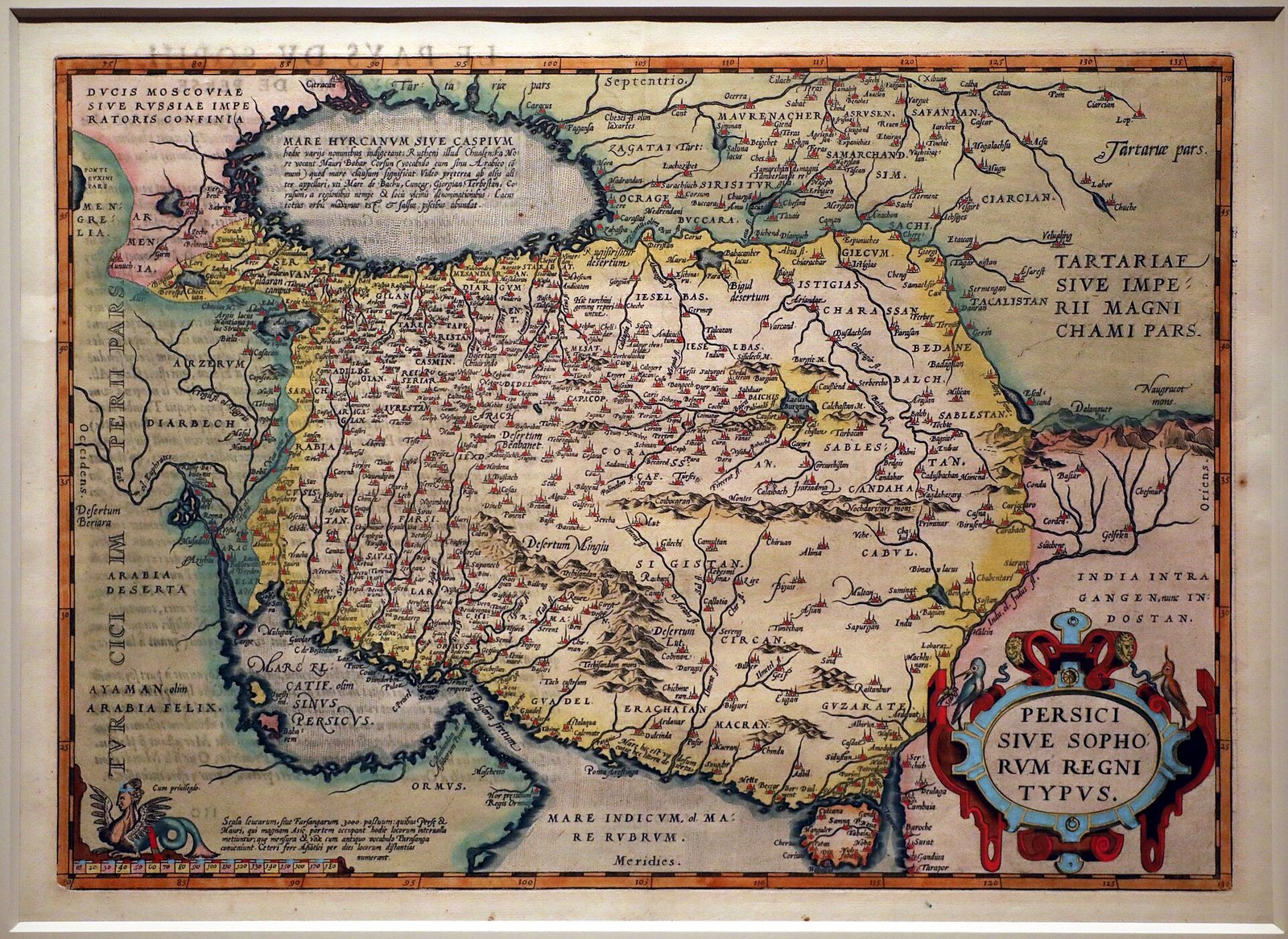
If you only have time to look closely at one thing, make it the maps. The collection includes European maps of Arabia and the Gulf going back to the 16th century, such as the Ortelius map pictured above, and it is fascinating to see how mapmakers drew, and misdrew, the Qatar peninsula over the centuries. What is on display changes with each exhibition, so ask at the desk what is currently out.
Children’s and young adult libraries
The children’s library is one of the largest spaces in the building, with well over 100,000 titles, and there is a sensory room for babies and toddlers up to age three. Teenagers have their own young adult section with tens of thousands of books. Note that the children’s library keeps shorter hours than the rest of the building on weekdays.
Events, concerts and tours
The library runs a busy free programme of talks, workshops, book clubs and performances. A typical month, such as September 2026, included a mentorship programme for students and graduates, a filmmaking workshop, a science book forum on artificial intelligence and a Philharmonic performance. Free guided tours of the building and the heritage collections are offered too; places are limited, so register in advance through the events page on the library’s website or the QNL app.
Work, study and create
Plenty of people use QNL as an office: there is free Wi-Fi, public computers and space to spread out. Residents with a Qatar ID can join for free and get access to borrowing, e-books and databases, bookable study spaces and the Innovation Stations, which include 3D printers and music studios. Short-term visitors cannot register as members, but the open collection, exhibitions and seating are there for everyone.
How to get there
The library is in Education City, Al Rayyan, on the western side of Doha. The easiest way to arrive is by Doha Metro: take the Green Line to Qatar National Library station, which is right next to the building. From Msheireb, the main interchange in central Doha, it is a direct ride with no changes.
By car from West Bay or the Corniche, head west via Al Luqta Street or Dukhan Road; allow roughly 20 to 30 minutes outside rush hour. Parking right beside the library is limited. The recommended options are the underground car park at Oxygen Park or the Education City Mosque car park, both linked to the library by the free Education City tram. Taxis and ride-hailing apps will drop you close to the main entrance if you ask for Qatar National Library, Education City.
Inside Education City the free tram is the simplest way to hop between the library, the mosque and the parks, especially in the hotter months.
Best time to visit
As an indoor, air-conditioned space, the library works all year, and it is one of the best ideas in Doha from May to September, when being outside at midday is hard work. From October to April, combine it with a walk in Education City before or after.
The main library opens Saturday to Thursday from 8am to 8pm and on Friday from 4pm to 8pm. The children’s library is open until 6.30pm from Sunday to Thursday and until 8pm on Friday and Saturday. Weekday mornings are calmest and best for photographs of the empty terraces. Late afternoons and Saturdays bring families and students, and study areas can fill up around university exam periods. Light is at its best in the morning and late afternoon, when the glass façade glows without harsh contrast.
Tips for your visit
- Friday opening is short (4pm to 8pm), so do not plan a Friday morning visit.
- Check the library’s homepage before you go; it has closed at short notice more than once in 2026.
- Book a free guided tour in advance if you want the architecture and the heritage collections explained.
- Keep voices low on the terraces; this is a working library and many people come to study.
- Photograph the building with consideration: avoid shooting people at their desks and do not use flash.
- Bring a light layer; the air conditioning can feel cool after time outside.
- Visitors can explore freely but cannot borrow; residents need a valid Qatar ID to sign up for free membership, which expires along with the ID.
- If you come by car, park at Oxygen Park or the Education City Mosque car park and take the free tram.
What first-timers get wrong
Treating it as a five-minute photo stop. The famous view of the terraces takes seconds to photograph, but the reward is underneath it. Most of what makes the library special, the manuscripts, maps and globes, sits in the sunken Heritage Library that many people never walk down to.
Turning up on a Friday morning. The library does not open until 4pm on Fridays. If Friday is your only free day, plan an evening visit and pair it with a sunset walk in Education City.
Assuming tourists are not allowed in. Some visitors hesitate because it is a national and university library. You do not need a membership card or an appointment to walk in and look around, and exhibitions are open to all.
Parking at the door. Spaces right by the entrance are limited. The car parks at Oxygen Park and the Education City Mosque, linked by the free tram, save a lot of circling.
Forgetting it is a working library. Students and researchers are concentrating at the desks around you. Keep conversations for the café and the open circulation areas, and step away from people’s screens when you take photos.
Combine it with nearby places
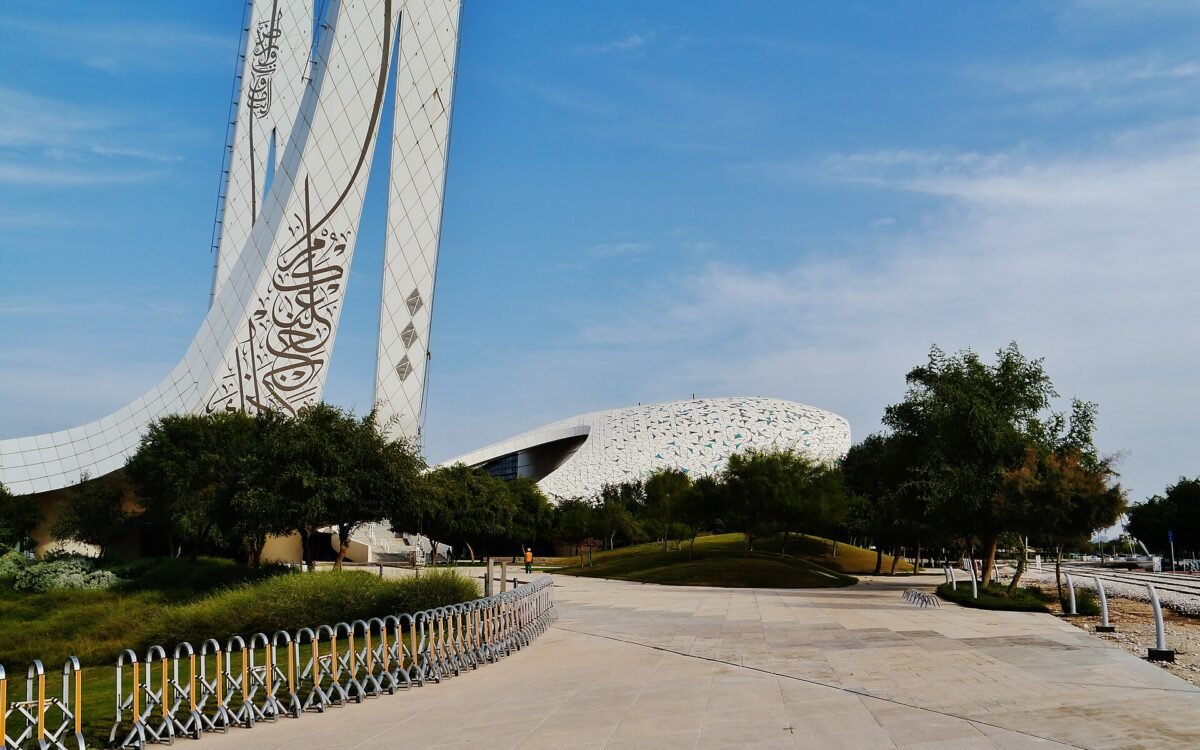
- Education City Mosque (Minaretein). The twin-minaret mosque is a short walk or tram ride away and welcomes visitors free of charge outside prayer times.
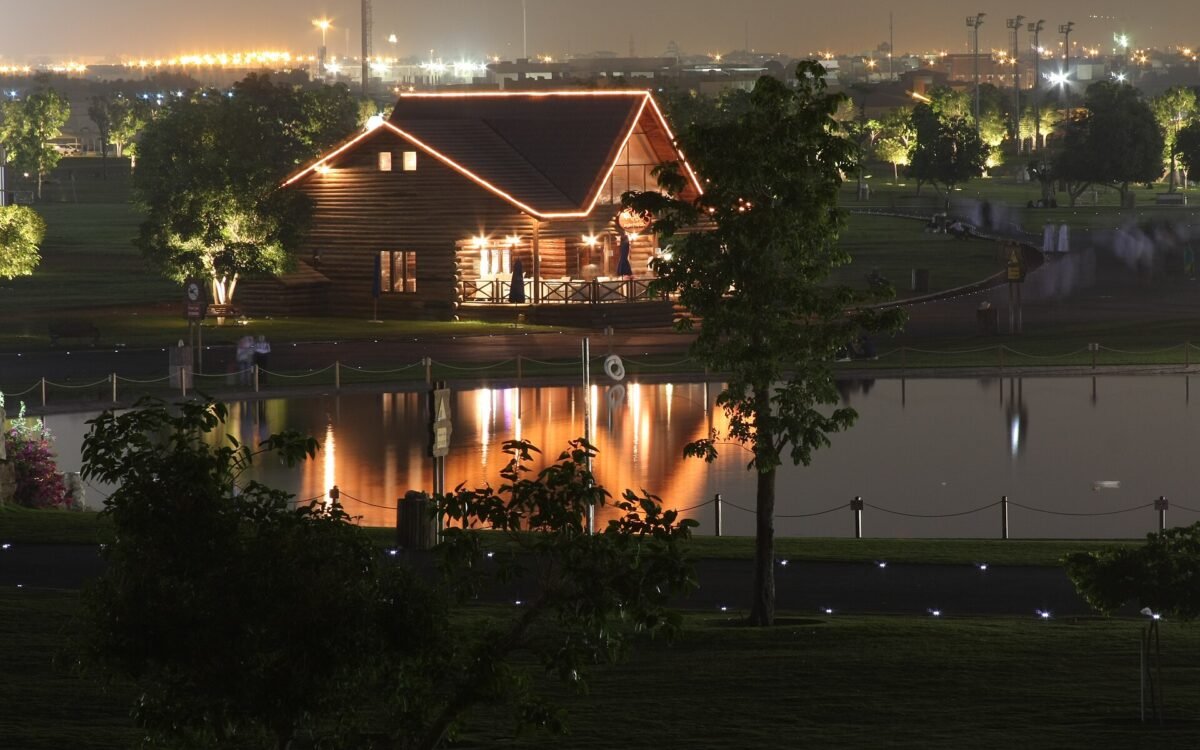
- Oxygen Park. A landscaped park with shaded paths, a running loop and water features, ideal for an evening stroll after the library closes its children’s section.
- Lawh Wa Qalam: M. F. Husain Museum. Education City’s free museum dedicated to the Indian modernist painter, a few minutes away.
- Al Shaqab Equestrian Centre. Arabian horses, stables and arenas on the edge of Education City; tours are by arrangement.
- 3-2-1 Qatar Olympic and Sports Museum. A short drive south in Aspire Zone, and a good second stop on a family day out.
For more cultural ideas, see our round-up of museums in Qatar and our list of free things to do in Qatar.
Frequently asked questions
Is Qatar National Library free to visit?
Yes. Entry is free for everyone, and tourists can explore the print collection, exhibitions and Heritage Library. Membership is free too, but only for holders of a Qatar ID.
What are the opening hours?
Saturday to Thursday 8am to 8pm, and Friday 4pm to 8pm. The children’s library closes at 6.30pm from Sunday to Thursday.
Can tourists borrow books?
No. Borrowing needs membership, which requires a Qatar ID. Visitors can still read in the library and attend many events.
Which metro station is nearest?
Qatar National Library station on the Green Line, right next to the building.
Who designed the building?
Rem Koolhaas and his practice OMA. The library opened in stages, with a soft opening in November 2017 and an official opening in April 2018.
Are there guided tours?
Yes, free tours of the building and the heritage collections are offered. Places are limited, so register in advance through the library’s events page.
Is it good for children?
Very. The children’s library has well over 100,000 titles, regular activities and a sensory room for under-threes, and the young adult section caters for teenagers.
Last checked October 2026. Hours, fees and access can change, so confirm with the official source before you go.
Read the Companies in Qatar visitor guide ↗
More places nearby
All places →
Run a tour, café or stay near Qatar National Library, Education City?
List your business free on Companies in Qatar, or get featured on Qatar Unseen in front of people planning their trip.