Al Jassasiya Rock Carvings, Al Shamal
Qatar's largest group of petroglyphs, with boats, cup marks and rosettes cut into a coastal ridge. How to actually see them, and when.
Al Jassasiya, Al Shamal (north-east coast, south of Fuwairit)
Overview
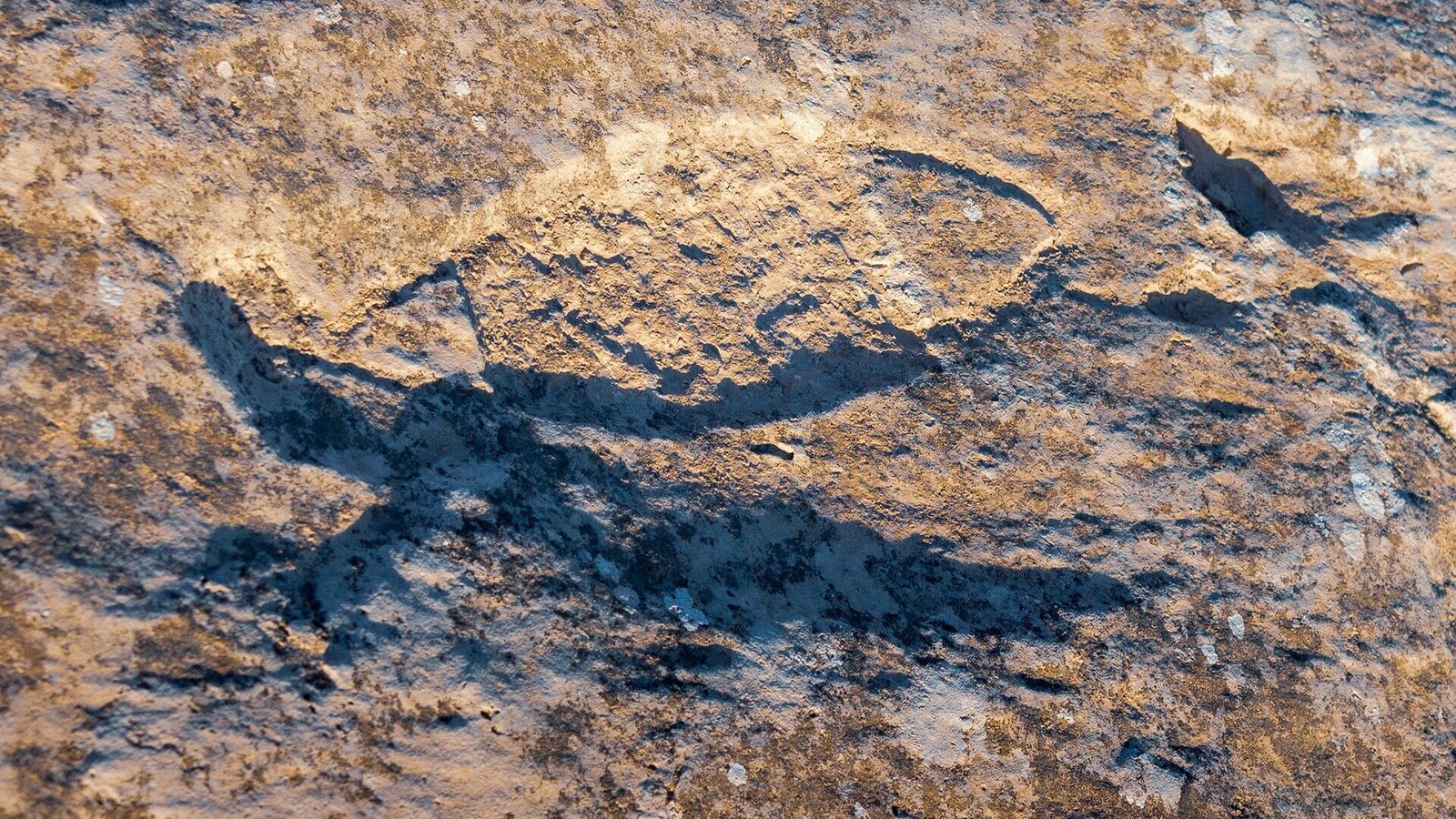
At first glance, Al Jassasiya is a low, crumbly limestone ridge a short way inland from Qatar’s north-east coast, between Fuwairit and Al Huwaila. Look closer, with the sun at the right angle, and the rock surface fills with shapes: lines of small round hollows, star-like rosettes, fish, footprints and, above all, boats.
This is the largest collection of rock carvings, or petroglyphs, in Qatar, with close to 900 figures and compositions recorded along the ridge. Its boat carvings are the most numerous and detailed in the country, although simpler boat-like motifs have also been reported at nearby Jebel Fuwairit. For a nation whose history was shaped by pearling and the sea, that makes it a special place, even though the carvings themselves are small, shallow and easy to walk past.
Important: Qatar Museums currently lists Al Jassasiya Rock Art Site as temporarily closed until further notice. This guide is written as a field guide for when it reopens: how to actually see the carvings, what the different motifs mean, and how to build a morning on the north-east coast around them. Check the Qatar Museums website before you drive up. The site suits archaeology fans, photographers and curious families who like a puzzle.
The story behind the carvings
Discovery and the big survey
The carvings came to light during the Danish archaeological expeditions to Qatar in the mid-20th century. Qatar Museums gives 1957 as the year of discovery, while other accounts credit a team led by Holger Kapel in 1961. In 1974 his son, Hans Kapel, carried out the detailed survey that still underpins what we know, cataloguing nearly 900 single figures and compositions. Current figures from Qatar Museums and Visit Qatar put the total at 874.
What was carved
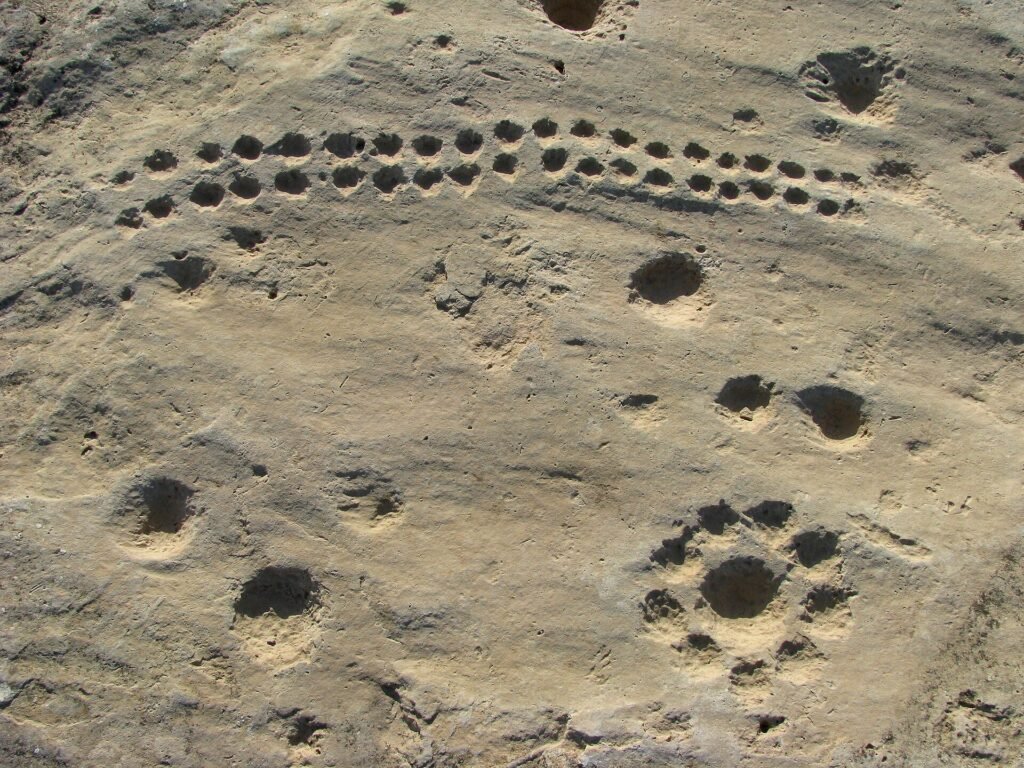
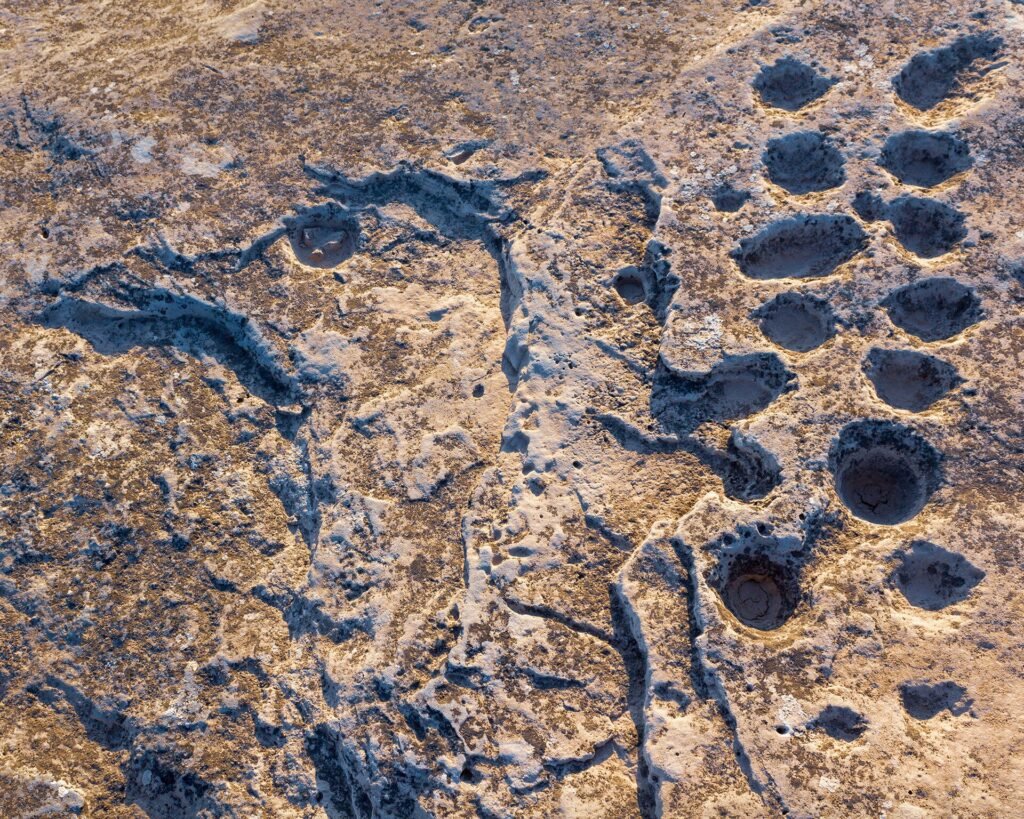
Most of the carvings are cup marks: small, round depressions pecked into the rock, often set in straight rows, in pairs of rows, or in circles and rosettes. Among them are figurative images. Wikipedia’s account of the site counts 141 boat carvings, 124 of them drawn as if seen from above and 17 in side view. There are also fish, turtles, ostriches, footprints and, in some later carvings, sails drawn without a boat beneath them.
How old are they?
This is where Al Jassasiya gets interesting. Early researchers wondered whether the carvings might be Neolithic. Later scholars suggested dates ranging from the 3rd century BC to the 11th century AD and beyond. Then a 2012 study tested nine samples and found that even the oldest was less than 300 years old. Qatar Museums now says the carvings were probably made within the past 250 years, which would place them in the great age of pearling on this coast. The debate is not completely closed, and it is part of the pleasure of a visit to make up your own mind in front of the rock.
A lookout over the sea
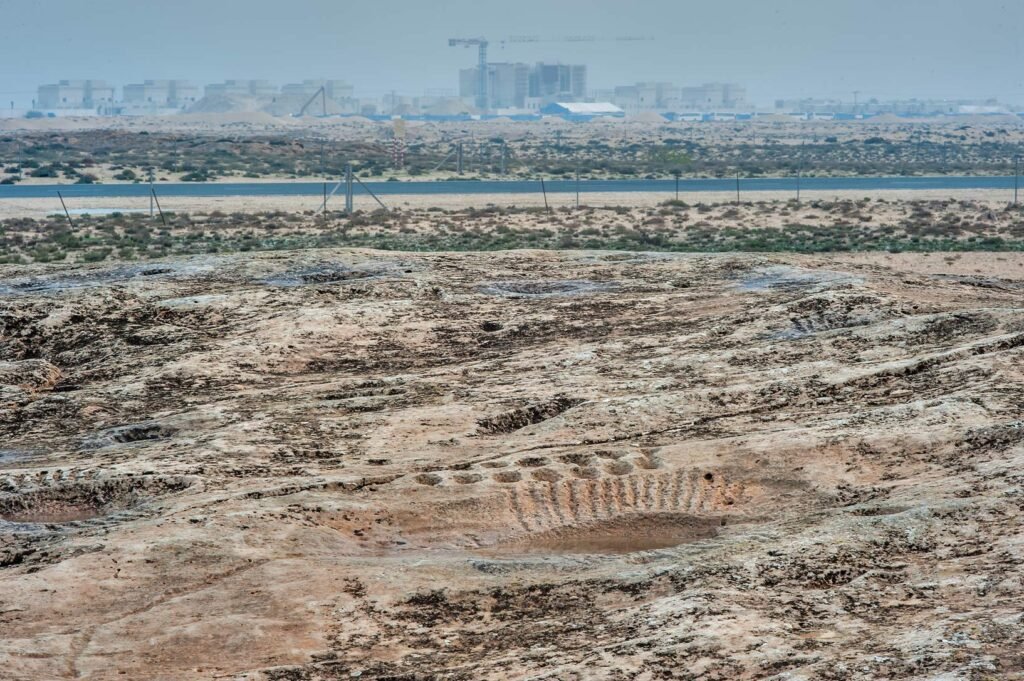
The ridge stands a little above the surrounding land, with views towards the coast, and the name is often linked to watching or keeping a lookout. The Qatar Tribune has suggested it may have been used to watch ships approaching Qatar. Visit Qatar also mentions residential remains from the 15th century found at the site. Fuwairit lies about 5 km to the north, and Al Huwaila, once one of Qatar’s main towns before Al Zubarah rose in the 18th century, is a similar distance away.
What to see and do
Learn to see in raking light
The single most useful thing to know about Al Jassasiya is that the carvings are shallow and the same colour as the rock around them. At midday, with the sun overhead, they almost disappear. In low morning or late-afternoon light, each groove casts a small shadow and the shapes jump out. Walk slowly, keep the sun to one side of you rather than behind you, and crouch down to look across the surface rather than straight down at it.
The boats
The boat carvings are the reason to come. Most are drawn from above, as long pointed ovals, some with lines along each side that may represent oars. A smaller number are drawn in profile. Try to find both kinds, and compare them with the dhows you will see at Al Khor or Al Ruwais: the hull shapes are unmistakable. Some later carvings show only a sail, as if the artist was interested in the rig rather than the hull.
Cup marks and rosettes
Everywhere you look there are rows of small round hollows. Qatar Museums says they are thought to have been boards for traditional games, possibly a form of mancala known locally as Al Haloosa or Al Huwaila, in which seeds or pebbles are moved from hole to hole. Other suggestions include sorting pearls. Look for the patterns: double rows, circles of cups around a central one, and star shapes that may be decorative rather than practical.
Animals, fish and footprints
Among the geometric marks are figures of fish, turtles and ostriches, as well as carved footprints. They are fewer and harder to spot than the cup marks, so treat them as a treasure hunt. A photograph of the Qatar Museums site plan or signage, if available on the day, helps you narrow down where to look.
The ridge and the view
Take a moment to look up from the rock. The ridge gives you a view over the flat coastal plain towards the sea, with rocky outcrops and quarried ground around it. It is easy to see why a raised spot near the shore might have served as a lookout, and why people waiting here might have passed the time carving boats and playing games in the stone.
Photographing petroglyphs well
Shoot early or late for side light. Frame tight on single carvings rather than trying to capture the whole ridge, and include a boot tip or a coin for scale only if you place it beside, never on, the carving. Never wet, chalk or trace the grooves to make them show up; it damages the rock and is not allowed.
How to get there
Qatar Museums and Visit Qatar both place Al Jassasiya about 60 km north of Doha, near the north-east coast. By road allow around an hour, depending on your starting point.
- From Doha, drive north on Al Shamal Road, past the turn-offs for Al Khor.
- Visit Qatar gives Exit 66 on Al Shamal Road as the exit for the site. Leave the highway there and follow the local roads east towards the coast.
- Signs are few, so use a map pin. OpenStreetMap places the petroglyphs at approximately 25.9551, 51.4012, south of Fuwairit.
Roads are paved most of the way and an ordinary car is fine in dry weather. The site is a fenced area with walking paths; park outside without blocking the gate and walk in.
There is no public transport. A taxi or ride-hailing car can take you, but getting one back is difficult, so book a return or drive yourself. Some north-coast tours from Doha include the rock carvings; ask whether the site is currently open before you book.
Best time to visit
The cooler months, roughly November to March, are best. The ridge is completely exposed, and from May to September the heat makes a visit unpleasant.
Time of day matters more here than almost anywhere else in Qatar. When the site is open, aim to arrive soon after it opens at 9am, while the sun is still low in the east, or in the last couple of hours before the 5pm closing time. On Fridays it opens only from 12.30pm, which makes it hard to catch good light, so choose another day.
Weekdays are quiet. On winter weekends the north-east coast is busier with families heading for Fuwairit and Al Ghariya beaches, but the rock art site itself rarely draws crowds.
Tips for your visit
- Confirm it is open. Qatar Museums lists the site as temporarily closed until further notice. Check its heritage sites page on the morning of your trip.
- Go for the light, not the clock. Low sun is everything. A visit at noon can leave you wondering where the carvings are.
- Never walk on the carved surfaces. Stay on the paths and step around the flat rock sheets where the carvings are.
- Do not touch, wet, chalk or rub the carvings. Even gentle contact wears the grooves down over time.
- Wear shoes with grip. The limestone is uneven and flaky in places.
- Read up in advance. On-site interpretation is limited, so knowing what a cup-mark rosette or a boat in plan view looks like helps enormously.
- Keep your visit short and focused. An hour is plenty; combine it with the coast for a full morning.
- Bring your own supplies. There is no café or shop at the site.
What to bring
- Water, hat and sunscreen
- Shoes with a good grip
- A camera or phone, ideally shooting in low side light
- Reference photos of the main carving types
- Snacks, and a picnic if you are heading on to the beach
- Swimwear and a towel for the coast afterwards, in season
Combine it with nearby places
Fuwairit Beach. About 5 km to the north, this long, quiet beach is one of Qatar’s main nesting sites for hawksbill turtles. It is usually closed to the public for the nesting season, roughly from April to the end of July, so plan beach time in the cooler months.
Al Huwaila. A short drive away, Al Huwaila was one of Qatar’s principal settlements before Al Zubarah rose in the 18th century. Driving through helps place the rock art in a landscape that was once busier than it looks.
Al Thakira Mangroves. South towards Al Khor, the mangroves at Al Thakira are one of the best places in Qatar for kayaking and birdwatching, and they make a green contrast to the bare ridge.
Al Ruwais Mosque and Old Port. Continue north along the coast road to the tip of the peninsula for a historic mosque, a working harbour and a café, then loop west to Al Zubarah if you have a full day.
Frequently asked questions
Is Al Jassasiya open to visitors?
Qatar Museums currently lists the Al Jassasiya Rock Art Site as temporarily closed until further notice, with no reopening date published. When open, its hours are Saturday to Thursday 9am to 5pm and Friday 12.30pm to 5pm.
Does it cost anything?
No. Qatar Museums lists the site as free, with no ticket required, when it is open.
How many carvings are there?
The 1974 survey catalogued nearly 900 figures and compositions. Qatar Museums and Visit Qatar give a figure of 874. Most are cup marks, with more than 140 boats among the figurative carvings.
Are the carvings prehistoric?
Probably not. They were once thought to be Neolithic, but a 2012 study found the samples tested were less than 300 years old, and Qatar Museums now suggests they were carved within the past 250 years.
What were the cup marks for?
The leading idea is that many were boards for a traditional mancala-type game known locally as Al Haloosa or Al Huwaila. Some may have had other uses, such as sorting pearls.
Which municipality is Al Jassasiya in?
It lies in Al Shamal municipality, on the north-east side of the peninsula between Fuwairit and Al Huwaila.
When is the best time to see the carvings?
Early morning or late afternoon on a clear day between November and March, when low sunlight throws shadows into the grooves.
Last checked October 2026. Hours, fees and access can change, so confirm with the official source before you go.
Read the Companies in Qatar visitor guide ↗
More places nearby
All places →
Run a tour, café or stay near Al Jassasiya Rock Carvings, Al Shamal?
List your business free on Companies in Qatar, or get featured on Qatar Unseen in front of people planning their trip.