Al Khuwayr Abandoned Village, Al Shamal
Once the raider Rahma bin Jaber's 'fox's den', now a seaside ruin of minaret, pillars and pearling-era houses on a turquoise bay.
Al Khuwayr, north-west coast west of Madinat ash Shamal
Overview
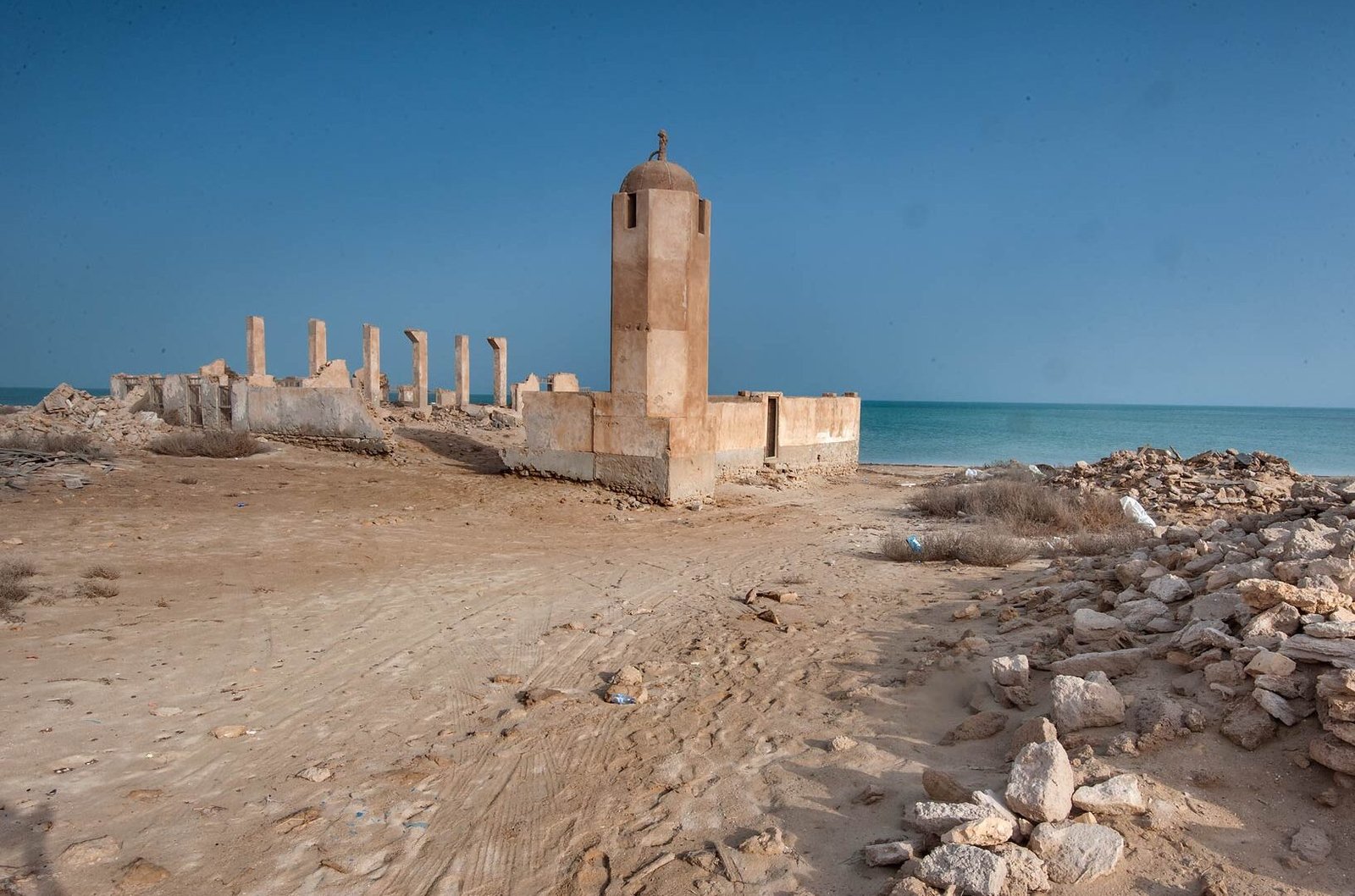
Al Khuwayr is an abandoned coastal village on Qatar’s north-west tip, a few kilometres up the shore from Al Arish and west of Madinat ash Shamal. Its ruins sit right at the water’s edge: a mosque with a weathered minaret, a row of free-standing stone pillars, roofless houses, rubble mounds and the odd collapsing wooden building, all looking out over a shallow, turquoise bay with a small island offshore.
It looks like just another empty fishing village, but Al Khuwayr has one of the most dramatic back stories on the coast. Under its older name, Khor Hassan, it was the stronghold of Rahma bin Jaber, the most notorious sea raider of the early 19th-century Gulf, and it was fought over, razed and rebuilt several times. Later it became a quiet pearling and fishing community until the oil era emptied it.
It rewards curious, slow visitors: history buffs who enjoy matching a story to a landscape, photographers drawn to stone, sky and sea, and families looking for an open-air stop on a day in the north. There are no facilities, no guides and no tickets, so treat it like a walk through a fragile outdoor museum.
The story behind Al Khuwayr
The settlement’s earlier name, Khor Hassan, means “beautiful inlet”, a fair description of the sheltered bay in front of it. In the late 18th century it became the base of Rahma bin Jaber Al Jalahmah, a tribal leader and raider who waged a long feud with the Al Khalifa of Bahrain. He built a fort with mud walls here, with only a few huts around it, and his enemies are said to have called it “the fox’s den”.
The village was caught up repeatedly in the region’s wars. In 1793 forces of the first Saudi state, under the commander Sulaiman ibn Ufaysan, razed it during a campaign in Qatar. In 1809 Rahma’s seizure of Kuwaiti ships led to the death of a son of Kuwait’s ruler and threats of revenge, and in March 1811 a Bahraini and Kuwaiti coalition defeated his forces at the Battle of Khakeekera. Rahma bin Jaber, who is also associated with Zekreet Fort on the west coast, moved on, and Khor Hassan’s days as a raider’s base were over.
The community that followed lived from the sea. In the 1820s the British surveyor George Barnes Brucks described a small village with a square fort, home to fishing families. In 1908 J. G. Lorimer’s Gazetteer of the Persian Gulf recorded about 80 families of the Kubaisi tribe who lived “solely by pearl diving and fishing”, with 20 pearling boats, 5 fishing boats and 20 camels. Drinking water was fetched from Al Thaqab, about three miles to the south-east, where a small fort still stands today.
The 20th century brought more change. In 1937 the village was occupied by forces of Sheikh Abdullah bin Jassim Al Thani during a dispute with a faction of the Al Naim tribe. A school opened in 1957. But as oil reshaped Qatar’s economy, families moved away to towns with modern services, and Al Khuwayr was gradually left to the wind and the tide.
What to see and do
The mosque and its minaret
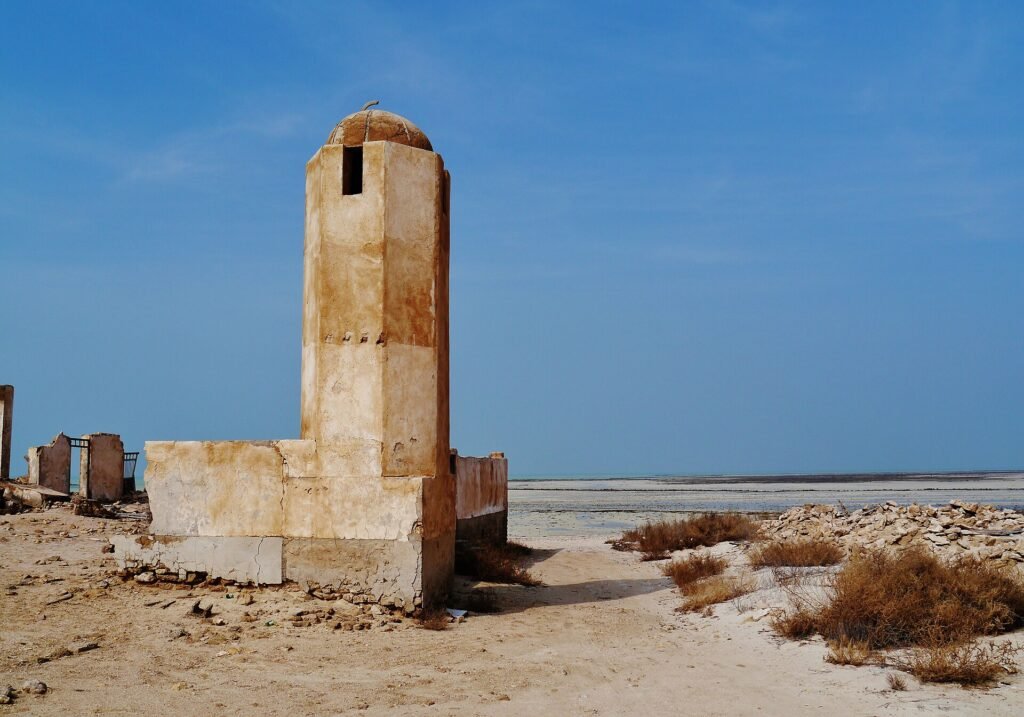
The minaret is the landmark you will see from the approach track: a squat, weathered tower standing beside the remains of the prayer hall, close to the shore. It is one of the most photographed ruins in the north, especially with the bay behind it. Walk around it rather than through it, and do not climb any part of the structure.
The line of pillars
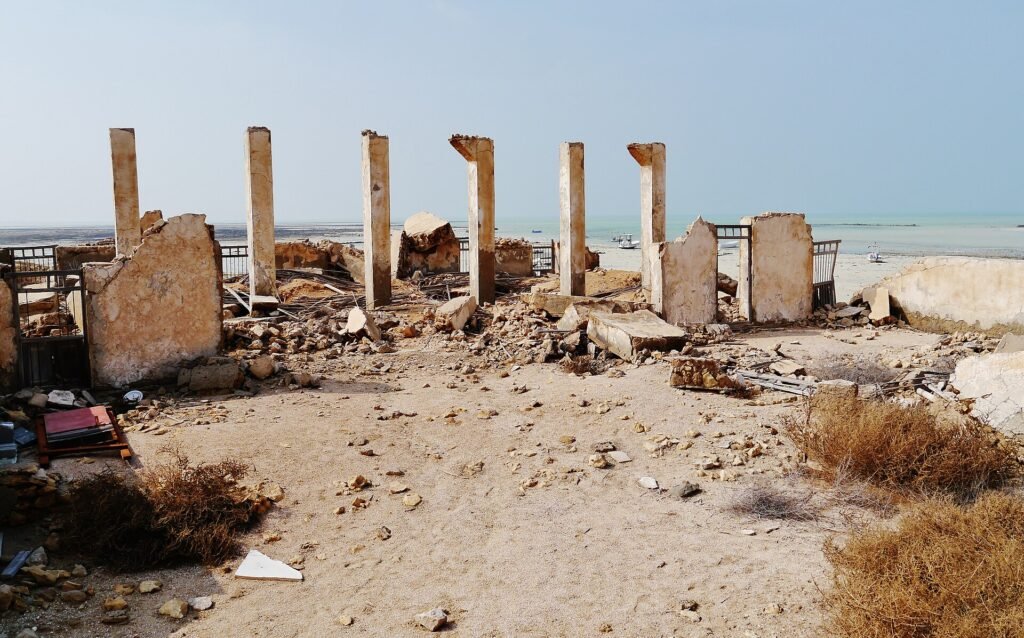
Not far from the mosque, a row of stone pillars stands on its own among the rubble, like the remains of a colonnade whose roof and walls have gone. With the sea and sky behind them they make a striking, almost classical composition, and they help you imagine the shaded verandas and courtyards that once lined the village lanes.
Houses and wooden structures
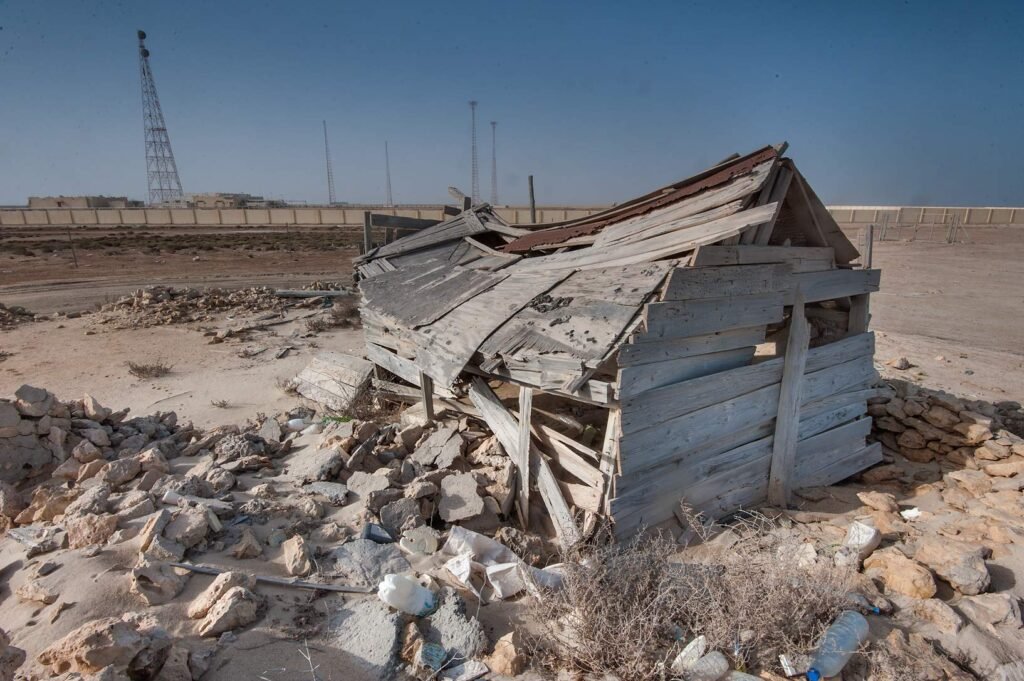
Wander between the houses to see thick walls of rubble stone and mud, doorways and wall niches, and here and there the remains of later timber buildings sagging into the sand. These wooden structures are a rare sight in Qatar’s old villages and show how long people stayed here, building with whatever materials were available. Look, but don’t touch: some are on the point of collapse.
Look for the fort site
Historical sources describe a square fort here, and visitors report traces of the old fort among the ruins. Little stands above ground, so it takes some imagination. Knowing that this unremarkable patch of stone was once one of the most feared bases in the Gulf is part of the pleasure of the visit.
The bay and the island
The “beautiful inlet” is still beautiful. At low tide the shallows reveal sand bars, beachrock and channels; at high tide the water turns a clear, pale turquoise. A small island, Jazirat Al Khuwayr, lies just offshore to the north. Stand at the water’s edge and you will understand why a raider wanted this protected anchorage.
Photograph the ruins in low light
Late afternoon is the best time for pictures, with warm light on the stone and long shadows across the rubble. The minaret and the pillar row both work as silhouettes against the sunset. Bring a wide lens for the village and a longer lens to pick out details such as wall textures and the island on the horizon.
How to get there
From Doha, take the Al Shamal Road north for around 100 km towards Madinat ash Shamal. Before the town, turn west towards the north-west coast, following signs for Al Khuwayr and Al Arish, or navigate to the map pin on this page, which is set on the ruins. The trip is roughly 110 to 120 km and takes about an hour and a half.
The last stretch is a sandy and gravel track. In dry weather a careful driver in a normal car can usually reach the edge of the ruins, but a 4×4 or SUV gives more margin, and after rain the low ground near the coast can be soft. Park at the edge of the village and explore on foot.
There is no public transport. Several Doha tour operators run north-west heritage trips by 4×4 that take in abandoned villages; if Al Khuwayr is important to you, ask before booking.
Best time to visit
Visit between November and March for comfortable temperatures. From May to September the site is extremely hot, with no shade and no help close by.
Plan to arrive in the late afternoon for the best light and cooler air, and stay for sunset over the bay. Low tide shows more of the shoreline and sand bars, while high tide brings the clearest colours in the water. Weekdays are very quiet; even on Fridays and Saturdays it rarely feels busy.
Tips for your visit
- Keep off the ruins. Don’t climb the minaret, pillars or walls. They are fragile and could collapse.
- Watch for hazards underfoot. Loose stones, broken timber, nails and holes are common.
- Respect any fences or signs. Heritage sites can be closed off for protection or restoration at short notice.
- Leave everything in place. Pottery, stones and wood are part of the site’s history.
- Dress modestly. The mosque ruins are still treated with respect by local visitors.
- Self-sufficiency is essential. Bring water and food. Madinat ash Shamal and Al Ruwais have the nearest shops and fuel.
- Drive on existing tracks. Don’t drive across the ruins or the fragile coastal flats.
What to bring
- Water and snacks
- Hat, sunglasses and sunscreen
- Sturdy closed shoes
- Camera and spare battery
- Rubbish bag
- Light jacket in winter evenings, when the coastal wind cools quickly
Combine it with nearby places
Al Arish Abandoned Village. Al Khuwayr’s neighbour to the south-west, with a cracked minaret, an old police station and stone fish traps.
Al Thaqab Fort. The small restored fort that once guarded the wells where Al Khuwayr’s families fetched their drinking water.
Al Rakiyat Fort. Another restored fort a short drive inland, often visited together with Al Thaqab.
Al Jumail Abandoned Village. A well-known deserted village further east towards Al Ruwais.
Zekreet Fort. If Rahma bin Jaber’s story grabs you, his other fort lies far to the south on the west coast.
Frequently asked questions
What was Al Khuwayr’s old name?
It was known as Khor Hassan, meaning “beautiful inlet”, and under that name it was the base of the raider Rahma bin Jaber in the late 18th and early 19th centuries.
Can you visit Al Khuwayr?
Yes, the ruins are an open-air site with no opening hours or fee. Respect any fences or signs, and don’t climb or enter unstable structures.
Is there anything to see apart from ruins?
The bay itself is beautiful, with clear shallow water, sand bars at low tide and a small island offshore. It is a lovely sunset spot.
Do I need a 4×4?
Not always, but it is recommended for the sandy final track, particularly after rain.
How far is Al Khuwayr from Doha?
Around 110 to 120 km, about an hour and a half by car.
Are there facilities?
No. There are no toilets, shops or shade. Madinat ash Shamal and Al Ruwais have the nearest services.
Last checked October 2026. Hours, fees and access can change, so confirm with the official source before you go.
More places nearby
All places → Beaches & IslandsAbu Dhalouf Park and Bahar Mosque, Al ShamalAl Shamal & Zubarah
 Beaches & IslandsAl Ghariya Beach, Al ShamalAl Shamal & Zubarah
 Heritage & FortsAl Jassasiya Rock Carvings, Al ShamalAl Shamal & Zubarah
Run a tour, café or stay near Al Khuwayr Abandoned Village, Al Shamal?
List your business free on Companies in Qatar, or get featured on Qatar Unseen in front of people planning their trip.