Al Rakiyat Fort, Al Shamal
A small, low desert fort built to guard a well in north-west Qatar, restored in 2021. Check its access status and what you can see.
Ar Rakiyat, Al Shamal (between Al Zubarah and Madinat Al Shamal)
Overview
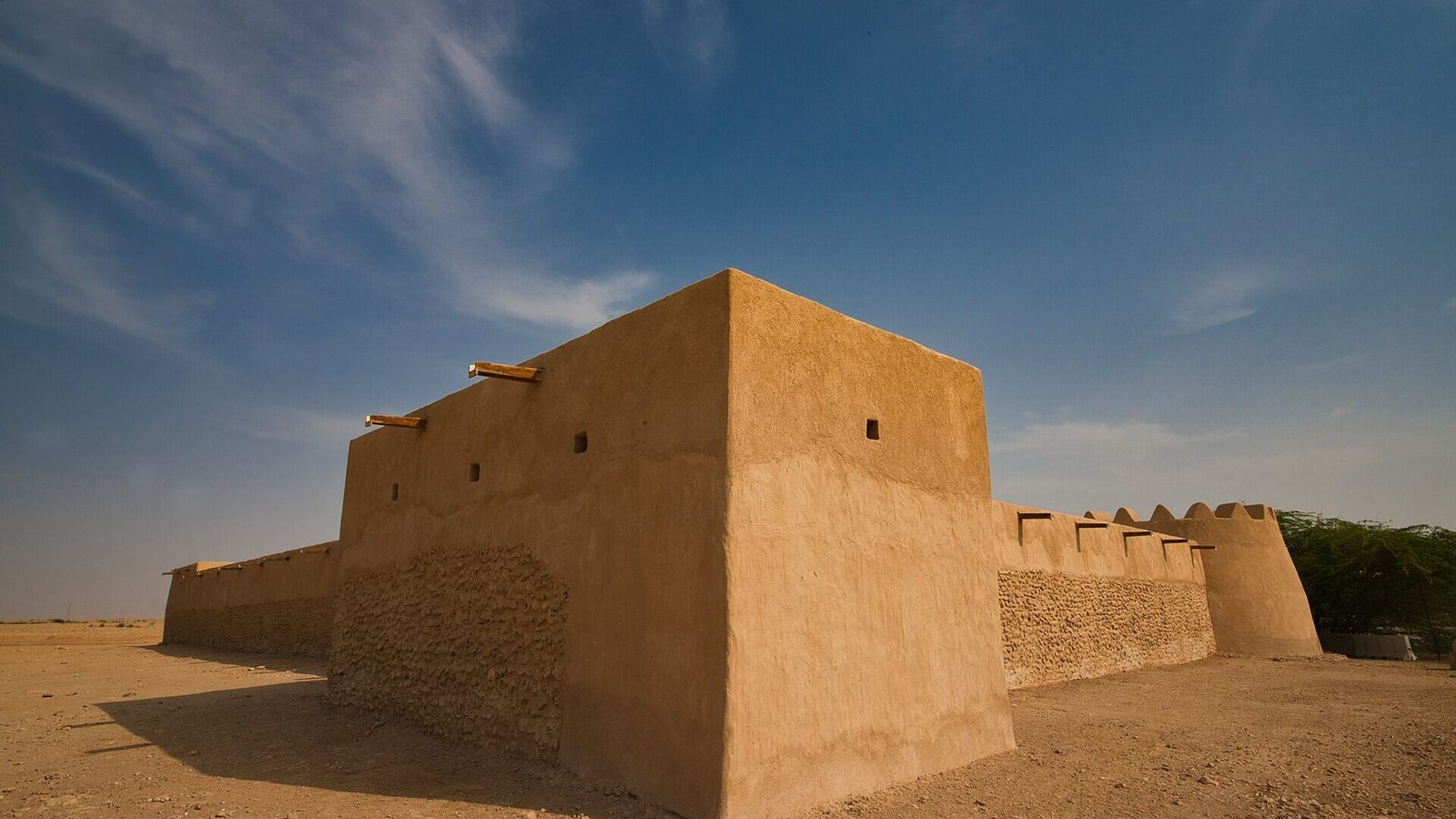
Al Rakiyat Fort is a small, low, sand-coloured stronghold in the flat country of north-west Qatar, between Al Zubarah and Madinat Al Shamal. It was built to guard a precious resource in this dry landscape: fresh water. The name comes from the Arabic for “well”, and the fort sits beside the remains of an abandoned village of the same name.
Compared with Al Zubarah Fort, it is modest, barely three metres high at its tallest, with a simple courtyard, three square towers and one round one. That is what makes it appealing. You can take in the whole building at a glance and imagine a small garrison living here, drawing water and watching the empty plain.
Check access before you go. After a major restoration finished in 2021, the fort was presented as ready for visitors, and Visit Qatar still lists it as open with free entry. However, Qatar Museums, which manages the site, currently lists Al Rekayat Fort (its official spelling) as temporarily closed until further notice. This guide explains what the fort is, what you can realistically see if the gate is shut, and how to fit it into a wider trip to the north. It suits fort enthusiasts, photographers and anyone already heading to Al Zubarah.
History and background
Nobody knows exactly when Al Rakiyat Fort was built. Qatar Museums suggests it was probably constructed in the mid-18th century, while other accounts place it in the 19th century, and press coverage of the restoration spoke of a date somewhere between the 17th and 19th centuries. What is clear is that it belongs to the period when the north-west coast was at its busiest, with Al Zubarah and a string of smaller settlements trading and pearling along the shore.
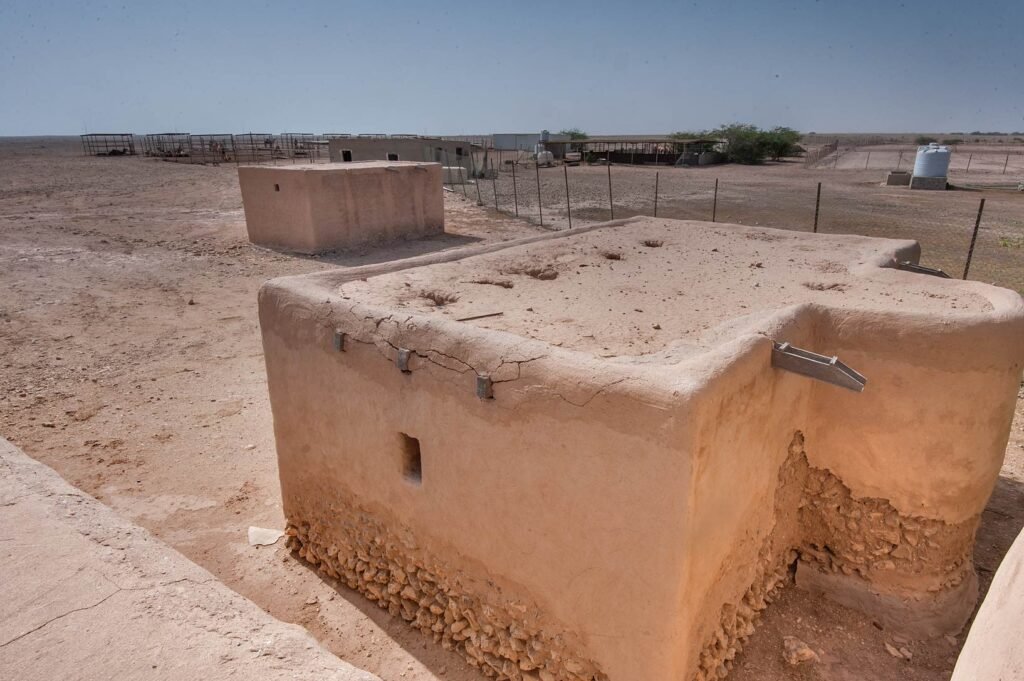
Coastal towns needed fresh water, and in northern Qatar that meant wells inland. Forts like Al Rakiyat protected those wells and the people and animals who depended on them. Wikipedia’s account notes that the fort was lived in until the 20th century, and a small stone mosque stands just to the south-west. Around it lie the ruins of the old village of Ar Rakiyat, and the abandoned settlements of Al Khuwayr and Freiha are within a few kilometres.
Qatar’s antiquities department excavated the fort in 1988 and carried out a first restoration. A coin from the early Abbasid period was found during that work, but it is not taken as proof that the fort itself is that old; coins travelled and were kept for generations. Wind, salt and heat took their toll in the following decades.
Between October 2020 and September 2021 Qatar Museums’ architectural conservation team carried out a second, more thorough restoration, announced in early 2022. They used traditional building methods and materials, redid the plaster and floors, installed wooden ceilings and new doors, and treated the structure against pests. Solar-powered lighting was added outside, and a separate service building was put up nearby so that the fort itself did not have to be altered. In 2021 the fort was also added to ISESCO’s Islamic World Heritage List alongside Barzan Towers and another Qatari site.
What to see and do
The outer walls and towers
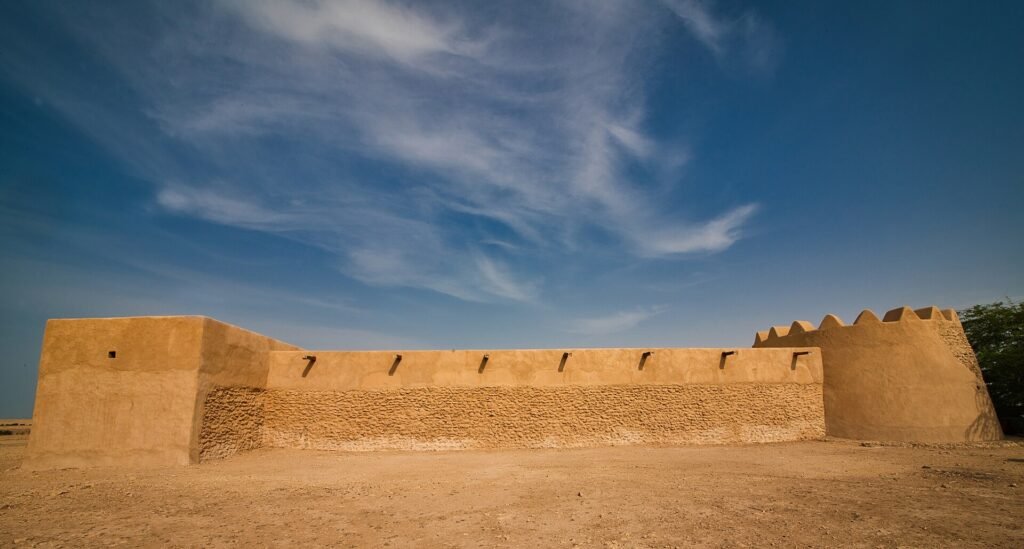
The fort is a rectangle of roughly 22 by 38 metres, according to Wikipedia’s description of the site. Three of its corner towers are rectangular and one is cylindrical, which gives the building a lopsided, handmade look that is typical of Qatar’s smaller forts. There are no decorative flourishes at all, just thick plastered walls, a parapet and small openings. Walk right around the outside: this is the part you can appreciate even when the site is closed.
The single southern gate
There is only one way in, through a doorway in the southern wall. A single entrance was a basic defensive choice. It meant that anyone arriving could be seen, stopped and questioned before they reached the courtyard. Stand back from it to photograph the gate with the round tower at the corner behind it.
The courtyard and living rooms (if open)
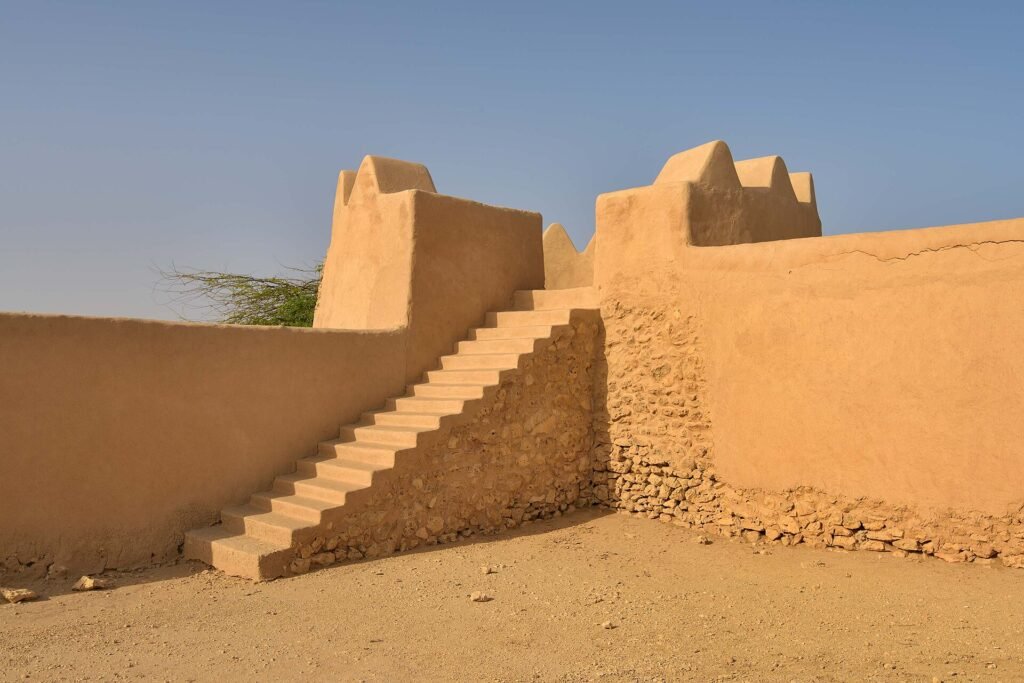
Inside, narrow, windowless rooms line the northern, eastern and western sides of an open courtyard. They were living and storage spaces for the small garrison. A date press was found in the courtyard during excavation, a reminder that dates were a staple food and a source of syrup. Staircases lead up to the roof and the round tower, and the restoration reinstated wooden ceilings in the traditional way.
Building materials up close
Look at how the walls are made. The lower parts are limestone bound with mud, while the upper sections were built with lubnah, a mixture of mud and clay formed into bricks. The restoration team used the same kinds of traditional materials, so what you see is a fair picture of how the fort would have looked when it was in use.
The small mosque and the village ruins
Just south-west of the fort is a small stone mosque, and the low ruins of Ar Rakiyat village are scattered nearby. Together they show that the fort was not an isolated military post but the heart of a small community built around its water. Keep to the edges and do not climb on any walls.
Golden-hour photography
Because the fort is so low and the land so flat, it looks best in low light, when the plaster turns amber and long shadows pick out the towers and parapet. Late afternoon in winter is ideal. A wide lens helps you capture the building against a big desert sky.
How to get there
Al Rakiyat Fort is in the municipality of Al Shamal, about 110 to 116 km from central Doha. Visit Qatar puts the drive at around 1 hour 20 minutes via Al Shamal Road.
- From Doha, drive north on Al Shamal Road towards Madinat Al Shamal.
- At the Madinat Al Shamal roundabouts, head west on the road towards Al Zubarah, which runs through the flat country behind the north-west coast.
- Use a map pin to find the turning for the fort. The fort is at approximately 26.0513, 51.1304, roughly 12 km north-east of Al Zubarah Fort as the crow flies.
You can also come the other way, from Al Zubarah, which makes sense if you are visiting the UNESCO site first. The main roads are paved. Visitor reports are limited on the final approach, so drive slowly on any unmade section and keep off soft sand; a normal car should manage in dry weather.
There is no public transport. A taxi from Doha is possible but you would need to arrange the return journey in advance. If you prefer not to drive, look for northern heritage tours from Doha and ask whether the fort is included and whether it is currently open.
Best time to visit
November to March is the season for the north. From late spring onwards the heat on this open plain is intense, and there is no shade outside the fort walls.
If the site reopens, its published hours when open have been Saturday to Thursday 9am to 5pm and Friday 12.30pm to 5pm. For photographs from outside, late afternoon gives the warmest light on the plaster. Early morning is quieter and cooler.
Weekdays are very quiet here. Even on winter weekends you are unlikely to meet many other visitors, as most day-trippers stop only at Al Zubarah.
Tips for your visit
- Check the status first. Qatar Museums lists the fort as temporarily closed. Look at the Qatar Museums heritage sites page on the day you plan to go.
- Do not enter if it is shut. If the gate is locked or the site is fenced, view it from outside and move on.
- Treat it as part of a loop. On its own it is a long drive for a short stop, but it adds real interest to a day at Al Zubarah and Al Ruwais.
- Leave no trace. Do not pick up pottery or stones from the village ruins; they are part of the archaeological site.
- Do not climb the walls. The new plaster is traditional and soft, and it is easily damaged.
- Park considerately. Keep your car on hard ground away from the walls and the mosque.
- Carry everything you need. There are no shops or cafés at the fort. Madinat Al Shamal and Al Ruwais are the nearest places for supplies.
What to bring
- Plenty of water
- Hat, sunglasses and sunscreen
- Sturdy shoes for stony ground
- A wide-angle lens, or a zoom if you are shooting from outside the boundary
- Offline maps with the fort pinned
- Snacks for the road
Combine it with nearby places
Al Zubarah Fort and Archaeological Site. The UNESCO-listed pearling town and its 1938 fort are a short drive away. This is the north-west site you can reliably visit, with displays, a shuttle to the ruins and set opening hours.
Al Thaqab Fort. Another small restored fort, only about 2.5 km from Al Rakiyat. It is a natural second stop to compare two very different desert fort designs.
Al Jumail Abandoned Village. A ruined fishing and pearling village on the coast to the north, with a standing minaret. It is closed to the public, but its outline and mosque can be seen from outside the fence.
Al Ruwais Mosque and Old Port. At the end of Al Shamal Road, the historic mosque, the restored 1955 police station and a harbour café make a relaxed final stop.
Frequently asked questions
Is Al Rakiyat Fort open to the public?
Qatar Museums currently lists Al Rekayat Fort as temporarily closed until further notice, although Visit Qatar still shows it as open. Check the Qatar Museums website before travelling. If it is closed, you can look at the exterior from outside the boundary.
Is there an entrance fee?
No. Both Qatar Museums and Visit Qatar list the fort as free, with no ticket required, when it is open.
How old is Al Rakiyat Fort?
Its exact age is not known. Qatar Museums suggests the mid-18th century, while other sources give the 19th century. It was restored in 1988 and again between 2020 and 2021.
Why was the fort built?
To protect a freshwater source. The name comes from the Arabic word for a well, and forts like this guarded the water that coastal settlements in the north depended on.
Is it spelt Rakiyat or Rekayat?
Both, and you will also see Rakayat and Ar Rakiyat. Qatar Museums uses Al Rekayat Fort; Wikipedia uses Ar Rakiyat Fort.
How far is it from Doha?
About 110 to 116 km, or roughly 1 hour 20 minutes by car via Al Shamal Road.
Last checked October 2026. Hours, fees and access can change, so confirm with the official source before you go.
More places nearby
All places →
Run a tour, café or stay near Al Rakiyat Fort, Al Shamal?
List your business free on Companies in Qatar, or get featured on Qatar Unseen in front of people planning their trip.