Education City Mosque (Minaretein), Al Rayyan
A free, welcoming modern mosque with two 90-metre calligraphy minarets. How to visit respectfully: timing, dress, photos and tours.
Minaretein, Georgetown Access Rd, Education City, Al Rayyan
Overview
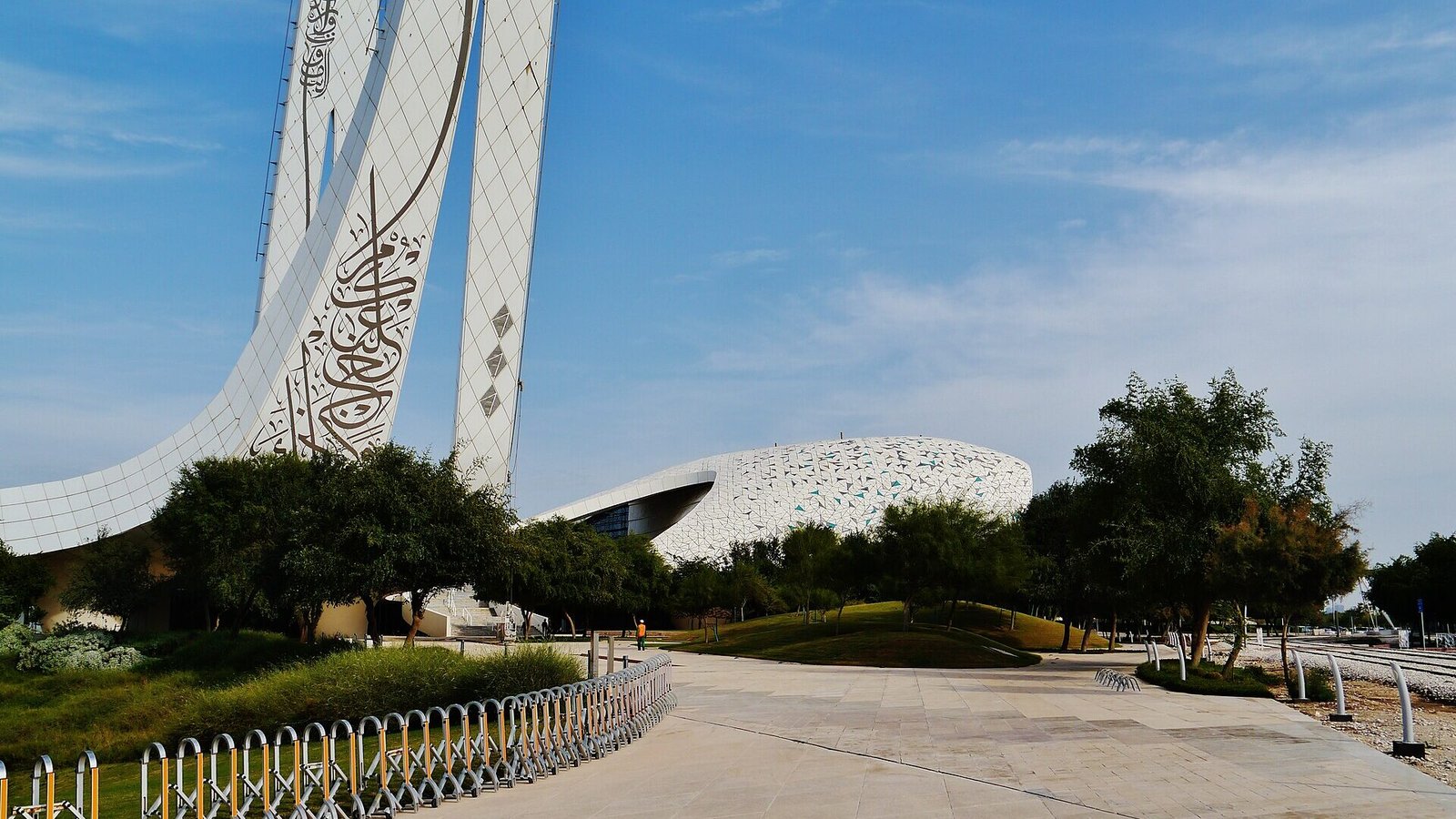
The Education City Mosque is the building most people mean when they talk about “the mosque with the two tall minarets” on the western side of Doha. It sits inside the Minaretein complex in Education City, the Qatar Foundation campus in Al Rayyan, and it is one of the few places in Qatar where a non-Muslim visitor can walk into a working mosque on their own, without booking and without paying.
That freedom is exactly why this guide is written the way it is. Most people who come here are not unsure about the architecture; they are unsure about the etiquette. What should I wear? Can I go in during prayers? Is it all right to take photos? Where do women go? Below you will find straight answers to those questions first, then a walk through the building itself, so you can enjoy a striking piece of modern design without feeling like an intruder.
It suits architecture lovers, photographers, students of Islamic art, families with older children and anyone who has never set foot inside a mosque and would like a calm, welcoming first experience. Allow around an hour, or longer if you join one of the free guided tours.
The story behind the mosque
The mosque was designed by the London and Barcelona practice Mangera Yvars Architects for Qatar Foundation, as part of the building that houses what is now the College of Islamic Studies at Hamad Bin Khalifa University. The idea behind the project draws on the traditional Islamic kulliyya, a complex where worship and learning sit side by side, expressing the view that knowledge flows from faith. The mosque opened in 2015, and the wider building is now run as the Minaretein Center, which organises lectures, Arabic and Qur’an classes, community programmes and guided tours.
Architect Ali Mangera has said the aim was a very contemporary building that shows Islam and modernity are compatible, while keeping enough traditional elements to speak to more conservative worshippers. You can see that balance everywhere: a smooth white structure that would look at home in a design magazine, but organised around the five pillars of Islam and covered in Qur’anic text.
The calligraphy was created by Iraqi architect and calligrapher Taha Al Hiti, who chose to run the verses vertically up the minarets rather than in the usual horizontal bands. He has described wanting your eye to travel from the ground upwards to the sky. In 2015 the building won Best Religious Building at the World Architecture Festival, and it was later nominated for a RIBA international award.
Visiting as a non-Muslim: the essentials
The Minaretein Center states that general visits need no booking and no fee, and that the mosque is open daily from the dawn (Fajr) prayer until 10pm, subject to operational needs. In practice, the only thing that really shapes your visit is the prayer timetable.
Time your visit around prayers
The five daily prayers move a little every day with the sun, so check a prayer-time app or website on the morning you go. The centre’s own advice is to arrive about 30 minutes before a prayer, or at least 40 minutes after it begins, so you are not in the main hall while it is full. During prayers, access to the prayer hall may be limited, and you should never walk in front of people who are praying. Friday around midday is the busiest time of the week, because of the congregational Friday prayer; leave that slot to worshippers.
What to wear
The centre asks visitors to follow an appropriate dress code. For everyone, that means loose clothing that covers shoulders, arms and legs to below the knee; avoid shorts, sleeveless tops, tight or see-through clothes. Women should bring a scarf to cover their hair before entering the prayer areas. Do not count on borrowing a robe or scarf at the door; come prepared.
Shoes, sound and behaviour
Shoes come off before you step onto the prayer carpet; look for the shoe racks and follow what others do. Inside, keep your voice low, switch your phone to silent and do not eat or drink. Children are welcome, but this is not a place for running about. If someone is reading the Qur’an or praying on their own, give them space.
Where women go
Women are welcome. The women’s prayer area is on the upper level, reached by a sculptural spiral staircase that is worth seeing in itself. Female visitors may be directed there, particularly around prayer times.
Photography etiquette
Photographing the building is generally fine, and the exterior is one of the most photographed in Qatar. Inside, be discreet: no flash, no tripods without permission, and never photograph people while they pray. If you want a shot that includes a person, ask first. If a member of staff asks you to put the camera away, do so without argument.
What to see and do
The two minarets
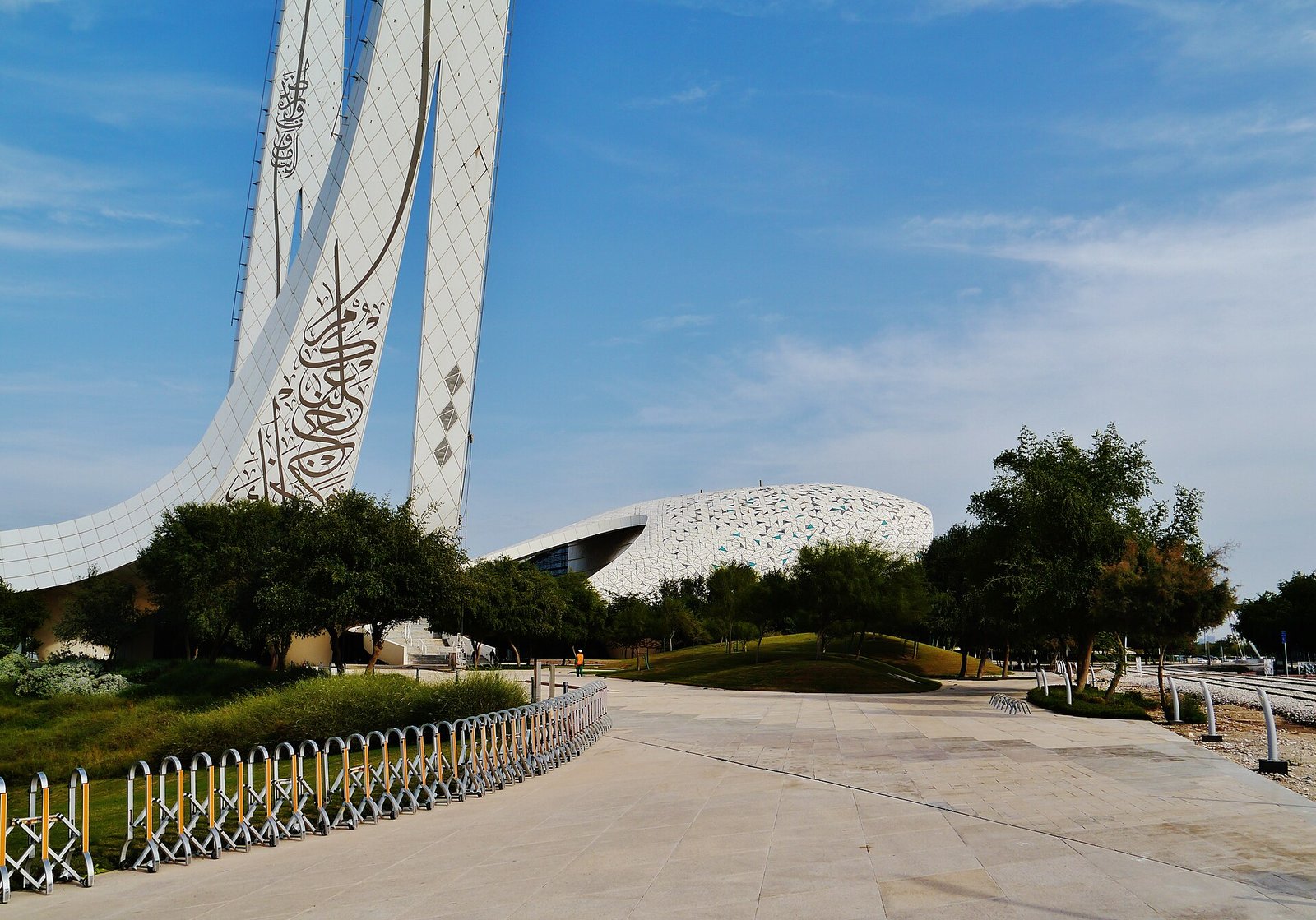
The minarets give the building its name: Minaretein means “two minarets” in Arabic. Each rises to about 90 metres, tapering as it climbs and wrapped in Al Hiti’s vertical calligraphy. Stand back on the approach path or the lawns to take in their full height, then walk close to the base and look straight up; the lettering seems to stream skywards, which is exactly the effect the calligrapher wanted.
The five pillars
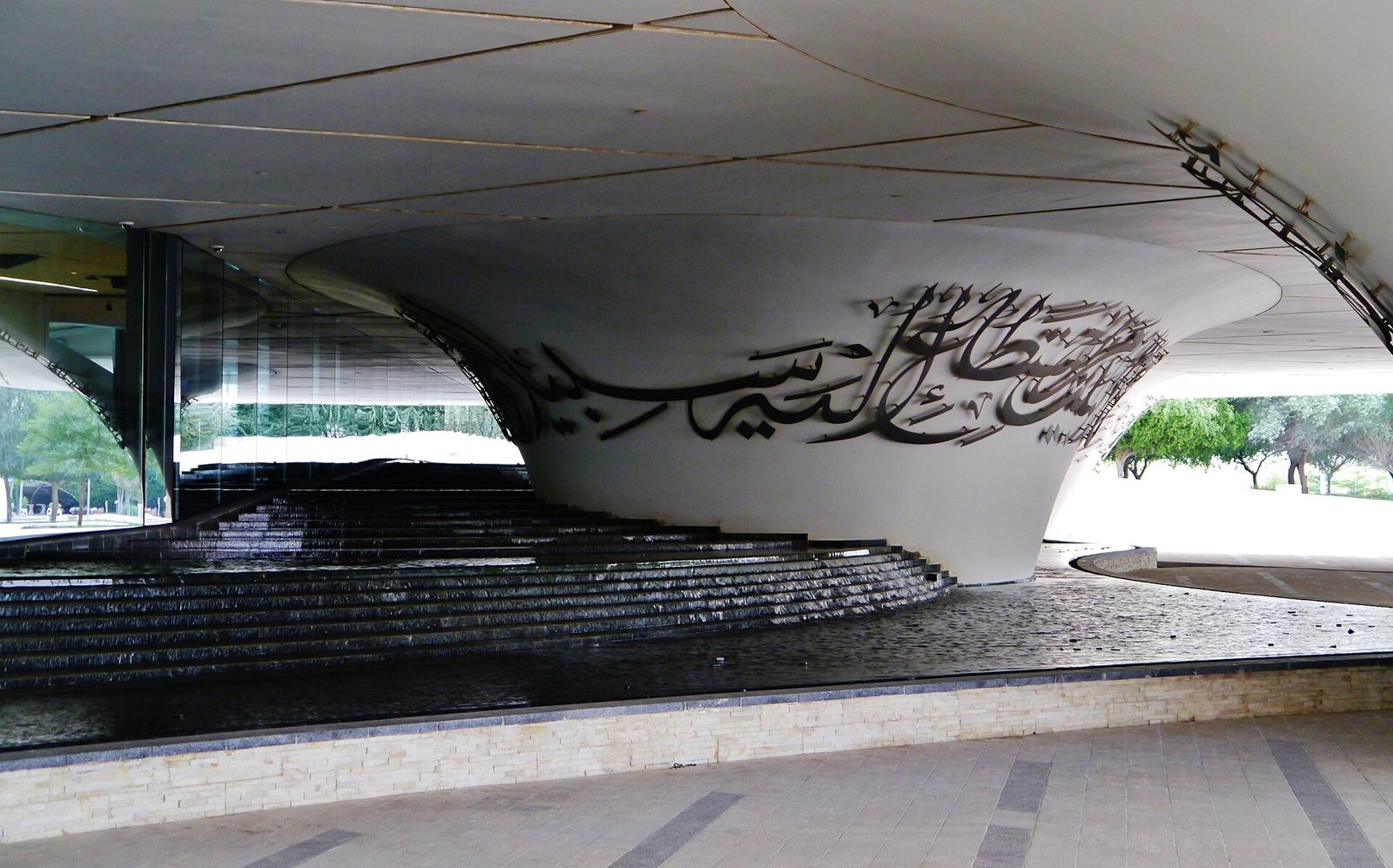
The prayer hall is lifted on five large columns, each standing for one of the five pillars of Islam: the declaration of faith, prayer, charity, fasting and pilgrimage. Each column carries a Qur’anic verse. Walking among them at ground level, under the raised hall, is one of the most memorable parts of a visit, with deep shade, cool air and calligraphy arching overhead.
Water beneath the hall
Under the mosque, water runs through shallow basins and a multi-storey ablution cascade. It is functional, used for ritual washing before prayer, and it also helps cool the spaces around it passively, a simple passive-cooling idea that works well in this climate. The reflections of calligraphy and white curves in the water make this area a favourite with photographers in soft afternoon light.
The prayer hall
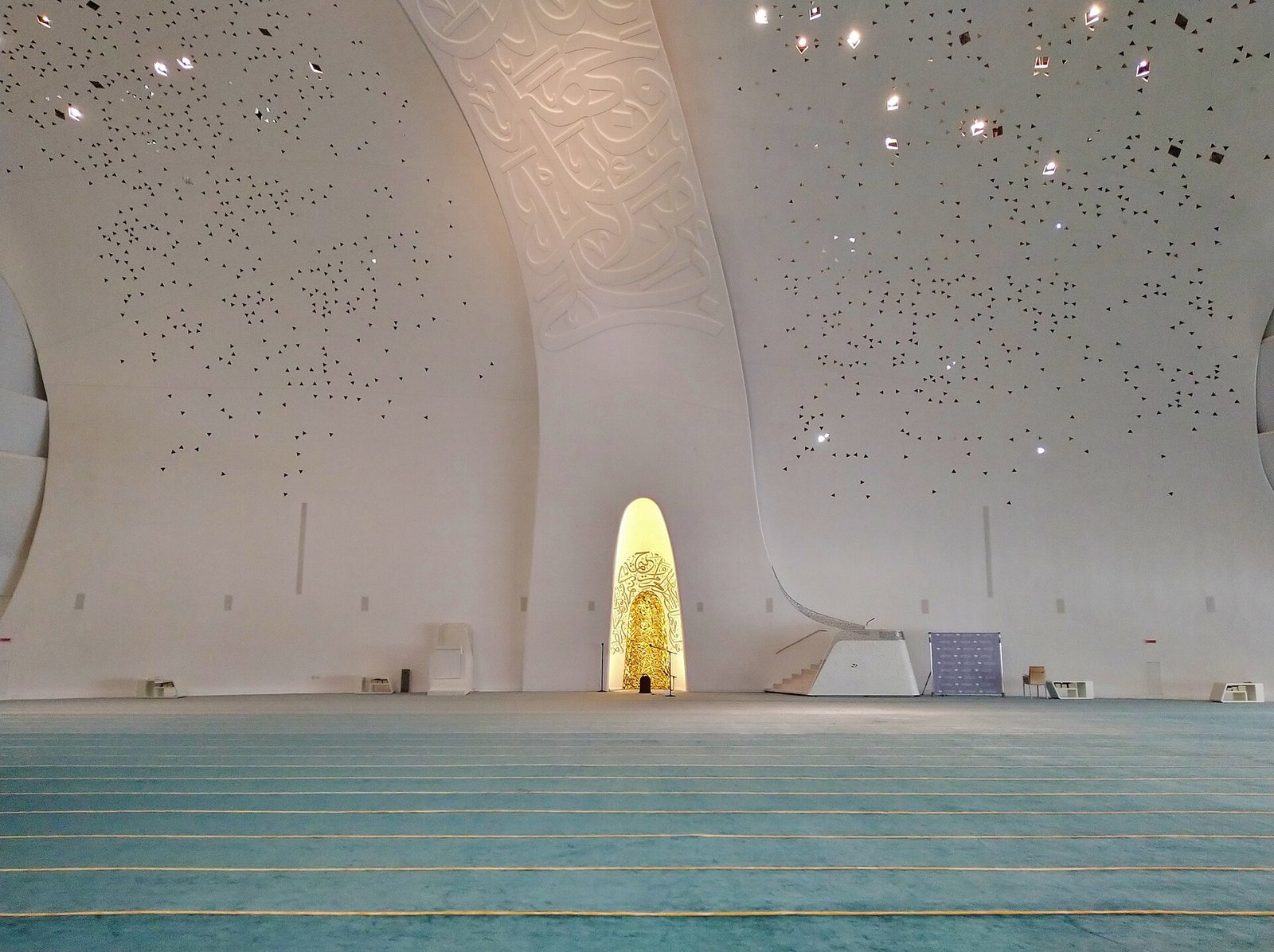
The main hall is column-free, a single sweeping white space that holds around 1,800 worshippers, with room for about 1,000 more in the courtyards. Small openings and soft lights in the ceiling are arranged with calligraphy, and the glowing mihrab, the niche showing the direction of Mecca, draws the eye to the far wall. The predominance of white is deliberate; it recalls the simple white garments worn by pilgrims in Mecca. Sit quietly at the back for a few minutes before you move on; the hush and the light are the point.
Courtyards and gardens
Two open-air courtyards, the Terrace and the Garden Courtyards, extend the prayer space outdoors, with ethical verses displayed on curved glass. Around the complex are four themed gardens, named the Gardens of Light, Scent, Art and Knowledge, designed for slow walks and reflection. Look out too for the series of 99 relief panels showing Islamic architecture from around the world; it is easy to rush past them.
Marhabtein guided tours
If you want the symbolism explained properly, join a Marhabtein tour, the centre’s guided visit covering the mosque’s architecture, symbolism and history. Tours run on set dates listed on the Minaretein Center website and need registration; for example, one is scheduled for 10 October 2026 from 12.30pm to 2pm. Schools and private groups can arrange a visit by emailing ecmosque@qf.org.qa or messaging the centre on WhatsApp (+974 3029 5541).
How to get there
The mosque stands on Georgetown Access Road in the middle of Education City, in Al Rayyan, on the western side of Doha. By car from West Bay or the Corniche, follow Al Luqta Street or Dukhan Road west; allow roughly 20 to 30 minutes outside rush hour. The roads are ordinary city streets, so any car is fine. Visitors can use the Education City Mosque car park, which is also the official parking for the neighbouring Qur’anic Botanic Garden. Keep to the low campus speed limits.
By metro, take the Green Line to Qatar National Library station. From there it is roughly a 12-minute walk through landscaped campus paths, or you can ride the free Education City tram, which links stops across the campus. Taxis and ride-hailing apps know the mosque as “Education City Mosque” or “Minaretein”.
You do not need a tour company to visit; if you want a guide, the Marhabtein tours run by the mosque itself are the best option.
Best time to visit
The mosque is open all year, but the outdoor parts of the visit, the gardens, courtyards and the walk from the metro, are far more pleasant from October to April. In summer, come early in the morning or after sunset, and save the outdoor wandering for last.
For photographs, late afternoon gives warm light on the white surfaces and long shadows from the minarets. After dark the campus is cooler and quieter, but remember that the evening prayers (Maghrib and Isha) fall in this window, so plan around them. Weekday mornings tend to be quietest. Avoid Friday midday and, during Ramadan, the busy evening prayer times unless you have come to observe them respectfully.
Tips for your visit
- Check the day’s prayer times before you set off; aim to arrive 30 minutes before a prayer or 40 minutes after it starts.
- Dress modestly in loose clothing, and women should carry a scarf for their hair.
- Wear shoes that slip on and off easily; you will remove them several times.
- Keep phones on silent and voices low, and never walk in front of someone praying.
- Ask before photographing people, and do not use flash inside.
- If you want to understand the symbolism, register for a Marhabtein tour rather than wandering alone.
- Bring water for the walk from the metro or the car park, especially from May to September.
- For questions about programmes or group visits, the Minaretein Center lists office hours of Sunday to Thursday, 7.30am to 3.30pm (+974 4454 6600).
What to bring
- A scarf (women) and clothes that cover arms and legs
- Slip-on shoes and clean socks
- Water and sun protection for the outdoor areas
- A camera or phone with flash turned off
Combine it with nearby places
- Qur’anic Botanic Garden. Right next to the Minaretein complex and open daily from 7am to 11pm, it grows plants mentioned in the Qur’an and Hadith, a natural follow-up to the mosque.
- Qatar National Library. Rem Koolhaas’s library is a short walk or tram ride away. Free to enter, it is the perfect air-conditioned stop on a hot day.
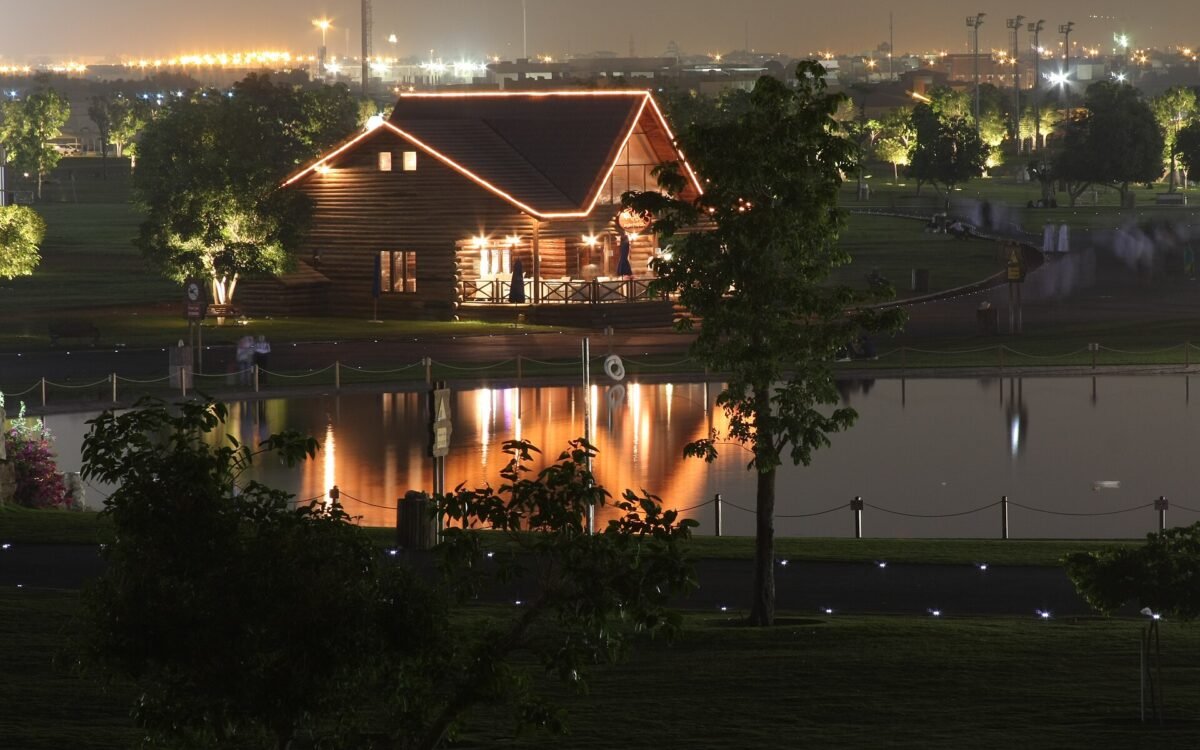
- Oxygen Park. A design-led park in Education City with shaded walking loops and water features, best in the cool of the evening.
- Lawh Wa Qalam: M. F. Husain Museum. Education City’s free museum dedicated to the Indian modernist painter, a few minutes’ drive away.
- Al Shaqab Equestrian Centre. Qatar’s flagship Arabian horse centre sits on the edge of Education City; tours are by arrangement.
- State Grand Mosque. Qatar’s largest mosque, with its rows of small domes and sandstone arcades, is a traditional counterpoint to Minaretein’s contemporary design, a short drive east towards West Bay.
For more ideas that cost nothing, see our guide to free things to do in Qatar, or browse more hidden gems in Doha.
Frequently asked questions
Can non-Muslims visit the Education City Mosque?
Yes. Visitors of all backgrounds are welcome. General visits need no booking, but plan around prayer times, when access to the main hall may be limited.
Is there an entry fee?
No. General visits are free. The guided Marhabtein tours also need registration in advance through the Minaretein Center.
What are the opening hours?
The mosque is open daily from the dawn prayer until 10pm, subject to operational requirements. The best windows are about 30 minutes before a prayer or 40 minutes after it begins.
What should I wear?
Loose, modest clothing that covers shoulders, arms and legs. Women should cover their hair with a scarf in the prayer areas. Shoes are removed before entering the prayer hall.
Can I take photos inside?
Discreet photography of the building is generally accepted, but never photograph people praying, avoid flash and follow any instructions from staff.
How tall are the minarets?
Each of the two minarets is about 90 metres tall and covered in vertical Qur’anic calligraphy by Taha Al Hiti.
What is the nearest metro station?
Qatar National Library on the Green Line. From there it is about a 12-minute walk, or you can use the free Education City tram.
Last checked October 2026. Hours, fees and access can change, so confirm with the official source before you go.
Read the Companies in Qatar visitor guide ↗
More places nearby
All places →
Run a tour, café or stay near Education City Mosque (Minaretein), Al Rayyan?
List your business free on Companies in Qatar, or get featured on Qatar Unseen in front of people planning their trip.