Mathaf: Arab Museum of Modern Art, Education City
Free museum of modern Arab art in Education City, with 9,000+ works. Next show opens 25 Oct 2026; how to time your visit and what to pair it with.
Umm Thenaitain Street, Education City, Al Rayyan
Overview
Visiting in October 2026? Mathaf’s spring exhibitions have closed and the museum is between seasons. Its next major exhibition, on the Baghdad Modern Art Group, opens on 25 October 2026. Before then, check the website for film screenings and talks, and confirm what is open before you travel.
Mathaf (the word simply means “museum” in Arabic) is the place to understand how modern art developed across the Arab world. Its collection, built from the private holdings of Sheikh Hassan bin Mohamed bin Ali Al Thani, runs to more than 9,000 works dating from the 1840s to the present, and it is often described as the largest collection of modern and contemporary Arab art anywhere.
Unlike the big landmark museums on the Corniche, Mathaf is low-key and compact. It occupies a converted school building on the Education City campus in Al Rayyan, west of central Doha, and what you see depends heavily on the current exhibition programme. When a season is running it is one of the most thought-provoking cultural stops in Qatar; between seasons there may be little on show, so timing matters more here than at any other Qatar Museums venue.
Entry is free for everyone, though you need a ticket. Mathaf suits art lovers, students, anyone curious about the 20th-century history of the Arab world, and visitors who prefer a quiet hour with a few strong works to a marathon through a vast collection.
History and background
Sheikh Hassan, a member of Qatar’s ruling family and an artist himself, began collecting Arab art in the early 1990s, when few museums anywhere were paying attention to it. He was interested in artists who had been overlooked outside their home countries, and his collection grew through friendships and support for artists across the region. The works were first kept in private villas before the idea of a public museum took shape.
Mathaf opened on 30 December 2010 as a joint project of Qatar Museums and Qatar Foundation. The French architect Jean-François Bodin turned a former school in Education City into galleries of around 5,500 square metres, with plain white rooms that let the art do the talking. Its opening shows, including Sajjil: A Century of Modern Art, set the tone for an institution that mixes scholarship on early modernists with new work by living artists.
The museum marked its 15th anniversary in the 2025–26 season with two exhibitions: Resolutions, which looked back at Mathaf’s founding vision through the collection, and we refuse_d, a contemporary show of 15 artists curated by Nadia Radwan and Vasıf Kortun. Both have now closed.

What to see and do
The autumn 2026 exhibition: the Baghdad Modern Art Group
From 25 October 2026 to 6 February 2027 Mathaf presents What Lingers in the Artist Mind: Experiments and Legacies of the Baghdad Modern Art Group. The group, formed in Baghdad in 1951 around Jewad Selim and Shakir Hassan Al Said, tried to build a modern art that was rooted in Iraq’s own history rather than borrowed from Europe, and it shaped Iraqi art for decades.
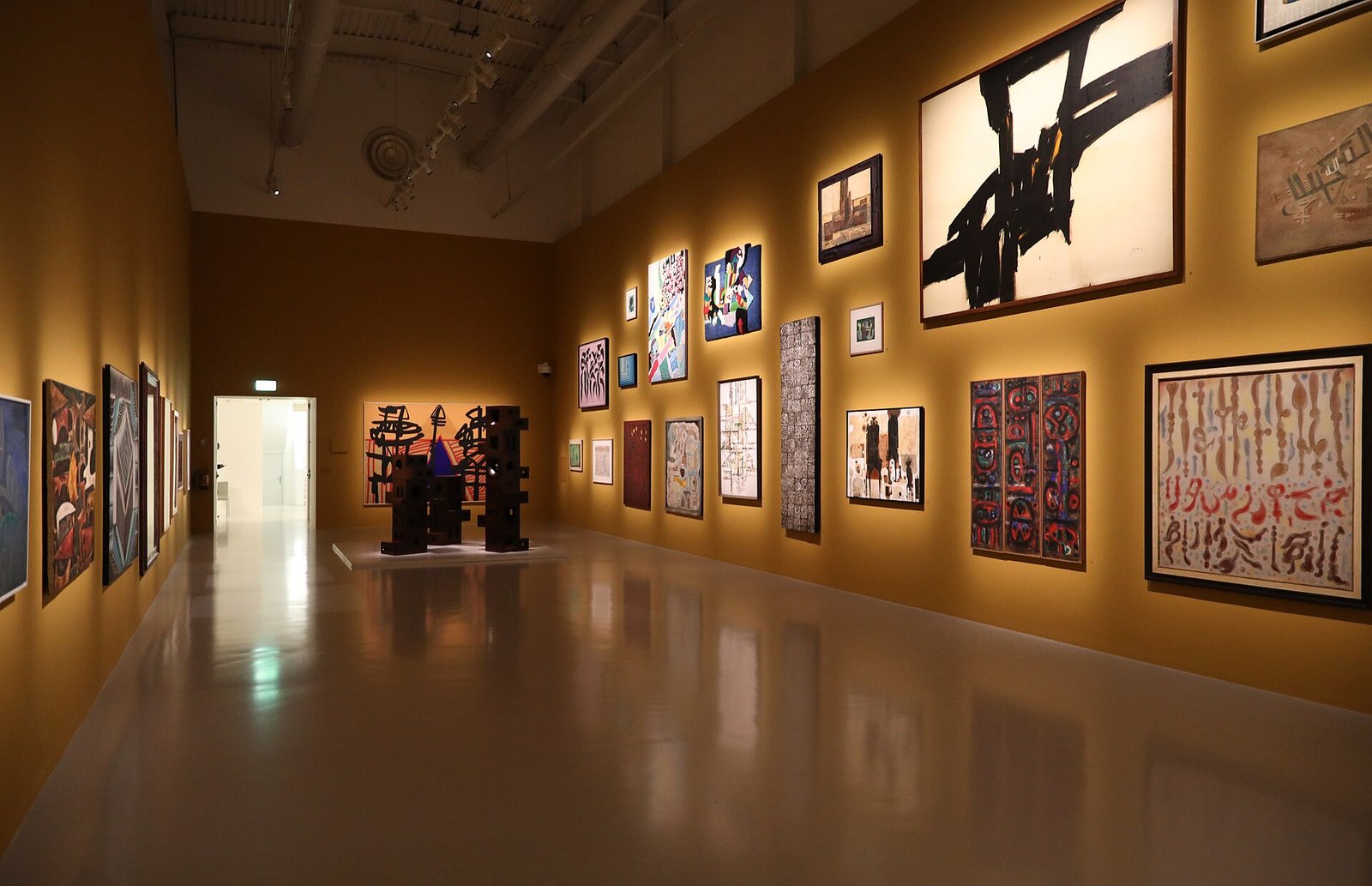
The show is organised in 17 thematic sections running from the 1940s to the present, with paintings, sculpture, sketches, photographs and archive material. Works announced for it include Jewad Selim’s Children’s Games (1953) and Baghdadiat (1956), and a 1959 preparatory sketch for Baghdad’s Freedom Monument shown alongside Mohammed Ghani Hikmat’s bronze maquette for the same landmark. Other artists include Naziha Selim, Lorna Selim, Faraj Abbo, Faiq Hassan, Khalid Al Rahal, Kadhim Haidar and Dia Al Azzawi.
If you have any interest in the modern history of the Middle East, this is one to plan a visit around. Allow at least an hour and a half; there is a lot of archive material that is easy to rush.
The collection and the story of Arab modernism
Mathaf’s permanent collection is shown through changing displays rather than a fixed hang, so you will not always see the same works. It spans the pioneers of the late 19th and early 20th centuries, such as the Iraqi painter Abdul Qadir Al Rassam and the Lebanese painter Daoud Corm, through the mid-century modernists of Cairo, Baghdad, Beirut and North Africa, to contemporary artists working today. Even a short visit gives a sense of how artists in different Arab cities wrestled with tradition, colonial history, independence and identity.
A first-timer’s way in
If modern Arab art is new to you, do not try to absorb every name. Pick three or four works that stop you, then read their labels closely: who made them, in which city and in what year. Patterns appear quickly. You will notice artists returning to calligraphy, folk motifs and ancient Mesopotamian or Pharaonic forms, and you will see how political turning points such as independence movements and wars show up in subject matter and style.
It also helps to start with the introductory text panel of each exhibition, which usually sets out the curators’ argument, and to finish with any archive cases of letters, catalogues and photographs. These small documents often tell you more about how artists in Baghdad, Cairo or Beirut knew each other than the paintings themselves.
Films, talks and events
Between and during exhibitions, Mathaf runs a public programme. In autumn 2026 this includes Mathaf in Motion, a series of film screenings for adults on selected days until 8 December 2026, and Fanoon artist talks on selected days in November. Check each event listing for timings, language and whether you need to register.
The building and its forecourt
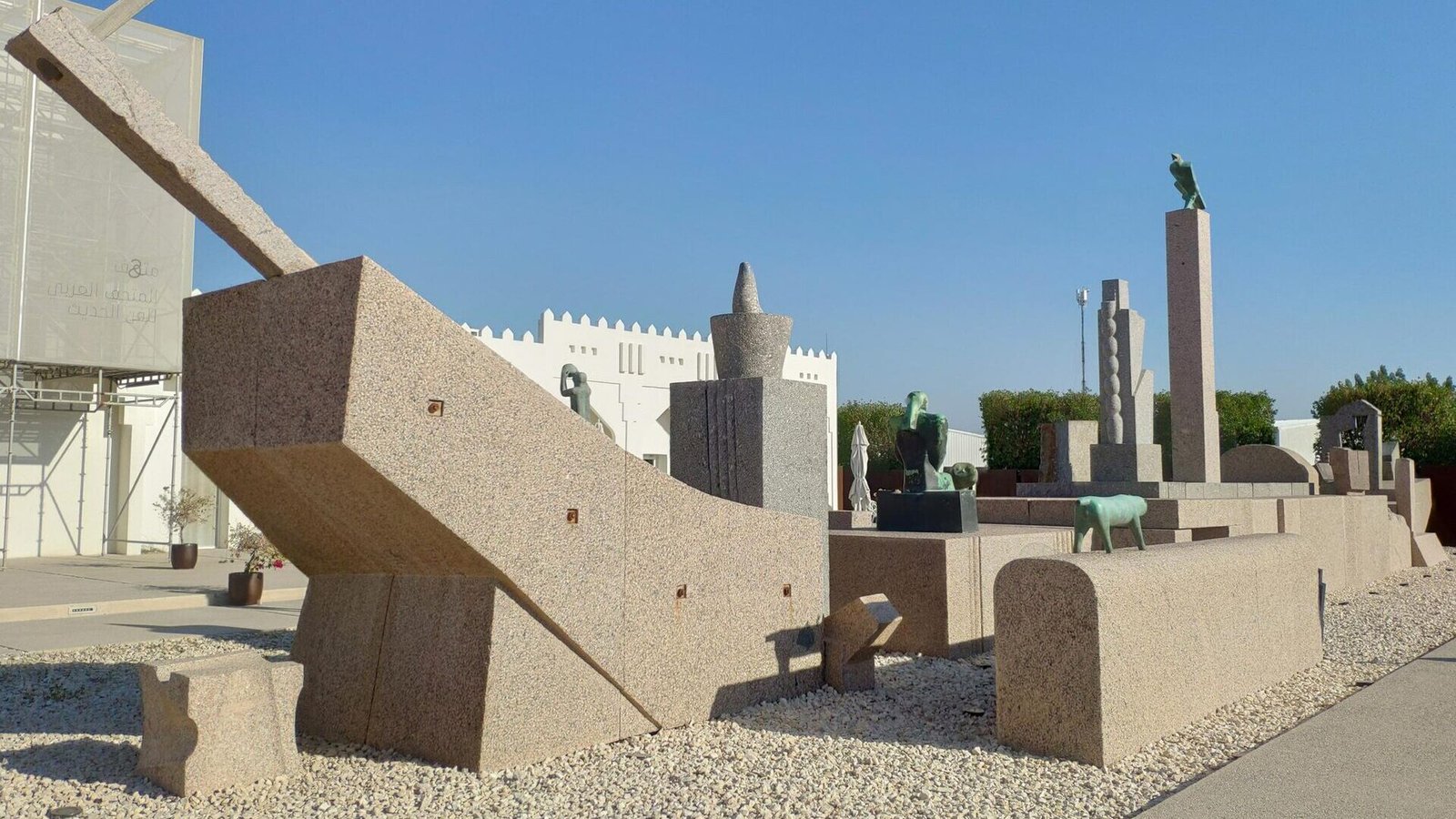
The museum’s conversion from a school is still easy to read: long, low wings, simple white galleries and a forecourt where large sculptures stand outside the entrance. It is not an architectural showpiece in the way MIA or the National Museum is, and that is part of its appeal; the building steps back and leaves the stage to the art.
Café, shop and audio guides
There is a Joe & The Juice café on site for coffee, juices and light food, and a museum shop with art books and gifts. Multilingual audio guides are available for the galleries. For a sit-down meal, you are better off at one of the Education City campus venues or heading back towards Doha.
Explore Education City around it
Mathaf sits inside Qatar Foundation’s Education City, a campus of university buildings, public art and landscaped spaces. A free tram loops around the campus, which makes it easy to string Mathaf together with the area’s other museums, parks and landmarks in one outing (see the suggestions below).
How to get there
Mathaf is on Umm Thenaitain Street in Education City, Al Rayyan, roughly 12 km west of the Corniche as the crow flies. Expect around 20 to 30 minutes by car from central Doha outside rush hour.
- By metro: take the Green Line to Education City station. The museum says the walk from there takes about 15 minutes; in the hotter months, use the campus tram instead.
- By tram: the free Education City tram links the metro station with stops across the campus. A route map can be downloaded from the Mathaf website.
- By car: the front car park has been closed for renovation, so check the museum’s website for the current alternative parking before you set off.
- By taxi or ride-hailing: ask for Mathaf in Education City. Sharing the map pin with your driver is the simplest way to arrive at the right entrance on a large campus.
Best time to visit
The single most important thing is to go when an exhibition is running. In the 2026–27 season that means from 25 October 2026, when the Baghdad Modern Art Group show opens, until it closes on 6 February 2027. Openings and the first weeks of a show often come with talks and tours.
Mathaf is closed on Mondays. It opens 9am to 7pm on Saturday, Sunday, Tuesday and Wednesday, 9am to 9pm on Thursday and 1:30pm to 7pm on Friday. Weekday mornings are the quietest, while Thursday’s late opening is handy after work. The galleries are air-conditioned, but if you plan to walk from the metro or explore the campus, November to March is far more comfortable.
Tips for your visit
- Book a free ticket online before you go. Entry to Mathaf and its special exhibitions is free for everyone, but tickets are required.
- Check the exhibition calendar first. Between seasons there may be little or nothing on display, which is the most common disappointment for visitors.
- Do not plan a Monday trip: Mathaf and the nearby M. F. Husain museum are both closed that day.
- Allow one to two hours for a full exhibition, more if you like reading wall texts and archive material.
- Dress modestly, with shoulders and knees covered, as at all Qatar Museums venues.
- Read the visitor guidelines on photography; rules can differ for loaned works in special exhibitions.
- Pick up an audio guide if you are new to Arab modern art, as it adds context the labels cannot.
- Parking arrangements have changed during renovation works, so check the website or come by metro and tram.
Combine it with nearby places
Lawh Wa Qalam: M. F. Husain Museum. A recent addition to Education City, this museum is devoted to the Indian modernist M. F. Husain and makes a natural partner to Mathaf. See our guide to Lawh Wa Qalam.
Oxygen Park. A landscaped park with walking and cycling paths at the heart of the campus. Read our Oxygen Park guide.
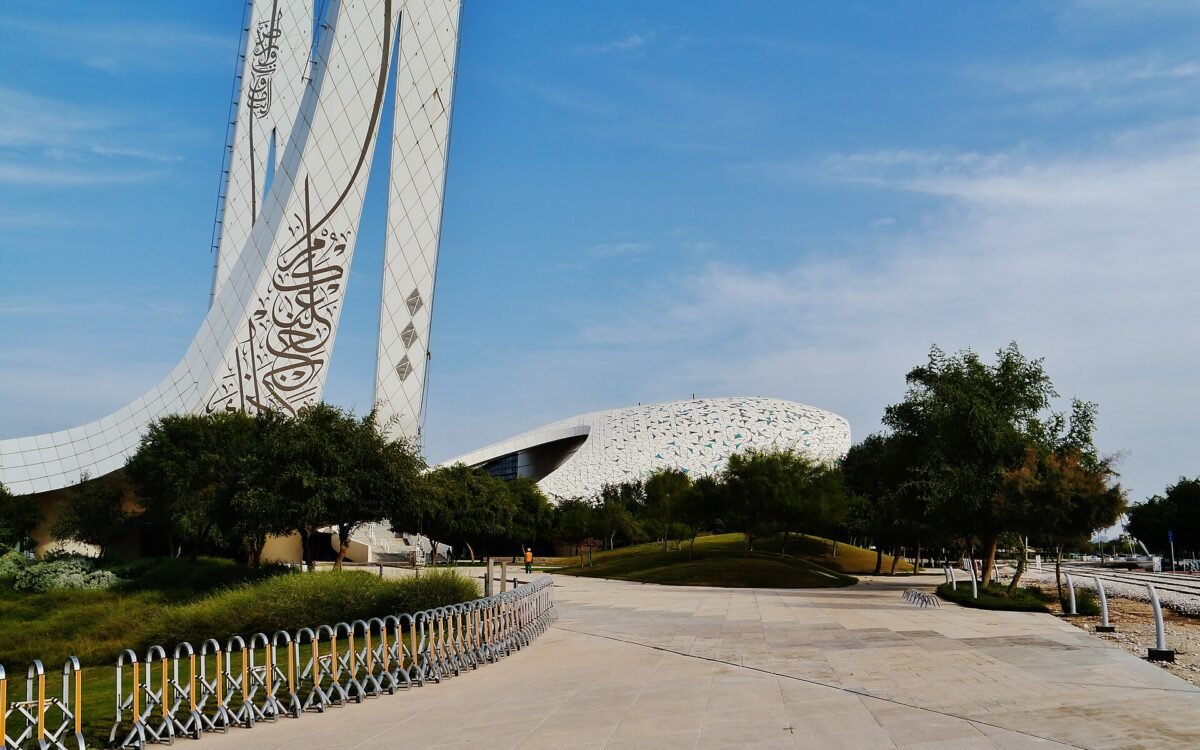
Education City Mosque and Qatar National Library. Two of the campus’s most striking buildings: the mosque with its pair of minarets, and the vast reading hall of the national library. See our guides to Education City Mosque and Qatar National Library.
Al Shaqab Equestrian Centre. Qatar’s flagship Arabian horse centre is also in Education City; tours are by arrangement. See Al Shaqab.
Aspire Zone. A short drive south, Aspire Zone has the 3-2-1 Qatar Olympic and Sports Museum and the green spaces of Aspire Park. For a fuller museum itinerary, see our guide to museums in Qatar.
Frequently asked questions
Is Mathaf free?
Yes. Entry to Mathaf and all its special exhibitions is free for everyone, but you need to book a ticket, which you can do online.
Is Mathaf open now?
As of early October 2026 the museum is between exhibition seasons, with the next major exhibition opening on 25 October 2026. Film screenings and talks continue on selected days. Check the official website before you go.
What day is Mathaf closed?
Mondays. Other days it opens 9am to 7pm, except Thursday (9am to 9pm) and Friday (1:30pm to 7pm).
Where exactly is Mathaf?
It is on Umm Thenaitain Street in Education City, Al Rayyan, on the western side of Doha. The nearest metro station is Education City on the Green Line.
What is in Mathaf’s collection?
More than 9,000 works of modern and contemporary Arab art, from the 1840s to today, begun as the private collection of Sheikh Hassan bin Mohamed bin Ali Al Thani. Works are shown in rotating displays and exhibitions.
How long should I spend at Mathaf?
One to two hours is enough for most visitors. Add time for the M. F. Husain museum or Oxygen Park nearby.
Last checked October 2026. Hours, fees and access can change, so confirm with the official source before you go.
Read the Companies in Qatar visitor guide ↗
More places nearby
All places →
Run a tour, café or stay near Mathaf: Arab Museum of Modern Art, Education City?
List your business free on Companies in Qatar, or get featured on Qatar Unseen in front of people planning their trip.