Souq Waqif is Doha’s old market and the one place almost every visitor to Qatar ends up. It sits in the centre of the city, a short walk from the Corniche, and is a maze of lanes lined with spice stalls, perfume shops, textile traders, cafés and restaurants, with a falcon market, horse stables, art galleries and a cluster of small heritage hotels folded in. It is free to enter, open every day and at its liveliest after dark.
What you see today is largely a careful reconstruction from the late 2000s, built on the site of a trading market that had stood by the old Wadi Musheireb for at least a century. That doesn’t make it a theme park. Qatari families shop here for oud, spices and abayas, falconers bring their birds in for advice and new hoods, and men gather on the benches to talk in the evening. It is a working souq that also happens to be Qatar’s best-known sight.
This guide covers the whole district: how it came to look the way it does, how the lanes and specialist souqs fit together, where to eat, how to shop and bargain, when shops actually open, the festivals held here through the year, how to get there by metro or car, and what to pair it with nearby. Each section links to our detailed place guides where we have them.
At a glance
- What: Doha’s traditional market, restored between 2006 and 2008, with specialist souqs for falcons, gold, spices, perfume, birds and pets.
- Cost: Free to enter and wander. Parking in the underground car parks is paid.
- Hours: Many shops open roughly 10am to noon and 4pm to 10pm; restaurants and cafés run from breakfast until late. Expect a quiet midday.
- Best time: November to March, from late afternoon into the evening. Weekday evenings are calmer than Thursday and Friday nights.
- Getting there: Souq Waqif station on the Doha Metro Gold Line, or underground parking beneath the souq.
- Allow: Two to three hours for a first visit; a full evening if you plan to eat and see the animal corner.
- Nearby: The Corniche and dhow harbour, the Museum of Islamic Art, Msheireb Downtown and its free museums.
History: from riverside trading post to restored souq
The souq grew up on the banks of Wadi Musheireb, a seasonal watercourse that once ran down to the sea through what is now central Doha. Bedouin from the interior came here to trade livestock, wool and other goods with townspeople and merchants from the coast. The name is usually translated as “the standing market”, and the common explanation is that traders stood along the banks to sell, since the ground flooded when the wadi ran.
As Qatar grew wealthy from oil and gas in the second half of the 20th century, the old market lost ground to modern shops and malls. Many of its buildings were replaced or altered with concrete, and by the 1990s it was in decline. In 2003 a fire destroyed a large part of the market.
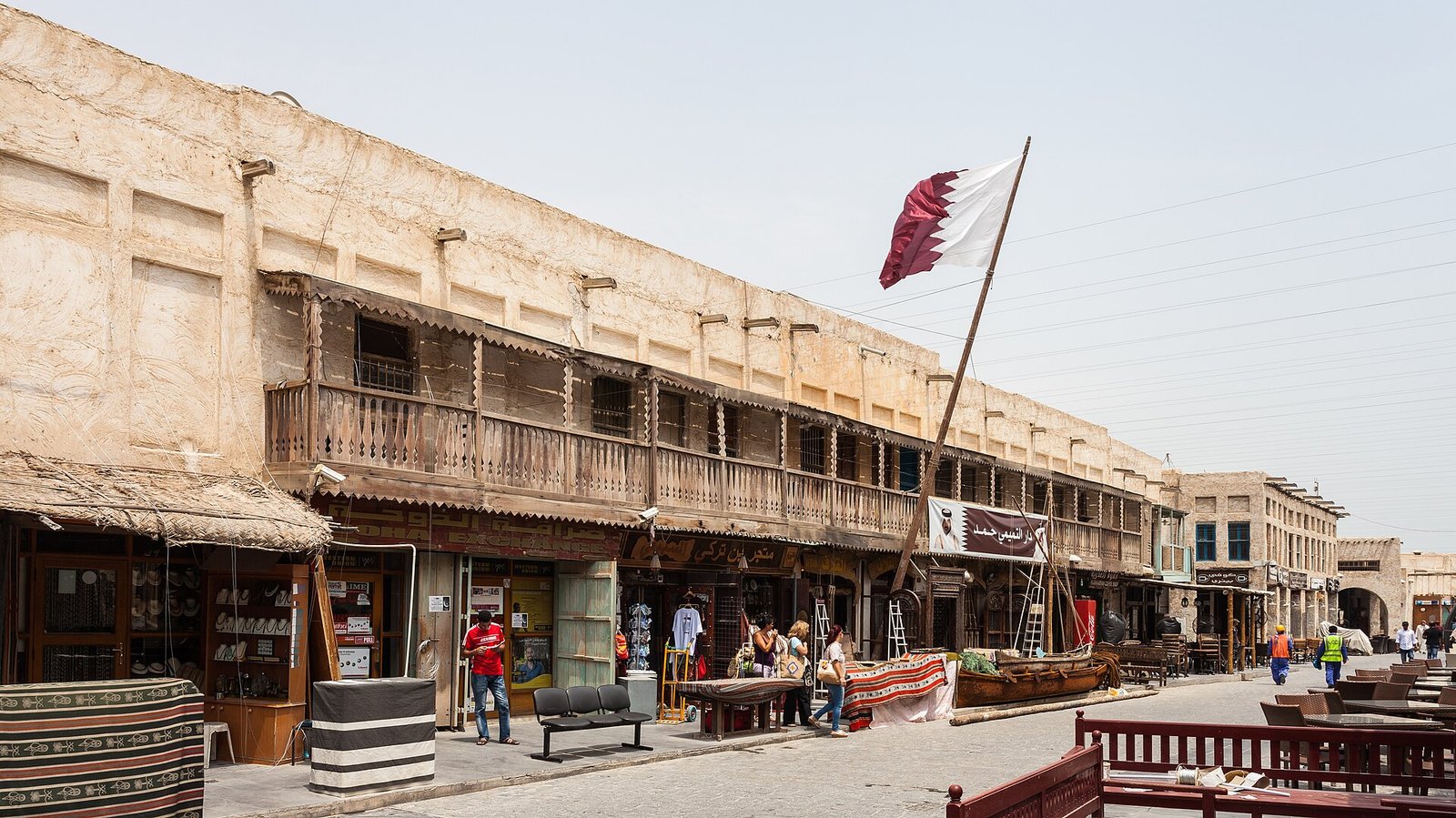
Restoration began in 2006 and was completed around 2008. The approach was bold: buildings put up after the 1950s were demolished, while older structures were repaired, and the rebuilt sections were designed in a traditional style with thick walls, mud plaster, timber and bamboo ceilings and wooden shutters. Metal sheeting and modern signage were removed, and the lanes were paved and shaded. The result is partly authentic and partly a reconstruction, which is worth knowing if you are interested in architecture, but it was done with care and has aged well.
The revival also brought back elements of the souq’s older life. A dedicated falcon quarter and the Falcon Hospital (opened in 2008) were part of the plan, as were the horse stables and camel pen and a group of small boutique hotels. Since then Souq Waqif has hosted crowds for the FIFA World Cup in 2022 and the AFC Asian Cup, played in early 2024, and it remains the default stop for first-time visitors and the place many residents bring visiting family.
Finding your way: the layout of the souq
Souq Waqif is not huge, but the lanes twist and many look alike, so it helps to have a rough mental map. Think of it as a long main walkway running roughly east to west, parallel to the Corniche, with a dense grid of narrow covered alleys on either side and open squares at each end. The official Souq Waqif website describes several sections spread from the eastern to the western side, and once you know which end is which, getting lost becomes part of the fun rather than a problem.
The main lane
The broad, paved main lane is where most people start. It is lined with restaurants, cafés with outdoor seating, sweet shops and souvenir stores, and in the evening it is the busiest part of the souq. If you only have an hour, walk its length, then dive into any side alley that looks interesting and work your way back.
The squares
Open squares at the eastern and western ends of the souq are used for events. The Eastern Square hosts many of the seasonal exhibitions, such as the dates fairs, and is where the Ramadan iftar cannon is fired. The Western Square, near the falcon quarter and stables, has been used for the winter equestrian festival. Outside event times they are simply places to sit and watch the crowds.
Spice and food lanes
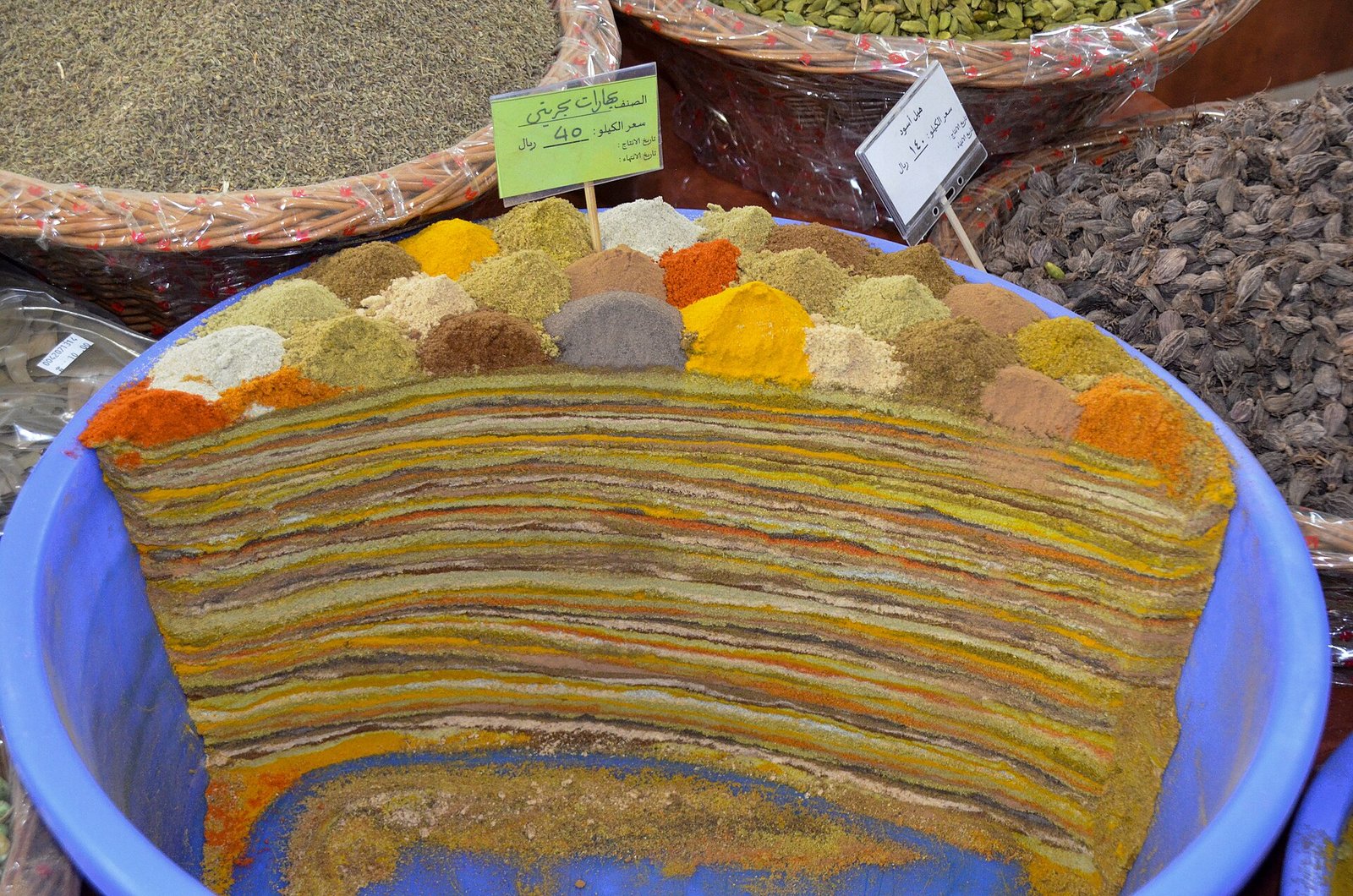
Some of the oldest-feeling alleys are given over to spices, dried fruit, nuts, dates, honey, rice, dried limes and incense. Sacks and bowls are piled high with cardamom, turmeric, cinnamon bark, saffron, rosebuds and blends for machboos and other Gulf dishes. The official souq site singles out its Arabic spice shops, and they are a good first stop because the colours and smells set the scene for everything else.
Textiles and clothing
Fabric shops and tailors sell everything from bolts of cotton and silk to embroidered cushion covers and ready-made thobes and abayas. You will also find scarves, pashminas and children’s traditional outfits, which are popular around Eid and Qatar National Day. Tailors can often make a garment to measure, though turnaround times vary.
Oud and Arabic perfume
According to the souq’s official site, the oud and Arabic perfume shops are concentrated in a traditional two-storey building on the eastern side. This is where you can try oud oil, bukhoor (scented wood chips burnt over charcoal) and blended attars. Sellers are generous with testers, and buying even a small bottle is a good way to understand why fragrance matters so much in Gulf culture.
Antiques, handicrafts and household goods
Elsewhere you will find shops of antiques and handicrafts, brass coffee pots (dallah), lanterns, wooden chests, carpets, musical instruments such as the oud, and stores selling traditional Gulf kitchenware. The quality ranges from mass-produced souvenirs to genuinely old pieces, so take your time and ask questions before buying anything presented as an antique.
The specialist souqs and animal corner
Beyond the general shopping lanes, Souq Waqif has several specialist areas that are worth seeking out deliberately. Most visitors walk past at least one of them without realising.
Falcon Souq and Falcon Hospital
On the western side, close to the main car park, is the Falcon Souq: a courtyard and covered lane of shops where hooded falcons sit on padded perches and the shelves hold leather hoods, gloves, leashes and GPS trackers. Falconry is a deep-rooted Gulf tradition and the falcon is Qatar’s national bird, so this is a working market for serious owners rather than a display. Late afternoon and evening, especially in the autumn and winter hunting season, is when owners come in with their birds. Next door is the Souq Waqif Falcon Hospital, a specialist veterinary clinic whose published hours are Saturday to Thursday, 7am to 2pm.
Read our full guide to the Falcon Souq and Falcon Hospital, including how to tell the birds apart and how to behave politely in the shops.
Horse stables and camel pen
Also on the western side are stables of Arabian horses, used by the souq’s mounted heritage police on their rounds, and a small pen of camels behind stone arches near the Corniche. Both are free to look at from outside. They are modest sights rather than attractions, but children love them, and the horses are at the centre of the Souq Waqif Equestrian Festival each winter.
Read our full guide to the horse stables and camel pen.
Pigeon, bird and pet souq
A section of the souq is devoted to birds, pigeons, pets and pet supplies. You will see songbirds, parrots, chickens, rabbits and other small animals for sale, along with cages and feed. The official souq website notes a weekly auction of birds and pets held on Friday mornings. Be prepared that conditions in some animal shops have drawn criticism from visitors over the years, and that crowded cages in the heat are not for everyone. If you go, keep children from tapping cages or feeding animals, and don’t buy a pet on impulse.
Gold Souq
Doha’s Gold Souq is on the southern side of the souq, a short walk from the main lanes, in a compact cluster of jewellery shops selling 18, 21 and 22 carat gold: bridal sets, heavy bangles, Arabic name pendants and modern pieces. Prices are based on the day’s gold rate and weight, plus a charge for workmanship, which is where there is room to negotiate. It is busiest in the evenings and in the run-up to Eid and weddings.
Read our full guide to the Gold Souq, with tips on how pricing works and buying with confidence.
Souq Waqif Art Center
The Souq Waqif Art Center is a small arts complex within the souq. Visit Qatar describes it as showing work by local and visiting artists, and it hosts exhibitions by local and visiting artists and has long offered workshops in calligraphy, drawing, painting, ceramics and sculpture. During Ramadan it has hosted exhibitions of Sadu weaving and Arabic calligraphy. It is an easy and often overlooked break from shopping; drop in and see what is on.
Mosques and Al Koot Fort
Several historic mosques stand in and around the souq, and the official site highlights the Abu Al Qubaib Mosque among its landmarks. Please don’t wander into a mosque during prayer times, and dress modestly if you visit one that welcomes non-Muslim visitors. On the edge of the souq stands Al Koot Fort, a white fortified building with corner towers. Visit Qatar dates it to the late 19th century and a rebuilding in 1927, and says the interior is accessible by appointment only, so for most visitors it is a sight to admire and photograph from outside.
Where to eat and drink
Eating is half the reason to come. The souq has dozens of restaurants and cafés covering Qatari, Yemeni, Persian, Levantine, Moroccan, Turkish, Indian and other cuisines, from simple counters to grand dining rooms. Many open for breakfast and stay busy until late. These are the places and styles we would point a first-time visitor towards.
A Qatari breakfast
Mornings are the quietest time in the souq, and a traditional breakfast is the best way to use them. Shay Al Shoomoos is a small, much-loved spot serving home-style Qatari breakfast dishes such as regag bread, balaleet (sweet vermicelli with omelette) and eggs with tomato, with tea. For a calmer setting, Athr Café is a courtyard café with a fountain and heritage décor, serving Qatari coffee and breakfast plates. Hours at both can change, so check before you go, especially in Ramadan.
Yemeni mandi at Bandar Aden
For lunch or dinner, Bandar Aden is the souq’s long-running Yemeni restaurant, known for smoky lamb mandi, saltah stew served bubbling in a stone pot and private carpeted rooms where you eat sitting on the floor. It is good value and ideal for groups.
Persian food
Visit Qatar points visitors to Parisa for Persian cuisine, served in an ornately decorated dining room. Persian menus centre on grilled kebabs, saffron rice and slow-cooked stews; check the current menu and book ahead at weekends.
Cafés, karak and shisha
The main lane is lined with cafés that set tables outdoors in the cooler months. This is where to order a glass of karak (sweet spiced tea with milk), Arabic coffee with dates, or fresh juice and simply watch the souq go by. Many cafés also serve shisha (water pipe) in their outdoor areas; it is legal and widely smoked, but if you would rather avoid the smoke, choose a table away from the shisha section or an indoor café. Small kiosks also sell karak and quick snacks to eat on the move.
Hotel restaurants and rooftops
The boutique hotels have their own restaurants and lounges that are open to non-guests. Visit Qatar lists outlets including Argan (Moroccan), La Piazza (Italian), La Patisserie and the Al Shurfa Arabic Lounge. A rooftop terrace overlooking the souq is one of the best places in Doha to watch the evening crowds below.
Sweets to take away
Look out for shops selling Arabic sweets such as baklava, kunafa and luqaimat (fried dough balls drizzled with date syrup), as well as halwa and boxes of stuffed dates. A box of dates or sweets makes a good gift if you are visiting a Qatari home.
Staying in Souq Waqif
You can sleep inside the souq itself. Souq Waqif Boutique Hotels by Tivoli is a collection of small heritage hotels spread through the lanes: Tivoli currently lists eight, including Al Jomrok, Al Mirqab, Al Jasra, Arumaila, Bismillah, Musheireb, Najd and Al Bidda. They share a spa with a Moroccan hammam, a pool and a gym, with a golf-cart shuttle between properties.
The Bismillah Hotel is the one with the story. It is widely described as Qatar’s first hotel, and its tiled balconies overlook the souq lanes. Staying here puts the spice lanes, Corniche and Museum of Islamic Art all within walking distance, which is a real advantage in a city built around the car. The trade-offs are that rooms vary a lot between hotels and the souq stays noisy late into the night, especially at weekends.
Read our full guide to the Souq Waqif Boutique Hotels, including how the hotels differ and what a weekend there costs.
Shopping and bargaining
Shopping at Souq Waqif is relaxed by Middle Eastern standards. Hard selling is rare, shopkeepers are used to tourists, and many shops display prices. Still, a little technique helps you get fair value and enjoy it more.
What is worth buying
- Spices and saffron: buy from busy stalls with fast turnover, and ask to smell before you buy. Saffron quality varies widely, so if the price seems too good to be true, it probably is.
- Dates: sold loose by weight or in gift boxes. Ask to taste a few varieties first.
- Oud and bukhoor: prices range from inexpensive blends to very costly pure oud oil. Try on your skin and wait a few minutes before deciding.
- Arabic coffee pots, lanterns and incense burners: classic souvenirs, available in every quality.
- Textiles: scarves, pashminas, embroidered fabrics and tailored garments.
- Gold: name pendants and traditional pieces at the Gold Souq.
How to bargain politely
In food and spice shops, and wherever prices are marked, you will usually pay the price shown, perhaps with a little extra thrown in if you buy a lot. For souvenirs, textiles, antiques, carpets and the workmanship part of gold prices, gentle negotiation is normal. Ask the price, show interest, and make a reasonable counter-offer. Smile, take your time, and be ready to walk away politely; that is often when the best offer appears. Buying several items from one shop is the easiest way to get a discount. Never start bargaining for something you have no intention of buying.
Paying
Many shops and restaurants accept cards, but smaller stalls and kiosks may prefer cash in Qatari riyals, so carry some notes. ATMs are easy to find in central Doha.
Opening hours and the best time to visit
The souq itself never really closes, since its lanes are public space. What matters is when the shops and restaurants are open, and this catches out many visitors who arrive in the early afternoon to find shutters down.
The daily rhythm
Many shops follow the traditional split day. Marhaba, a long-running Qatar visitor guide, gives shop hours of roughly 10am to noon and 4pm to 10pm, with restaurants open from about 8am until midnight. In practice hours vary from shop to shop: some open earlier, some stay open through the afternoon, and the busiest restaurants and cafés keep going late. On Fridays, many shops stay closed during the morning and midday prayers and open later in the day.
| Time | What it’s like | Best for |
|---|---|---|
| Early morning (7–10am) | Quiet lanes, few shops open, cool in winter | Photography, architecture, a Qatari breakfast |
| Late morning (10am–noon) | Shops open, light crowds | Relaxed shopping, spices and perfume |
| Midday to 4pm | Many shops shut, hottest part of the day | A long lunch indoors; otherwise visit somewhere else |
| Late afternoon (4–6pm) | Shops reopen, falconers arrive, light turns golden | Falcon Souq, stables, photos |
| Evening (6–11pm) | Busiest and liveliest, everything open | Atmosphere, dinner, shopping, people-watching |
The best season
November to March is the ideal time. Evenings are mild enough to sit outside for hours, café terraces are full, and most of the festivals and exhibitions fall in these months. October and April are warm but pleasant after dark. From May to September the heat and humidity are intense, so come after sunset, keep to the shaded and covered lanes, and duck into air-conditioned shops and restaurants. The souq is still worth visiting in summer, just later in the evening.
Weekdays and weekends
Qatar’s weekend is Friday and Saturday, and Thursday and Friday evenings are the busiest of the week. If you dislike crowds, come on a Sunday to Wednesday evening. If you want the souq at its most festive, choose a winter weekend evening and accept that parking and tables will be harder to find.
Ramadan
The souq takes on a different character during Ramadan. Hours shift around the fast: for Ramadan 2026, Visit Qatar listed shops open roughly 8am to noon and again from iftar until midnight, with restaurants serving from iftar until suhoor. Days are very quiet; evenings are lively and atmospheric. Eating, drinking and smoking in public during daylight hours should be avoided by everyone during the holy month.
Souq Waqif after dark
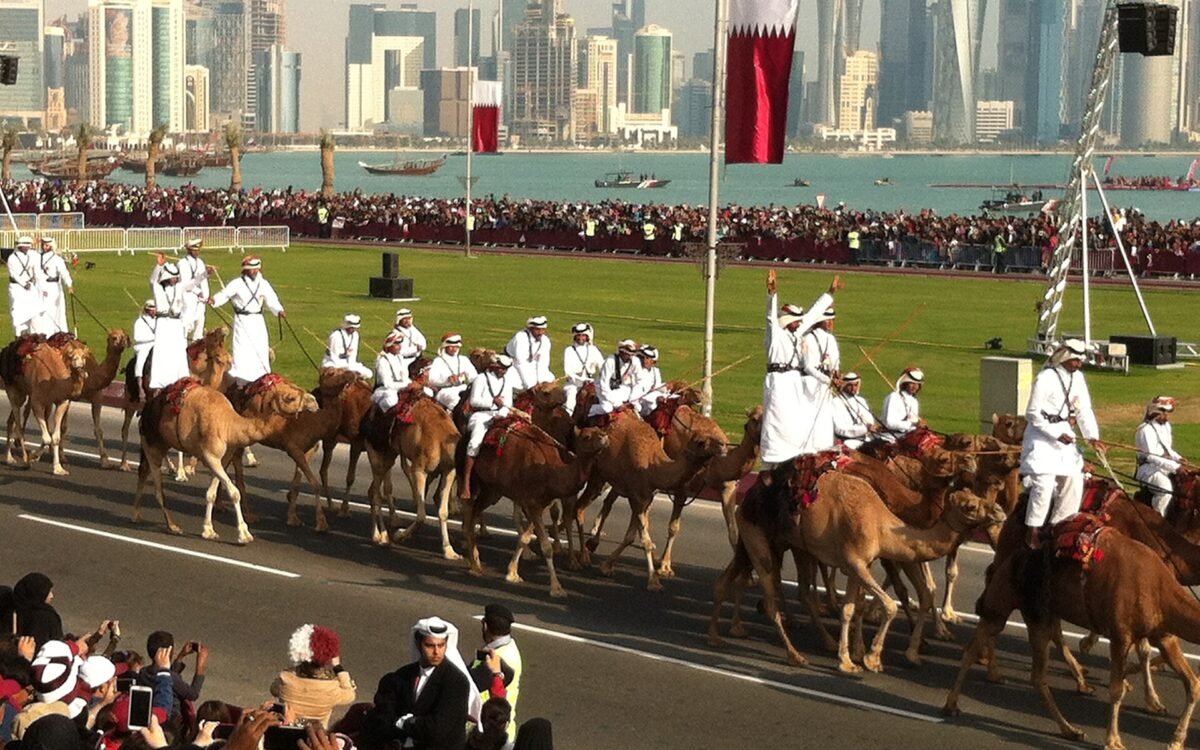
If you only visit once, make it an evening. As the light fades the lanterns come on, the stone and mud walls glow amber, and the main lane fills with people. Families stroll with pushchairs, groups of young men sit on benches drinking tea, tourists browse for souvenirs, and the smell of grilled meat and bukhoor drifts through the alleys. Pairs of heritage police on Arabian horses patrol slowly through the crowds, and you may see porters with wheelbarrows offering to carry heavier shopping, a souq tradition that has survived the restoration.
Look up as well as around. Beyond the souq rooftops you can see the spiral minaret of the Abdulla Bin Zaid Al Mahmoud Islamic Cultural Centre, lit at night, which makes a good landmark if you lose your bearings. The open squares at each end are good places to pause, and a rooftop terrace gives you the whole scene from above.
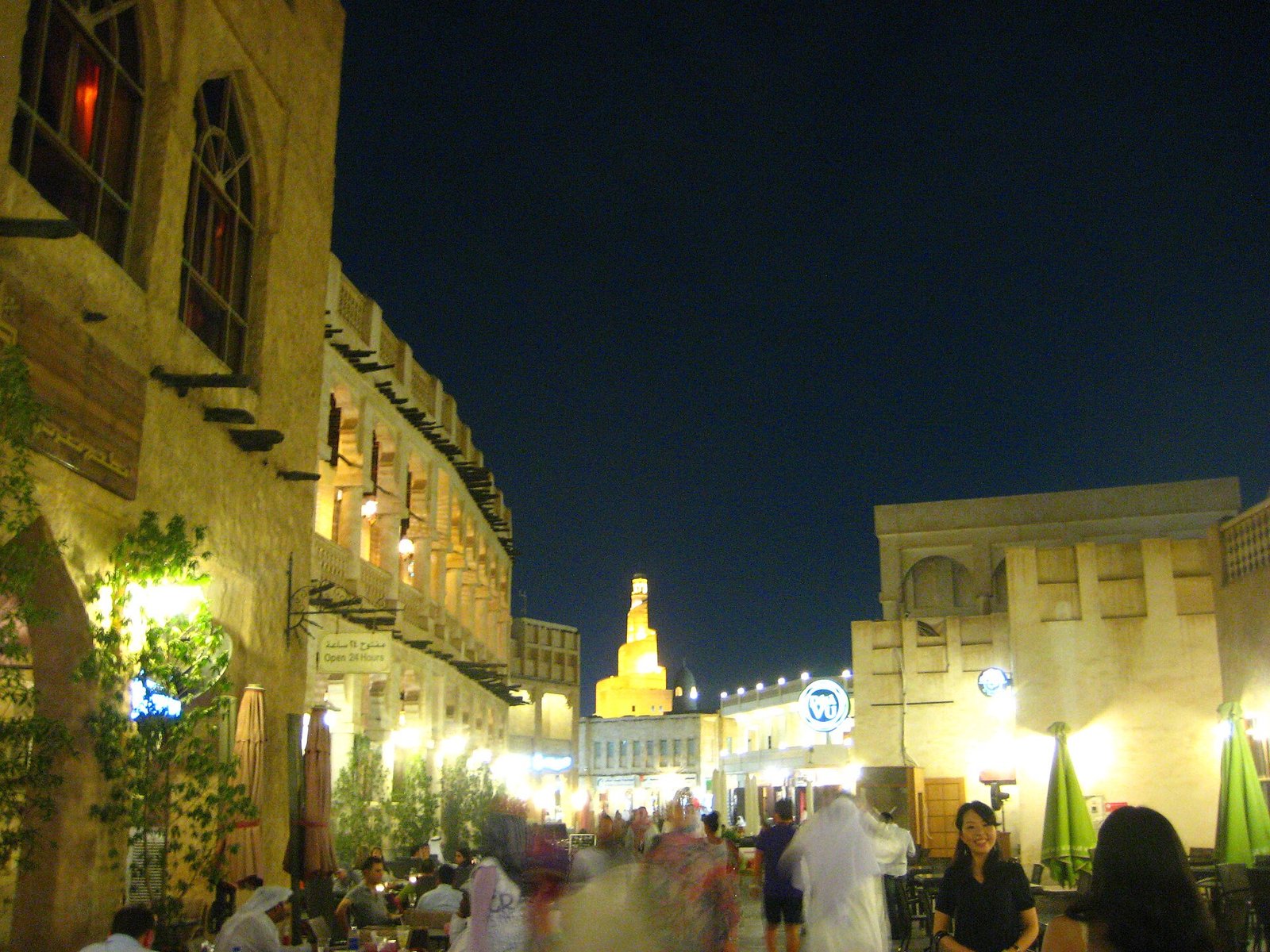
For photographers, the blue hour just after sunset is the time to be here: there is still colour in the sky and the souq lights are on. Ask before photographing people, especially women and families, and respect a “no”.
Festivals and events at Souq Waqif
Souq Waqif is one of Doha’s main event venues, and something is on most weeks in winter. Dates change every year and are usually announced only a few weeks ahead, so treat the months below as a guide and check Visit Qatar, the Ministry of Municipality and local press before planning a trip around an event.
| Event | Usual timing | Where | What to expect |
|---|---|---|---|
| Souq Waqif Equestrian Festival | January (20–27 January in 2026) | Western side, near the stables | International Arabian horse shows, children’s heritage events, an auction |
| Souq Waqif International Honey Exhibition | Winter (late January to February in recent years) | Within the souq (venue varies) | Beekeepers and honey traders from Qatar and abroad, tastings |
| Souq Waqif International Dates Exhibition | February (5–16 February in 2026) | Eastern Square | Date producers and products from the region |
| Ramadan nights | Holy month (moves about 11 days earlier each year) | Throughout, iftar cannon in the Eastern Square | Iftar cannon at sunset, Garangao celebrations, late-night souq |
| Eid celebrations | Eid al-Fitr and Eid al-Adha | Throughout | Performances, family activities, crowds |
| Local Dates Festival | Late July to mid-August (25 July–10 August in 2026) | Eastern Square | Qatari farms selling fresh rutab dates and farm products |
Souq Waqif Equestrian Festival
Each winter the stables become the focus of the Souq Waqif Equestrian Festival, with international shows for purebred Arabian horses, heritage activities for children and a closing auction. The 2026 edition ran from 20 to 27 January. Halter classes, in which handlers present horses to the judges for their beauty and movement, are a spectacle even if you know nothing about horses. Details are in our stables and camel pen guide.
Honey and dates exhibitions
The winter exhibitions are some of the best times to shop for food. The sixth Souq Waqif International Honey Exhibition, held in early 2025, opened with 107 exhibitors from 27 countries, according to The Peninsula. The fourth Souq Waqif International Dates Exhibition took place in the Eastern Square from 5 to 16 February 2026. Both are good places to taste before you buy and to meet producers.
Local Dates Festival
Held in the height of summer, when fresh dates are harvested, the Local Dates Festival brings Qatari farms to the Eastern Square to sell rutab (soft, fresh dates) and other produce. The 2026 edition, organised by the Ministry of Municipality, ran from 25 July to 10 August, open from 4pm in the evenings. It is one of the few reasons to plan a summer visit, and the atmosphere is very local.
Ramadan, Garangao and Eid
During Ramadan a cannon is fired in the Eastern Square at sunset to mark iftar, the breaking of the fast, and crowds gather to watch. Mid-Ramadan brings Garangao, when children in traditional clothes go from house to house collecting sweets and nuts, and the souq usually marks it with festivities. At Eid the souq hosts performances and family activities and is packed with people in their best clothes.
Other events
Over the years the souq has also hosted spring and winter festivals with rides, circus acts and folk performances, as well as celebrations around Qatar National Day on 18 December. These are not held every year in the same form, so watch local listings.
Getting there: metro, parking and taxis
Souq Waqif is in central Doha, just south of the Corniche and next to Msheireb Downtown. Visit Qatar and the souq’s official site put it about 15 minutes’ drive from Hamad International Airport, traffic permitting.
By metro
The easiest option for most visitors is the Doha Metro. Souq Waqif station is on the Gold Line, which runs east to west between Ras Bu Aboud and Al Aziziyah. The station opened in November 2019. If you are coming from the Red or Green Lines, change at Msheireb, the network’s central interchange, which is the next station west on the Gold Line. Trains are clean, air-conditioned and inexpensive; there are Standard, Family and Gold Club carriages. Service hours are shorter on Fridays, when trains start later in the day, so check Qatar Rail’s current timetable before you travel.
By car and parking
There are air-conditioned underground car parks beneath the souq, signposted from the surrounding roads. Parking is paid, and payment methods have changed over the years, so have a card and some cash ready. On winter weekend evenings the car parks can fill and queues build on the approach roads; arrive before about 6pm or use the metro. Street parking nearby is limited and often restricted.
By taxi or ride-hailing
Karwa taxis and ride-hailing apps such as Uber operate across Doha. Ask to be dropped at the souq’s main entrance on the Corniche side or by the car park on the western side. Getting a ride back late on a busy night can take a while, which is another reason to consider the metro.
On foot
From Msheireb Downtown, the dhow harbour and the eastern end of the Corniche, the souq is an easy walk in the cooler months. Use the signed pedestrian crossings and underpasses to cross the busy Corniche road safely.
Etiquette, heat and practical tips
Souq Waqif is relaxed and very safe, and visitors from every background mix happily. A few local norms make the visit smoother for everyone.
- Dress modestly. Covering shoulders and knees is the respectful norm in public places in Qatar, for men and women. Light, loose clothing is both cooler and appropriate. Swimwear and very short shorts are out of place.
- No alcohol. Alcohol is not sold in the souq’s cafés and drinking in public is illegal in Qatar.
- Ask before photographing people. Most shopkeepers are happy to be photographed if you ask, but never photograph local women without permission. In the Falcon Souq, ask before photographing someone’s bird.
- Respect prayer times. Some shops close briefly during prayers, and many are shut on Friday mornings and around midday prayers.
- Be gentle with animals. Don’t touch or feed the horses, camels, falcons or birds unless invited, and keep children back when the mounted police pass.
- Public displays of affection should be kept low-key, as anywhere in Qatar.
- Stay hydrated. Even on a winter afternoon the sun is strong. In summer, come after dark and carry water.
- Keep your bearings. Drop a pin on your phone where you parked or the metro exit you used; the lanes look alike at night.
Mistakes to avoid
- Arriving at 2pm. The single most common disappointment. Many shops are shut from about noon until 4pm. Come in the morning or after 4pm.
- Only walking the main lane. The specialist souqs and the quieter side alleys are where the souq’s character lives. Go down at least a few.
- Missing the western side. The falcons, horses and camels are all on the western side and are easy to miss if you enter from the east and turn back early.
- Driving in on a winter Friday night. Expect queues for the car park. Take the metro or arrive by late afternoon.
- Buying the first saffron or oud you are offered. Compare a few shops first and taste or test before paying.
- Forgetting cash. Small purchases at stalls and kiosks are easier with riyals in your pocket.
- Treating the animal shops as a zoo. These are commercial businesses. If animal welfare concerns you, skip the pet section rather than spending money there.
Nearby: what to pair with Souq Waqif
The souq sits at the heart of Doha’s most walkable area. In the cooler months you can easily combine it with several of the sights below in a single day, much of it on foot.
Doha Corniche and the dhow harbour
The Corniche, Doha’s seven-kilometre waterfront promenade, runs right past the souq. Cross to the water and you reach the dhow harbour, where traditional wooden boats moor and short evening rides set out across the bay, with the West Bay skyline lighting up across the water at dusk. Read our full guide to the dhow harbour.
Museum of Islamic Art and MIA Park
The Museum of Islamic Art, I. M. Pei’s landmark on its own island off the Corniche, is a pleasant walk east of the souq along the waterfront, roughly 15 to 20 minutes on foot. Beyond it, MIA Park leads out to the tip of a long promenade where Richard Serra’s sculpture 7 stands. Read our guide to Richard Serra’s 7 and MIA Park.
Msheireb Downtown and Msheireb Museums
Immediately west of the souq, Msheireb Downtown is a rebuilt city district of shaded streets and modern Qatari architecture. Four restored heritage houses here form the free Msheireb Museums, which tell the story of 20th-century Doha far better than any sign in the souq. Read our full guide to Msheireb Museums. Msheireb’s free tram makes a gentle loop of the district; see our Msheireb tram heritage loop for a route that starts on the edge of Souq Waqif.
Bayt Sharq
For a sit-down Qatari meal in a restored family house, Bayt Sharq is just off the eastern Corniche, a short taxi ride from the souq. It is a good alternative if the souq restaurants are packed.
Old Doha Port
Further along, past MIA, the old cargo harbour has been reborn as the Mina District, with pastel lanes, murals, cafés and a marina. It is best reached by taxi from the souq. Read our guide to Old Doha Port and the Mina District.
For more ideas in the area, see our pillar guides to hidden gems in Doha and free things to do in Qatar; Souq Waqif features in both.
How to plan your visit: three easy routes
The two-hour first look
Arrive around 4.30pm in winter. Start on the western side with the Falcon Souq as the shops reopen, then walk past the stables and camel pen. Head east through the spice and perfume lanes, pause for karak at a café on the main lane as the lights come on, and finish on a rooftop or in one of the restaurants.
The slow morning
Come at 8am for breakfast at Shay Al Shoomoos or Athr Café, then photograph the empty lanes before the shops open. Browse spices and perfume from 10am, walk over to the Gold Souq, and finish with a visit to Msheireb Museums next door, which are air-conditioned for the warmer part of the day.
The full heritage day
Start at the Museum of Islamic Art when it opens and walk out to Richard Serra’s 7. Have lunch at Bandar Aden, rest through the hot middle of the day at Msheireb, then return to the souq after 4pm. As the sun goes down, cross to the dhow harbour for a short boat ride, and come back to the souq for dinner and an evening wander. If you want to stay the night, book one of the boutique hotels and you won’t need a car at all.
Frequently asked questions
Is Souq Waqif free to visit?
Yes. There is no entry fee and you can wander the lanes at any time. You only pay for what you buy, eat or drink, and for parking if you drive.
What are Souq Waqif’s opening hours?
The lanes are always open, but many shops follow a split day, roughly 10am to noon and 4pm to 10pm, while restaurants and cafés open from breakfast until around midnight. Many shops are closed on Friday mornings and hours change during Ramadan, so expect variation from shop to shop.
Which metro station is closest to Souq Waqif?
Souq Waqif station on the Doha Metro Gold Line, a short walk from the souq lanes. From the Red or Green Lines, change at Msheireb, one stop away.
When is the best time to visit Souq Waqif?
Between November and March, from late afternoon into the evening, when the weather is mild, all the shops are open and the lanes are at their liveliest. For fewer crowds, choose a weekday evening; for a quiet look at the architecture, come early in the morning.
Is there parking at Souq Waqif?
Yes, there are air-conditioned underground car parks beneath the souq. Parking is paid, and the car parks can fill on winter weekend evenings, when the metro is the easier option.
What should I wear to Souq Waqif?
Modest, comfortable clothing that covers shoulders and knees is the respectful choice for both men and women. Women do not need to cover their hair. Wear comfortable shoes, as you will walk a lot on paving.
Can you bargain in Souq Waqif?
Yes, for souvenirs, textiles, antiques, carpets and the workmanship charge on gold. In food and spice shops with marked prices, you will usually pay the price shown. Bargain politely and only if you intend to buy.
How long do you need at Souq Waqif?
Two to three hours is enough for a first look including a drink or meal. Allow a full evening if you want to see the falcons, horses and camels, shop properly and have dinner.
Last checked October 2026. Rules, fees and access can change, so confirm with the official source before you go.