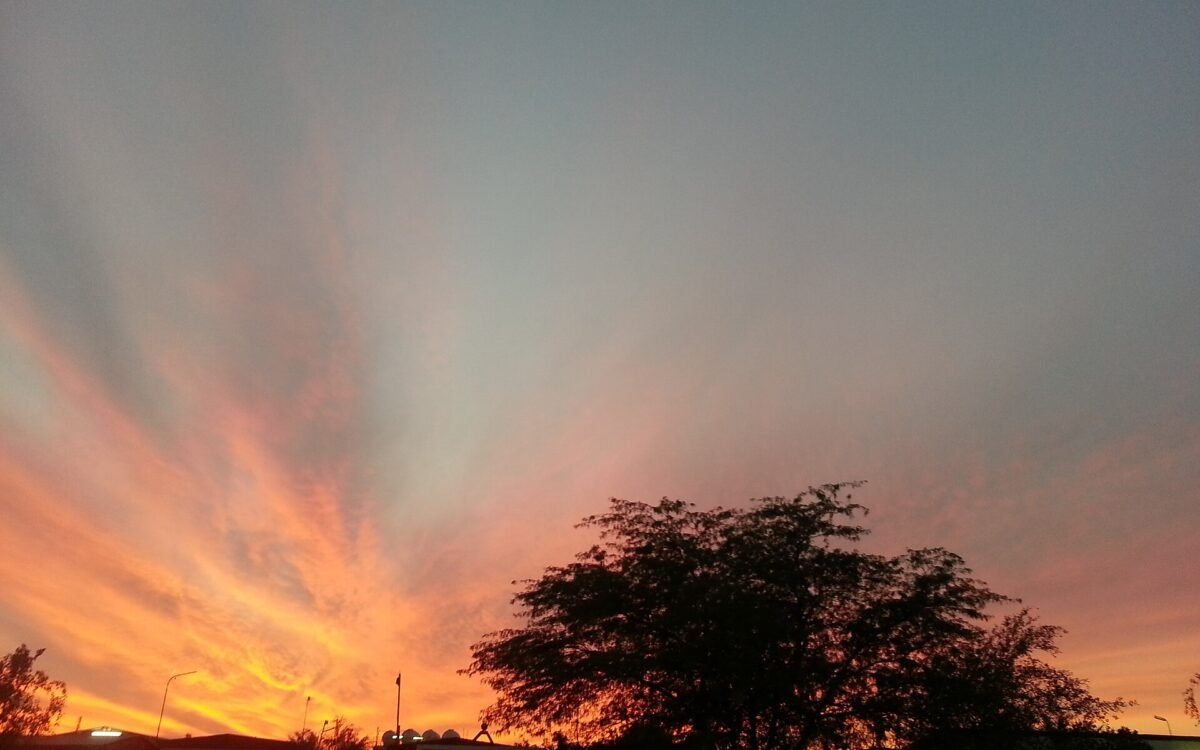
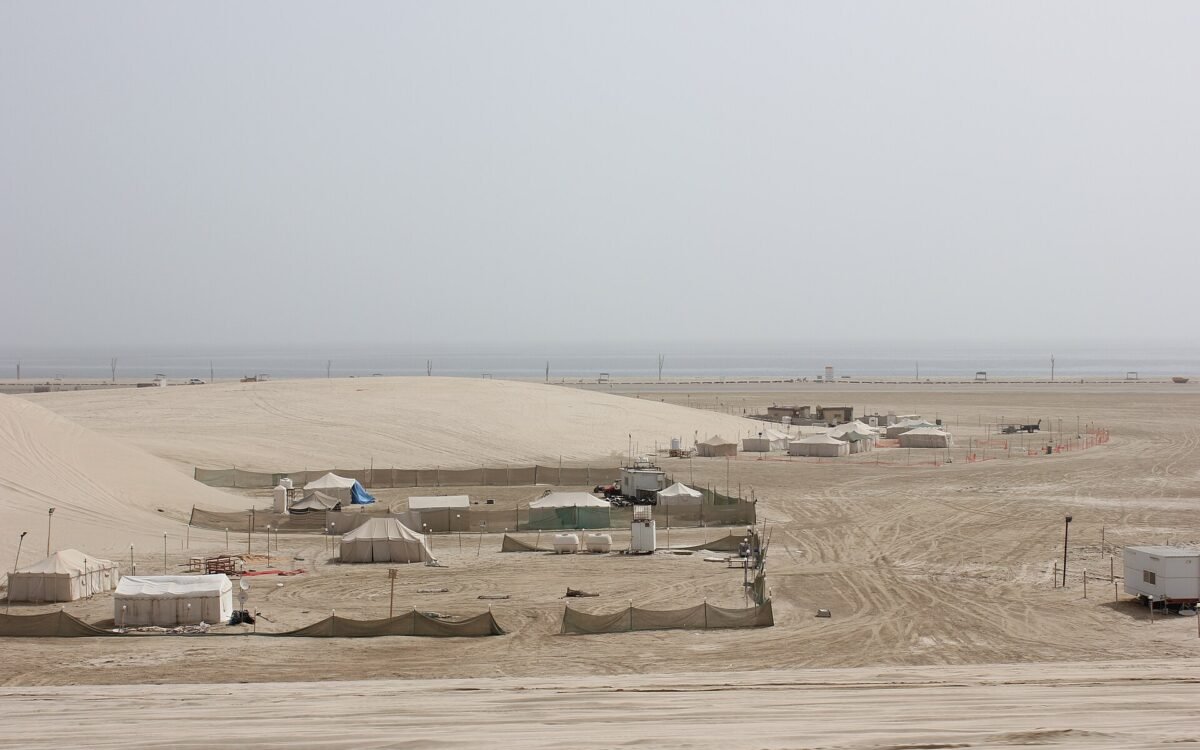
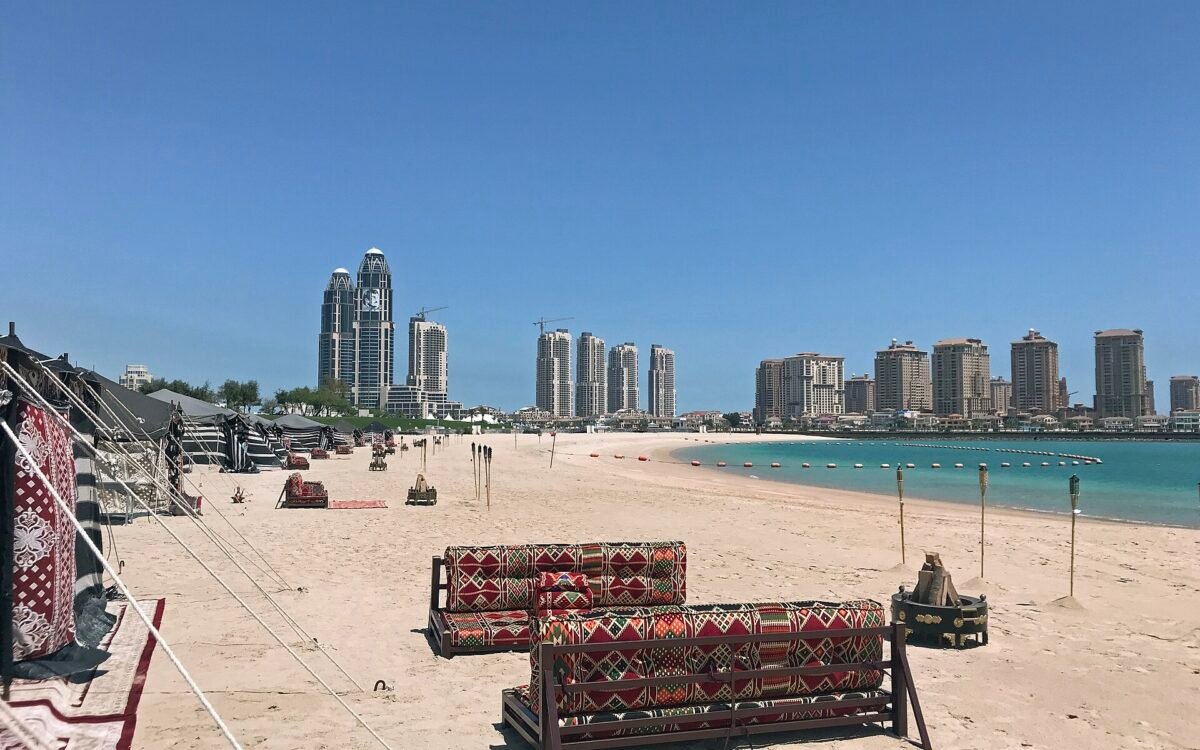
The best sunset spots in Qatar are on the west coast, where the sun drops straight into the sea: Richard Serra’s steel plates in the Brouq Nature Reserve, the Zekreet Peninsula, Dukhan Beach and Umm Bab’s Palm Tree Beach. Add the abandoned pearling villages of the north-west, the dunes of Sealine and the Inland Sea, and a handful of city waterfronts where the West Bay towers turn gold and then light up, and you have more golden-hour options than most visitors expect from a small, flat country.
Geography does most of the work. Doha and almost all of the popular beaches look east or north, so in the city you watch the sun set behind buildings or across the bay towards the skyline. To see the sun meet the water, you need to drive about an hour west. Inland, the dunes south of Mesaieed glow orange and the sand ripples sharpen into lines. Below are our 15 picks, with which way to look, when to arrive, whether you need a 4×4 and how to get home safely after dark.
One thing surprises most newcomers. Qatar is close to the tropics, so the sun sets steeply and twilight is short: about 22 to 26 minutes from sunset to the end of civil twilight, according to the US Naval Observatory’s data for Doha. Arrive late and you will miss it.
At a glance
- Best overall: East-West/West-East on the Zekreet Peninsula, where four steel plates turn into silhouettes against the western sky.
- Sun into the sea: Dukhan Beach and Umm Bab (Palm Tree Beach) on the west coast, and the abandoned villages of the north-west.
- Easiest from Doha: MIA Park and Serra’s 7, the Corniche dhow harbour, Katara, Lusail Marina and Qanat Quartier, all within 25 minutes of the centre.
- Desert sunsets: Sealine dunes (no 4×4 needed for the beach), the Singing Sand Dunes, and the Inland Sea by 4×4 or tour.
- When: November to March for clear, comfortable evenings. Sunset ranges from about 4.45pm in late November and early December to about 6.30pm in late June and early July.
- Arrive: 45 to 90 minutes before sunset for out-of-town spots, 30 minutes for city spots.
- Drive home: learn the track out in daylight, carry a torch, and never cross dunes in the dark without a guide.
Sunset times in Doha by month
The table below gives approximate sunset times for central Doha, rounded to the nearest five minutes, based on the US Naval Observatory’s astronomical data for 2026. Times barely shift from year to year. Qatar does not use daylight saving, so there are no clock changes to catch you out.
| Month | Sunset on the 1st | Sunset on the 15th | Sky dark (end of civil twilight, 15th) |
|---|---|---|---|
| January | 4.55pm | 5.05pm | 5.30pm |
| February | 5.20pm | 5.30pm | 5.50pm |
| March | 5.35pm | 5.45pm | 6.05pm |
| April | 5.50pm | 5.55pm | 6.20pm |
| May | 6.05pm | 6.10pm | 6.35pm |
| June | 6.20pm | 6.25pm | 6.50pm |
| July | 6.30pm | 6.25pm | 6.50pm |
| August | 6.20pm | 6.10pm | 6.35pm |
| September | 5.55pm | 5.40pm | 6.00pm |
| October | 5.20pm | 5.05pm | 5.30pm |
| November | 4.55pm | 4.45pm | 5.10pm |
| December | 4.45pm | 4.45pm | 5.10pm |
Two adjustments are worth knowing. On the west coast at Dukhan, Zekreet and Umm Bab, the sun sets roughly three minutes later than in Doha because you are further west. And the sun does not set due west all year: in December it goes down well to the south-west (an azimuth of about 244 degrees) and in June well to the north-west (about 296 degrees). That swing decides which spots line up best in which season, and we note it below where it matters.
The 15 spots compared
Drive times are from central Doha in normal traffic and are approximate. “Facing” is the direction you look towards the sunset. “4×4?” refers to the last stretch; every place here is reached on paved highway for most of the way.
| Spot | Area | Facing | Drive from Doha | Best months | 4×4? |
|---|---|---|---|---|---|
| East-West/West-East (Serra) | Zekreet Peninsula | West along the line of plates | About 1 hr 15 min | Nov–Mar | Recommended (unpaved last few km) |
| Zekreet rocks and Ras Abrouq | Zekreet Peninsula | West over rock and sea | 1 hr–1 hr 15 min | Nov–Mar | Strongly recommended |
| Dukhan Beach | West coast | West over the sea | Just over 1 hr | Oct–Apr | No |
| Umm Bab (Palm Tree Beach) | South-west coast | West over the Gulf of Salwa | About 1 hr 30 min | Oct–Apr | No (only to drive on the sand) |
| Al Jumail (outside the fence) | Al Shamal, north-west | West, sea behind the ruins | 1 hr–1 hr 30 min | Nov–Mar | No (short dirt track) |
| Al Khuwayr and Al Arish | Al Shamal, north-west | North-west over the bay | About 1 hr 30 min | Nov–Mar | Advisable, essential after rain |
| Shadows Travelling (Eliasson) | Near Al Zubarah | West over open desert | About 1 hr 15 min–1 hr 30 min | Nov–Mar | No |
| Sealine dunes | South of Mesaieed | West over the dunes | About 40 min | Oct–Apr | No for the beach; yes for the dunes |
| Singing Sand Dunes | West of Mesaieed | West across the crests | 40–50 min | Nov–Mar | No (park on hard ground and walk) |
| Khor Al Adaid (Inland Sea) | South-east, Saudi border | West over dunes and lagoon | About 1 hr, then 40–60 min over sand | Nov–Apr | Yes (tour or experienced convoy) |
| MIA Park and Serra’s 7 | Central Doha | North-west to West Bay (sun sets to the west) | Central | Nov–Mar; summer after dark | No |
| Corniche and dhow harbour | Central Doha | North-west to West Bay (sun sets to the west) | Central | Nov–Mar; summer after dark | No |
| Katara pigeon towers | Katara, north Doha | West, light on the towers | 15–25 min | Nov–Mar | No |
| Lusail Marina Promenade | Lusail | Across the marina, then city lights | 15–25 min | Nov–Mar | No |
| Qanat Quartier | The Pearl | Along the canals, light on façades | 15–25 min | Nov–Mar | No |
West coast: where the sun sets into the sea
The west coast runs from Umm Bab in the south past Dukhan to the Zekreet Peninsula, then on towards the north-west tip. It is the only stretch of Qatar where you can watch the sun touch the water without a skyline in the way, and it is also the emptiest, with few shops and long distances between fuel stations. Fill up in Doha or at Dukhan and carry more water than you think you need.
1. East-West/West-East, Brouq Nature Reserve
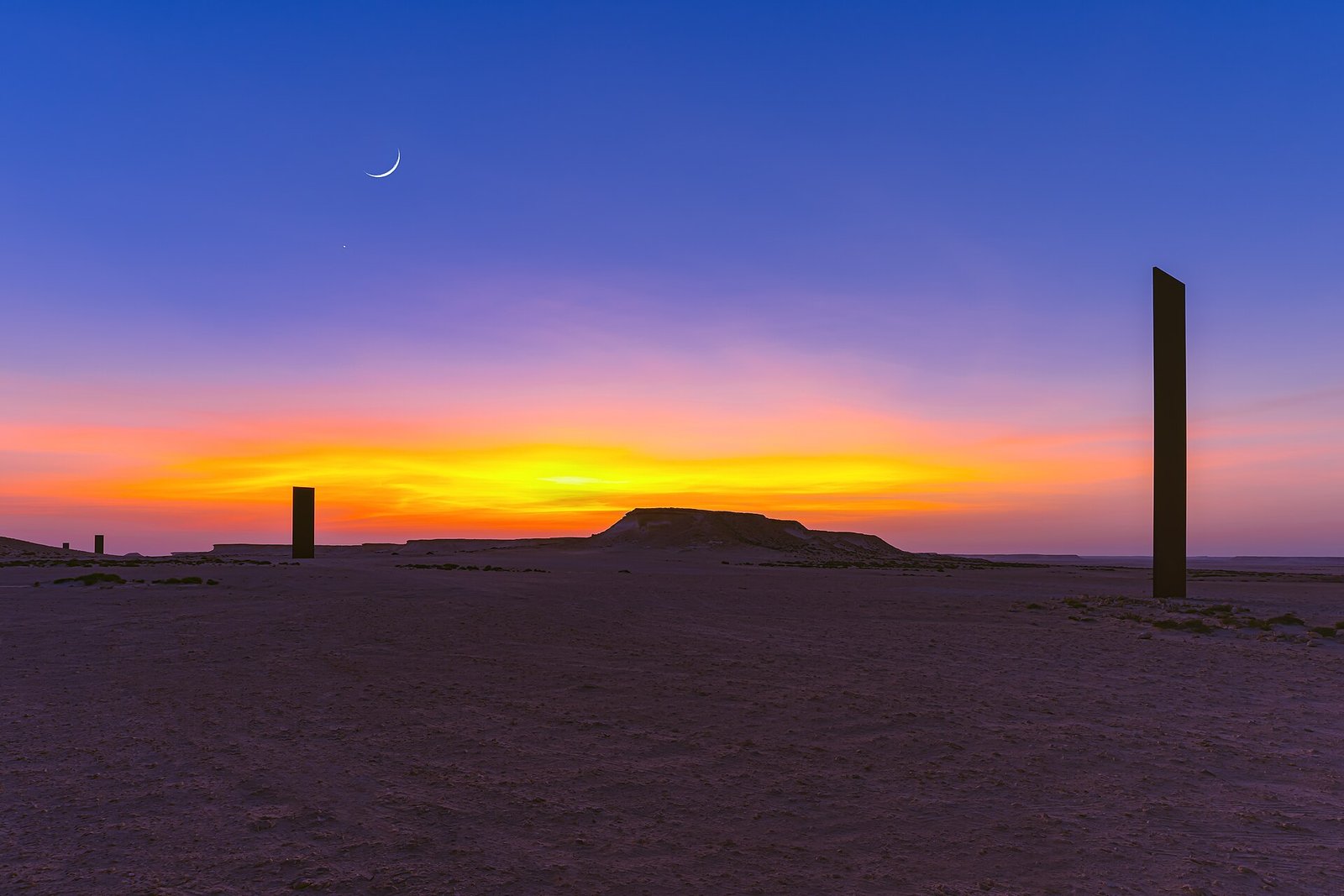
Four steel plates by the American sculptor Richard Serra stand in a line across a shallow desert valley, framed by low white plateaus of gypsum and limestone. The line runs roughly east to west, so as the sun goes down towards the western end the plates become sharp black silhouettes against an orange sky.
Why it works: the sculpture gives the empty landscape scale. In winter, when the sun sets to the south-west, it drops slightly to the left of the line as you look west; around the equinoxes it goes down almost along it.
What’s in frame: the plates, the plateau edges and open sky. A longer lens compresses the line so all four plates stack up; a wide lens close to one plate exaggerates its height.
Arrive: about 90 minutes before sunset. Qatar Museums’ head of public art has suggested walking in from the eastern end at least 30 minutes before sunset, so the sun is in front of you as you reach the western plates.
Access: about an hour and a quarter from Doha. The last few kilometres are unpaved. Some people do it slowly in an ordinary car, but a 4×4 or high-clearance SUV gives you a margin on soft or rutted patches. Several Doha operators run sunset 4×4 tours of the peninsula that include the sculpture.
Facilities: none. No shade, toilets or shops. The site is free, unfenced and has no set hours.
After dark: the Zekreet area has some of the darkest skies within easy reach of Doha, which tempts people to stay. Only do so if you have driven the track out in daylight and know exactly where you are going. Read our full guide to East-West/West-East.
2. Zekreet mushroom rocks, Film City and Ras Abrouq
North of the Serra plates, wind has carved the limestone of the Zekreet Peninsula into mesas, pillars and mushroom-shaped rocks. In the last hour before sunset, low light picks out every ledge and turns the chalky rock gold and pink. Further north, the white cliffs of Ras Abrouq drop to clear shallow water inside the Al Reem Biosphere Reserve, Qatar’s first UNESCO biosphere reserve.
What’s in frame: rock silhouettes against the western sky, long shadows across the plain and, from the northern cliffs, the sea. The walled TV set of Zekreet Film City makes a strong foreground when you can get to it.
Access: this is the most important caveat. The northern tip of the peninsula, including Film City and the Ras Abrouq cliffs, has been gated for long periods, and in recent winters the main public access has been Visit Qatar’s seasonal Brouq event (from QAR 30 in the 2025–26 season) or a stay at Our Habitas Ras Abrouq. Check what is open before you set out. The tracks are unpaved, rutted and sandy in places, so a 4×4 is strongly recommended.
Arrive: mid-afternoon, so you can explore the formations and then move to your sunset spot. Many people finish at the Serra plates.
Facilities: none among the rocks; food and toilets only inside the event area or resort when they are operating. Read our guides to the Zekreet mushroom rocks, Zekreet Film City, Ras Abrouq and Al Reem Biosphere Reserve and Our Habitas Ras Abrouq. On the way in you pass Zekreet Fort, temporarily closed by Qatar Museums but handsome from outside in low light.
3. Dukhan Beach
The long public shore beside Qatar’s first oil town faces west across the Gulf, so the sun sets straight over the water. There is no resort polish here and few facilities, which is exactly why residents like it: you bring a chair, a flask and a barbecue and watch the sky change over shallow, clear water.
Who it suits: anyone who wants a classic sea sunset with the least effort on the west coast. The approach is paved and a normal car is fine for the main beach; a 4×4 only helps if you want to drive along softer sand.
Arrive: at least 45 minutes before sunset to pick your spot. The seabed changes quickly from sand to sharp rock, so wear water shoes if you swim.
Facilities: basic. Fast food and a supermarket are a few minutes away near Dukhan’s main security gate. Do not photograph oil installations. Read our full guide to Dukhan Beach.
4. Umm Bab (Palm Tree Beach)
About 25 km south of Dukhan, a small cluster of palms stands on a quiet beach facing west over the Gulf of Salwa. It is the postcard version of a Qatari sunset: palm silhouettes, calm water and an orange sky, with very few people on a weekday.
Access: about 110 km and an hour and a half from Doha via Salwa Road and the Umm Bab road across the desert. A normal car reaches the parking near the palms; you only need a 4×4 to drive along the sand, which catches cars every winter.
Arrive: at least an hour before sunset, and walk a few minutes along the shore away from the palms to frame them without other visitors.
Facilities: do not count on any. Bring water, food, shade and rubbish bags. Read our full guide to Umm Bab Beach.
The north-west: heritage silhouettes and art in the desert
Qatar’s north-west coast is scattered with pearling and fishing villages abandoned in the 20th century. Their coral-stone walls and slim minarets make some of the most evocative sunset silhouettes in the country, and the coast faces west and north-west, so the sea sits behind the ruins as the sun goes down. Allow about 100 to 120 km from Doha via Al Shamal Road. Fuel and snacks are easiest to find around Madinat ash Shamal.
Respect is the rule here. Several of these sites are managed by Qatar Museums, some are fenced, and the walls are fragile. Never climb on ruins, and if a gate is closed, stay outside it even if you see others inside.
5. Al Jumail Abandoned Village (viewpoint outside the fence)
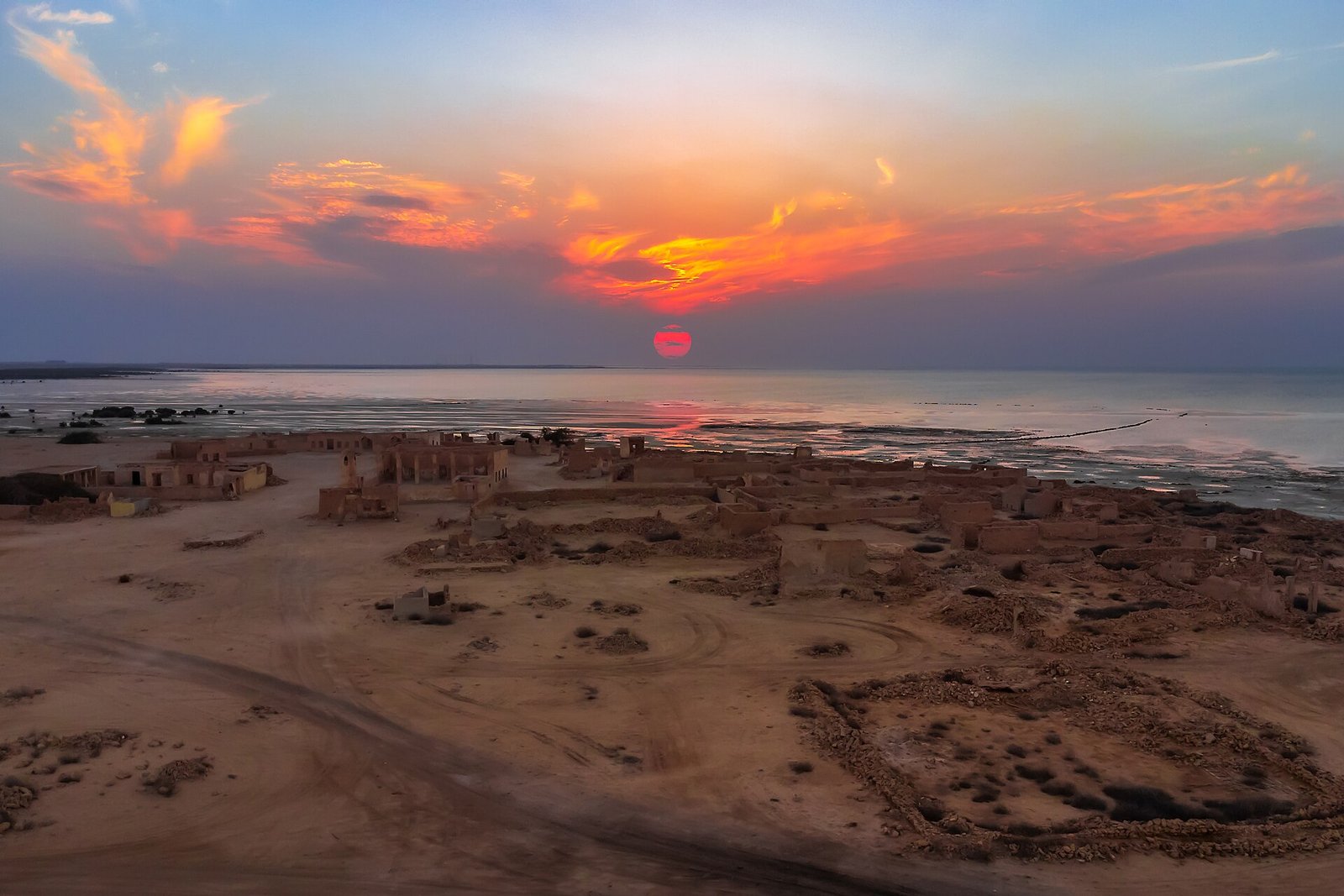
A 19th-century pearling and fishing village a few kilometres west of Al Ruwais, empty since the 1970s, with a standing minaret that is the tallest thing for some distance. Al Jumail became one of Qatar’s best-known sunset photos because the coral walls turn gold while the Gulf catches the light behind them.
Access status: Qatar Museums states that Al Jumail Heritage Village is not open to the public, and it has been fenced since at least 2021. You can still see and photograph the village from outside the boundary; walk the fence line and use a longer lens rather than trying to get in close.
Getting there: roughly an hour to an hour and a half from Doha, on tarmac except for a short unpaved track of around 600 m. An ordinary car manages it slowly in dry weather; avoid it after rain.
Arrive: at least 45 minutes before sunset to find your angles. There are no facilities. Read our full guide to Al Jumail.
6. Al Khuwayr and Al Arish abandoned villages
Further west along the coast, two more empty villages sit a few kilometres apart. Al Khuwayr, on a turquoise bay, has a minaret and a row of pillars that both work as silhouettes against the sunset; it is linked to the 19th-century raider Rahma bin Jaber’s base of Khor Hassan. Al Arish has a cracked minaret, an old police station and stone fish traps, with salt flats beyond that draw wading birds in the cooler months.
Access: about 110 to 120 km and an hour and a half from Doha. The last stretch is a sandy or gravel track. A careful driver in a normal car can usually reach the edge of the ruins in dry weather, but a 4×4 or SUV is the safer choice, and after rain the low ground can be soft and muddy.
Arrive: late afternoon, and stay for sunset over the bay. Respect any fences or restoration work. Read our guides to Al Khuwayr and Al Arish.
7. Shadows Travelling on the Sea of the Day, near Al Zubarah
Olafur Eliasson’s installation, commissioned by Qatar Museums and opened in October 2022, is a cluster of white circular shelters and rings in the stony desert just north of Al Zubarah. Stand under one of the roofs and look up into its mirror and you see the sand, the sky and yourself upside down. In the last two hours before sunset, shadows stretch across the gravel and the mirrors fill with warm colour.
What’s in frame: the circles against open desert with nothing on the horizon. The low sun throws the rings’ shadows into long ellipses, which is the shot most people come for.
Access: paved roads all the way; you leave the car at the gate and walk in. No 4×4 needed. No bins or facilities.
Combine it: visit Al Zubarah Fort and Archaeological Site first. Qatar’s UNESCO World Heritage Site is open Saturday to Thursday 9am to 5pm and Friday 12.30pm to 5pm, so in winter you get warm late light on the fort but not the sunset itself from inside the grounds. Then drive the short distance to the installation for the last hour. The stone fish traps at Freiha, 3 km north of Al Zubarah, are also atmospheric in late light at low tide; contact Qatar Museums before visiting. Read our full guide to Shadows Travelling on the Sea of the Day.
A family-friendly northern option: Abu Dhalouf Park
If you want facilities and a playground rather than ruins, the small seafront park at Abu Dhalouf, just west of Al Ruwais, is a calm place to watch the evening light wash over its white arcade and the sea. The route is paved all the way and children get a run around before the long drive home.
Desert sunsets: Sealine, the Singing Dunes and the Inland Sea
South of Doha the landscape changes to sand. Here the sea is mostly to the east, so you are not watching the sun meet the water; instead, you watch the dunes turn orange and every ripple and crest line sharpen in the low light.
8. Sealine dunes and beach
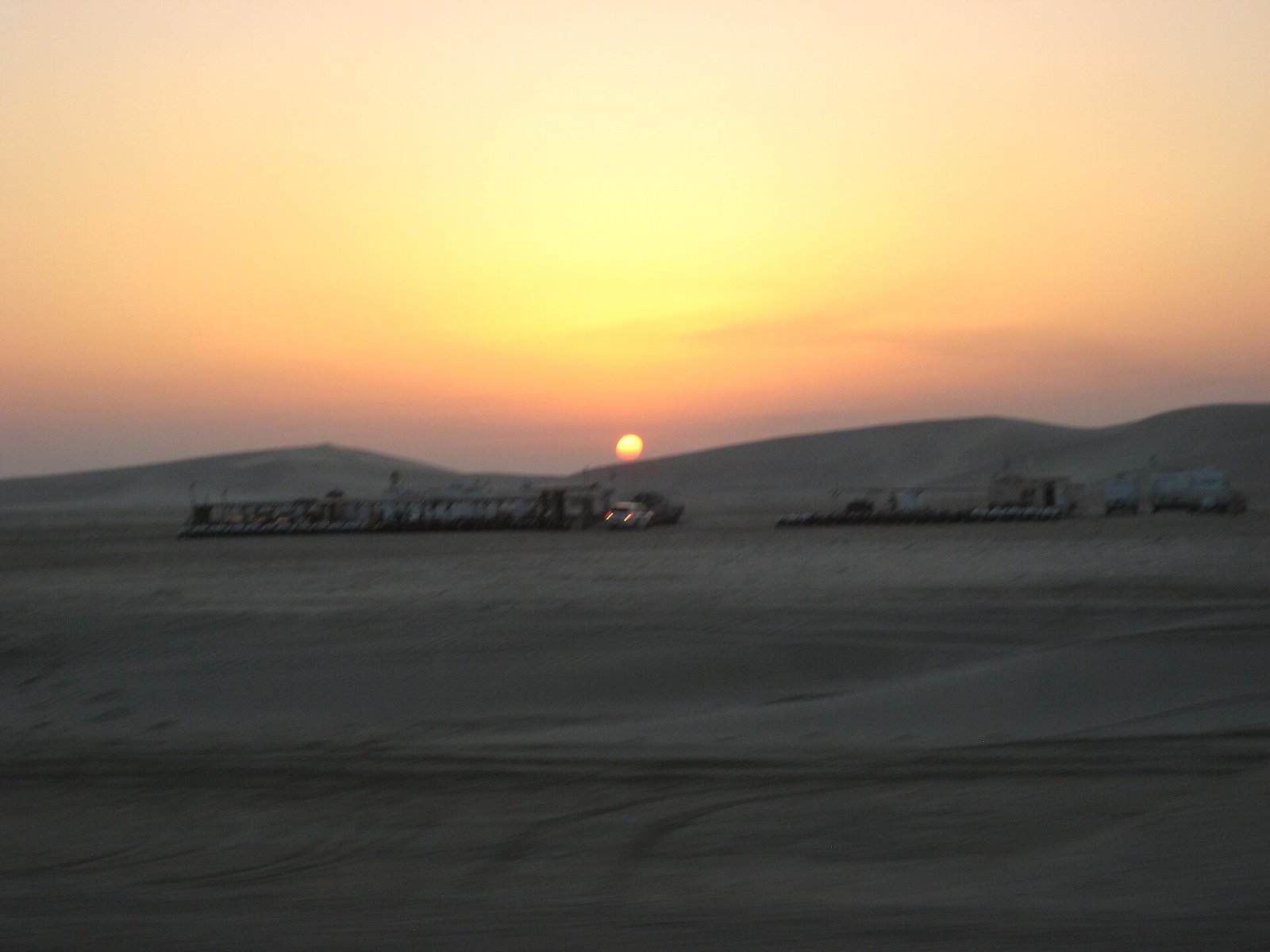
About 40 minutes south of Doha, past Mesaieed, the tarmac ends at a long shore of pale sand with dunes rising behind it. The classic plan is to arrive mid-afternoon, swim, ride a camel or watch the 4x4s on the dunes, then climb a little way up the dunes behind the beach for sunset as the coast turns orange.
Access: paved road to the public beach and free parking near it; no 4×4 needed unless you want to drive into the dunes, which takes a 4×4, lowered tyre pressures and experience.
Facilities: limited on the public beach and changing as Qatar’s national beach upgrade work goes ahead. For full facilities, Sealine Beach, a Murwab Resort offers day use, and Regency Sealine Camp has air-conditioned seafront tents for an overnight stay.
Safety: quad bikes and 4x4s share the dunes; keep children close and keep away from vehicle routes. Read our full guide to Sealine Beach.
9. Singing Sand Dunes
A set of crescent dunes inland of Mesaieed, about 40 km south-west of Doha, whose sand can hum when it slides on dry days. The curved crests and ripples look best in low, raking light, so the hour before sunset is ideal.
Access: 40 to 50 minutes from Doha. No 4×4 needed if you park on hard ground by the road and walk in; the walk is short. Do not drive an ordinary car onto the sand: that is the most common way a visit here goes wrong.
Facilities: none. No gate, ticket, toilets or bins. Read our full guide to the Singing Sand Dunes.
10. Khor Al Adaid (Inland Sea)
In the far south-east, against the Saudi border, a tidal channel winds inland to a wide lagoon ringed by dunes that Visit Qatar says reach about 40 metres. Afternoon trips are timed so you watch the sun go down over the dunes, when the sand turns orange and the water goes silver, and then the stars come out with very little light pollution. The area is a protected nature reserve and has been on Qatar’s UNESCO World Heritage Tentative List since 2008.
Access: about an hour from Doha to Sealine on tarmac, then 40 minutes to an hour across open sand. This needs a 4×4, lowered tyres and dune experience; most people go with a tour, which usually takes four to six hours door to door. If you drive yourself, go in convoy with someone who knows the route.
Facilities: none at the water unless you book a camp. Read our full guide to Khor Al Adaid.
City sunsets in Doha and Lusail
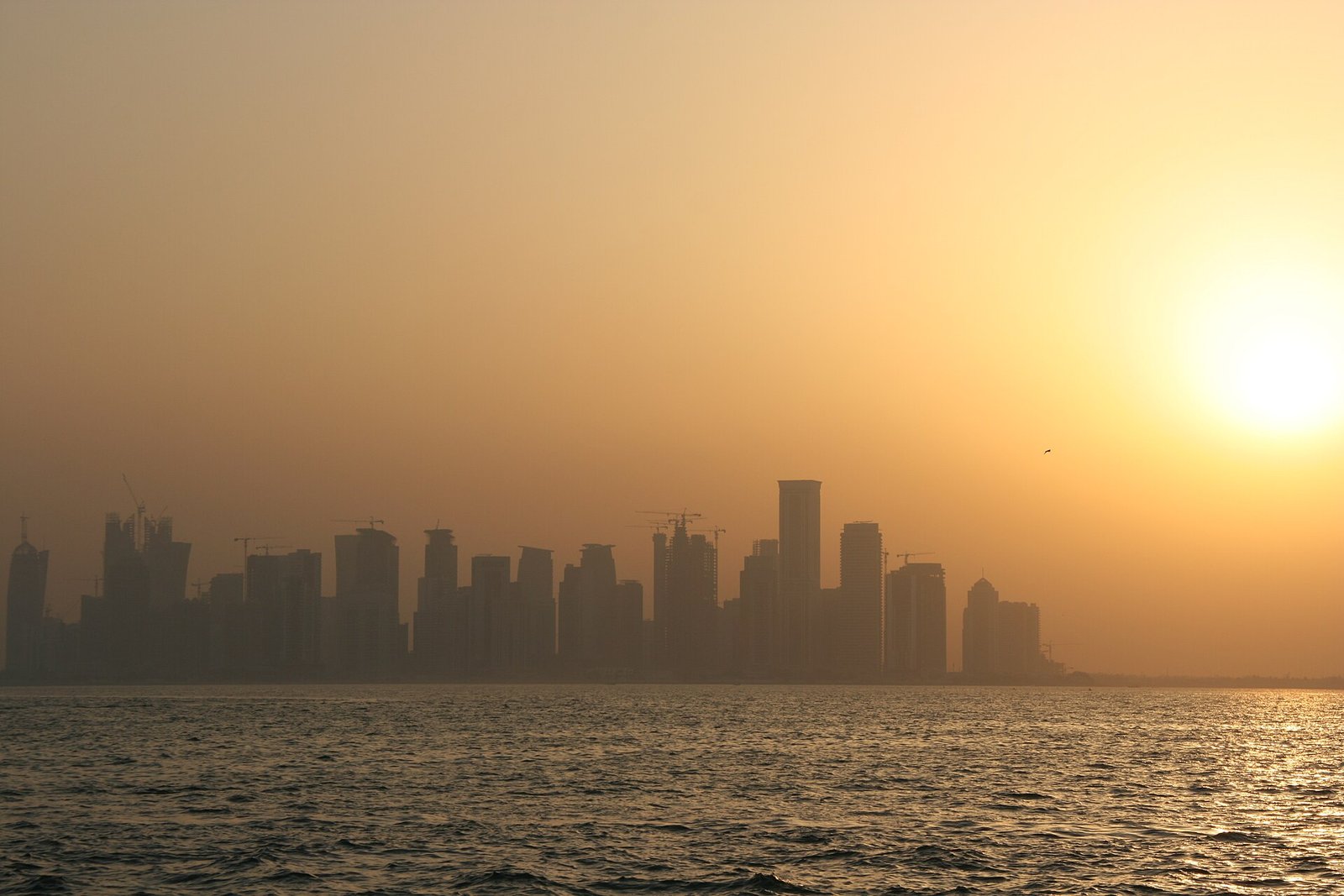
In the city you rarely see the sun touch the horizon. What you get instead is a two-part show: half an hour of warm light on the skyline and the water, then the blue hour, when the towers light up and their reflections stretch across the bay. Because twilight is short, plan to be in place 30 minutes before sunset and to stay for 30 minutes after. These spots are also your best option from May to September, when out-of-town trips are hard work in the heat; come late and stay into the evening.
11. MIA Park and Richard Serra’s 7
MIA Park wraps around the Museum of Islamic Art on the Corniche, and at the tip of its crescent-shaped promenade stands Serra’s 7, a 24-metre steel tower unveiled in 2011. From here you look north-west across the bay to West Bay. The sun itself goes down to the west, over the Corniche, so the towers take warm side light and then switch on one by one.
What’s in frame: the skyline across the water, the steel tower lit from below after dark, and the museum’s geometric silhouette behind you. Step inside the sculpture at blue hour and look up for a frame of sky few people photograph.
Arrive: about 30 minutes before sunset. The walk from the museum to the sculpture takes 10 to 15 minutes.
Facilities: the park is free and open 24 hours, with paths, lawns and food trucks that Visit Qatar mentions among its attractions. The museum itself is closed on Wednesdays and opens from 1.30pm on Fridays. Read our full guide to Serra’s 7 and MIA Park.
12. The Corniche, dhow harbour and Old Doha Port
The 7 km Corniche promenade curves around Doha Bay, and its most photogenic stretch is the dhow harbour opposite Souq Waqif, where wooden boats bob in front of the West Bay towers and the Pearl Monument stands at the entrance. Stand on the promenade and shoot north-west across the moorings. The sun sets to the left of the towers, behind the western Corniche, so the classic picture here is warm light and colour in the sky with the skyline in front of it, rather than the sun dropping behind the buildings.
On the water: short shared dhow rides leave from the harbour, mostly in the afternoon and evening. Take one just after sunset rather than before to see the towers light up from the middle of the bay. Organised sunset cruises are also available; one operator, Discover Qatar, listed a two-hour shared sunset cruise at QAR 150 per person for autumn 2026.
Just round the bay: the wooden promenade at Old Doha Port and the Mina District looks straight back at the West Bay skyline, with pastel buildings and boats in the foreground. At the western end of the Corniche, Al Bidda Park is good for an evening picnic.
Getting there: central Doha; the Corniche station on the Metro Red Line is a pleasant waterfront walk away. Parking along the Corniche fills on weekend evenings. Read our full guide to the dhow harbour.
13. Katara Cultural Village and the pigeon towers
Katara’s tall clay dovecotes stand beside the tiled Katara Mosque, and in the hour before sunset they glow orange against the sky. The beach at Katara faces east, so this is a sunset of warm light on buildings rather than sun over the sea.
Arrive: an hour before sunset, start at the three towers by the mosque, then walk on to the two by the sea. Parking near the mosque fills on busy weekend evenings, and Katara has large underground car parks.
Etiquette: sunset is the time of Maghrib prayer, so the mosque will be busy. Keep your voice down near the entrance and don’t photograph worshippers. Read our full guide to the Katara pigeon towers.
14. Lusail Marina Promenade
A palm-lined waterfront walk around Lusail’s marina, with yachts, fountains and the curved Katara Towers. It is calm and fairly quiet by day; after sunset the towers light up and reflect in the marina, and families and joggers come out.
Arrive: in the hour before sunset and stay for about an hour after dark. Allow 15 to 25 minutes from West Bay by car. Read our full guide to Lusail Marina Promenade.
15. Qanat Quartier, The Pearl
The Pearl’s Venice-inspired canal district, with pastel façades, arched bridges and calm water. In the last 20 minutes before sunset, stand on one of the smaller footbridges and look along the canal towards the larger bridge: the façades turn gold and reflect in still water. After dark, lamps and lit windows give a softer mood.
Access: 15 to 25 minutes from West Bay; public areas are free and open at all times. Some canal edges are unfenced. For dinner with a view afterwards, the island hotel Marsa Malaz Kempinski has restaurants open to non-guests. Read our full guide to Qanat Quartier.
East-facing favourites: better at sunrise
A few of Qatar’s most-loved beaches appear on sunset lists but face east, so the sun sets behind you over land. They are still lovely in the evening light, but if the sun itself is what you are after, go at dawn instead.
- Al Ghariya Beach: a long northern beach with a slim lighthouse that makes a fine subject in warm evening light. The coast faces the rising sun, and the water is often glassy first thing.
- Fuwairit Beach: Visit Qatar lists it among its sunset places for its white sand and clear water, but it faces east and is a hawksbill turtle nesting beach, closed every year from 1 April to 1 August. Visit from October to March and keep away from nesting areas.
- Al Wakrah Souq and Beach: the sun sets behind the old town, but the low-tide shore walk followed by seafood at the souq makes a relaxed evening.
- Purple Island, Al Khor and Al Farkiya Beach are on the east coast too, and are best in the morning.
When to go: a seasonal sunset calendar
November to March (and the shoulder months)
Evenings are mild, the air is usually clearer and sunsets come early, between about 4.45pm and 5.45pm. This is the time for the west coast, the north-west villages and the desert. October and April also work for beaches, with warm afternoons. Desert evenings cool quickly after sunset, so bring a warm layer. It is also the winter camping season: in 2025–26 the Ministry of Environment and Climate Change ran it from 15 October to 15 April, with registration required for camps. As of early autumn 2026 the 2026–27 dates had not been published, so check the Ministry’s announcements before you plan an overnight stay.
May to September: city sunsets only
Heat and humidity make long drives and desert walks hard work, and dust and haze often turn the sun into a pale red disc well before it reaches the horizon. Stick to waterfront spots in Doha and Lusail, arrive just before sunset and stay for the lights. Sunset is late, around 6.10pm to 6.30pm.
Weather that makes or breaks a sunset
The best sunsets usually follow a clear day with a few high clouds to catch the colour. Strong north-westerly shamal winds lift dust that can flatten the colours; the days after winter rain are often the clearest of the year, though tracks to the north-west villages can be soft then.
Photography tips for phones and cameras
Phones
- Lock exposure on the sky. Tap the bright part of the sky, then drag the exposure slider down slightly. Silhouettes of plates, palms and minarets look stronger slightly underexposed.
- Avoid digital zoom. Use the phone’s optical telephoto lens if it has one, or walk closer. Zooming a wide lens on a bright sun gives mushy results.
- Switch to night mode at blue hour. Rest the phone on a harbour wall or bag for the lit skyline and reflections at MIA Park, the dhow harbour or Lusail Marina.
- Clean the lens. Dust and fingerprints cause the haze and flare you see around the sun in many beach photos.
Cameras
- Take two lenses: a wide angle for the dunes, ruins and canals, and a telephoto (70–200mm or longer) to compress the Serra plates into a line or pull the West Bay towers closer.
- Bracket exposures or use a graduated ND filter at the coast, where the sky is far brighter than the sea and rocks.
- Set white balance to daylight rather than auto, so the camera does not cancel out the warm colour.
- Bring a tripod for blue hour and for night skies on the Zekreet Peninsula.
- Protect your gear from sand. Change lenses inside the car, not in the wind, and keep a blower brush handy.
- Watch for condensation. In humid months, a camera taken from an air-conditioned car fogs instantly. Let it warm up in a closed bag for a few minutes.
Driving back in the dark: safety first
The light goes fast in Qatar, and most of the out-of-town spots on this list have no lighting at all. The drive home is the riskiest part of a sunset trip.
- Learn the way out in daylight. Desert tracks look completely different after dark. Note where you left the tarmac and save it on your map.
- Download offline maps. Mobile coverage is patchy on parts of the Zekreet Peninsula and in the dunes.
- Never cross dunes at night without a professional guide. If you are self-driving to the Inland Sea, be back on the tarmac before dark or stay at a registered camp.
- Keep off soft sand in an ordinary car, especially after rain. Getting stuck is the most common way sunset trips go wrong.
- Watch for animals. Camels and other livestock can wander onto unlit rural roads.
- Fuel up before you go. Stations are sparse on the west coast and in the north-west; Dukhan, Madinat ash Shamal and Mesaieed are the useful ones.
- Carry a torch or head torch for the walk back to the car from the Serra plates, the ruins or the dunes, and tell someone where you are going.
Qatar’s emergency number is 999.
Etiquette and rules
- Dress modestly in public places, covering shoulders and knees, especially in the city, at heritage sites and around mosques. Swimwear is fine on the beach itself.
- No alcohol in public places, including beaches and parks.
- Respect family areas and women-only days, such as those at some fenced public beaches.
- Ask before photographing people, and never photograph women or families without permission.
- Drones are regulated in Qatar. Check the Qatar Civil Aviation Authority’s rules before you fly, and never fly near the Dukhan oil installations or over crowds.
- Leave no trace. Take every bit of rubbish home, keep barbecues off the sand and lawns where signs say so, and never drive across protected areas or rawdas.
- Keep off the ruins and artworks. Don’t climb walls at abandoned villages or write on the Serra plates, which have already had to be cleaned of graffiti.
What to bring
- Plenty of water, more than you think, and snacks
- A warm layer for winter evenings in the desert or on the coast
- A torch or head torch, and a charged power bank
- Comfortable closed shoes for gravel, ruins and dunes
- Rubbish bags
- For self-drive 4×4 trips: tyre gauge, compressor, tow strap and a shovel
Common mistakes to avoid
- Arriving at sunset. The best colour often comes in the 20 minutes before, and twilight is short. Aim for 45 to 90 minutes early out of town.
- Assuming everything is open. Al Jumail is fenced, several Qatar Museums forts are temporarily closed and the tip of the Zekreet Peninsula opens mainly during the winter Brouq season. Check before you drive.
- Driving a saloon car onto sand at the Singing Dunes, Sealine or along the beach at Umm Bab.
- Leaving straight after the sun goes down in the city. At MIA Park, the Corniche and Lusail, blue hour is the best part.
Frequently asked questions
Where is the best place to watch the sunset in Qatar?
For most people, East-West/West-East, Richard Serra’s four steel plates in the Brouq Nature Reserve on the Zekreet Peninsula, about an hour and a quarter from Doha. For the sun setting into the sea with an easy drive, choose Dukhan Beach or Umm Bab on the west coast. In the city, MIA Park and the Corniche dhow harbour are the classic choices.
What time is sunset in Doha?
It ranges from about 4.45pm in late November and December to about 6.30pm in late June and early July. In October it falls from about 5.20pm to 5.05pm, and in March it moves from about 5.35pm to 5.45pm. The sky is dark around 25 minutes after sunset.
Which beaches in Qatar face west for sunset?
The west-coast beaches: Dukhan, Umm Bab (Palm Tree Beach) and the shores of the Zekreet Peninsula, plus the north-west coast around Al Jumail, Al Khuwayr and Al Arish. Most beaches near Doha, Al Khor and the north-east, including Fuwairit and Al Ghariya, face east and are better at sunrise.
Do I need a 4×4 to see the sunset at the Richard Serra sculpture?
It is recommended. The last few kilometres are unpaved, and while some people drive them slowly in an ordinary car, a 4×4 or high-clearance SUV is safer, especially for the drive back in the dark. Sunset 4×4 tours from Doha are an easy alternative.
Can I watch the sunset in the desert without a tour?
Yes, at Sealine Beach and the Singing Sand Dunes, both reachable on paved roads. Park on hard ground and walk onto the dunes. The Inland Sea is different: it needs a 4×4 and dune experience, so most visitors book a tour.
Is it safe to drive back from the west coast after dark?
Yes on the main highways, with care. The risk is on unlit desert tracks: learn your route in daylight, keep off soft sand, watch for livestock on rural roads and never cross dunes at night without a guide.
Can I see sunset at Al Jumail if it is closed?
Yes. Qatar Museums keeps the village fenced and closed to the public, but you can view and photograph it from outside the fence, with the sun setting over the sea behind the ruins.
Last checked October 2026. Rules, fees and access can change, so confirm with the official source before you go.