A Qatar road trip is easier than most visitors expect. The country is a small peninsula with fast, well-maintained highways, so every route in this guide starts and ends in Doha on the same day. You can loop the far north, follow the west coast past limestone mesas and an oil town, or head south to where the dunes meet the sea, all with a normal hire car for most of the way. The catch is the last few kilometres: some of the best stops sit at the end of sandy tracks, several heritage forts are currently closed or view-only, and the summer heat changes everything.
This guide is built around six self-drive routes, each with its stops in driving order, approximate distances and drive times between them, the type of road you will be on, where to fill up, and exactly where a 4×4 becomes necessary. If you would rather pick a single destination than drive a loop, our guide to day trips from Doha groups the same places by direction. This page is for people who want to plan the drive itself.
Distances and times below are our estimates from map routing between the coordinates of each place, rounded and labelled approximate. Real times depend on where in Doha you start, traffic leaving the city and how long you stop.
At a glance
- Easiest loop: Al Shahaniya (camel racetrack, Heenat Salma Farm, Sheikh Faisal Museum), about 100 km round trip on paved roads.
- Biggest day: the north loop via Al Khor, Al Ruwais and Al Zubarah, about 285 km and four to five hours of driving.
- 4×4 needed: Khor Al Adaid (go with a licensed tour), the tracks around Zekreet and Ras Abrouq, and Dahl Al Misfir Cave. Many rental agreements forbid off-road driving.
- Closed or view-only right now: Zekreet Fort, Barzan Towers, Al Rakiyat Fort, Al Jassasiya (temporarily closed per Qatar Museums); Al Thaqab, Umm Salal Mohammed Fort and Al Jumail (view from outside the fence); Simaisma Beach (closed since June 2025).
- Seasonal: Fuwairit Beach closes 1 April to 1 August for turtle nesting; northern Zekreet is gated outside the winter Brouq Season.
- Best season: November to March. From June to September, drive early, keep stops short and never leave the tarmac alone.
- Fuel: fill up in Doha, Al Khor, Madinat Al Shamal or Al Ruwais, Dukhan and Al Shahaniya. Stations thin out fast in the north-west and south-west.
The six routes compared
Use this table to choose. Distances are approximate round trips from central Doha by the most direct paved roads, excluding off-road detours.
| Route | Main stops | Approx. distance | Driving time | Road type | 4×4? | Best for |
|---|---|---|---|---|---|---|
| 1. North loop | Al Khor, Al Thakira, Al Ghariya, Al Ruwais, Al Jumail, Al Zubarah | 280–300 km | 4–5 hours | Highway, coast roads, short dirt tracks | No | Mangroves, beaches, ruins, a full day out |
| 2. West coast | Zekreet, Film City, Dukhan Beach, Umm Bab | 260–290 km | 4.5–5.5 hours | Highway, then unpaved tracks | Yes for Film City outside events | Desert scenery, sunsets, empty beaches |
| 3. South | Al Wakrah, Sealine, Khor Al Adaid | 110–120 km on tarmac | About 2 hours plus dune crossing | Highway to Sealine, then open sand | Yes, tour only beyond Sealine | Dunes, swimming, the Inland Sea |
| 4. Heritage forts | Umm Salal, Barzan, Al Rakiyat, Al Thaqab, Al Zubarah | 240–260 km | 3.5–4 hours | Highway, desert roads, short tracks | Not usually; SUV helps at Al Thaqab | History, photography, a UNESCO site |
| 5. Al Shahaniya | Al Shaqab, Sheikh Faisal Museum, Heenat Salma, camel racetrack | About 100 km | 2–2.5 hours | Highway and paved local roads | No | Families, culture, a half day |
| 6. Desert art | East-West/West-East, Zekreet mushroom rocks, Zekreet Fort (outside) | 180–200 km | 3.5–4.5 hours | Highway, then rutted desert tracks | SUV or 4×4 strongly advised | Land art, sunset photography |
Before you set off: car hire and licence rules
You do not need a car inside Doha, where the metro, taxis and ride-hailing cover most sights (see our Doha for first-timers guide). For every route below, though, a car is the only practical way to travel independently: there is no public transport to Al Zubarah, Zekreet, Umm Bab or the camel racetrack, and taxis are hard to find for the return.
Who can drive
Licence rules depend on your nationality and how long you have been in Qatar, so treat the following as a guide and confirm with your rental company and the General Directorate of Traffic before you travel. According to Ministry of Interior guidance reported by local outlets in 2026, visitors from outside the GCC with a licence from an approved country can generally drive on their home licence for up to seven days from arrival, and for up to six months with an International Driving Permit carried alongside the original. GCC licence holders can drive for up to three months. Rental desks often ask for both your licence and an IDP regardless, so the simplest advice is to get an IDP at home before you fly. Driving without a valid licence carries heavy penalties.
Choosing a car
An economy or mid-size saloon handles routes 1, 4 and 5 and the paved parts of routes 2, 3 and 6. Qatar Living’s 2026 rental guide puts typical daily rates at about QAR 80 to 150 for an economy car and QAR 200 to 450 for an SUV or 4×4, with a refundable deposit of roughly QAR 1,000 to 2,500 blocked on a credit card. Expect a minimum age of around 21 at most desks. Before you sign, read the off-road clause: many agreements forbid driving on sand or unpaved tracks, which means your insurance may not cover you on the final stretch to Film City or the Serra sculpture even in a hired 4×4. Our Qatar on a budget guide compares hiring with tours, and our Qatar itinerary shows how a car fits into a week.
Navigation and signal
Download offline maps for the whole country before you leave. Main roads are well signposted in Arabic and English, but signs and mobile signal fade on the north-west and south-west coasts and on the Zekreet peninsula. Save each stop’s map pin from our place guides; several sites have no signposting at all.

Route 1: the north loop (Al Khor to Al Zubarah)
Approx. 280–300 km round trip, 4–5 hours’ driving, normal car. Allow a full day.
This is the classic Qatar road trip: mangroves and a family beach in the morning, empty coast and abandoned pearling villages at lunchtime, and the UNESCO-listed ruins of Al Zubarah in the afternoon light. Drive it clockwise, as below, so you end on the west coast and return to Doha on the fast cross-country road.
Stop 1: Al Khor (about 50 km, 40–50 minutes from Doha)
Take Al Shamal Road north, then the Al Khor Expressway. Al Khor is the last big town on this route with plenty of fuel, supermarkets and cafés, so it is the natural first stop. Families can start at Al Khor Park (park and zoo, small entry fee) or the fenced family beach at Al Farkiya. Early risers should walk the boardwalk on Purple Island before the heat builds. Our things to do in Al Khor guide covers the town in more depth.
Stop 2: Al Thakira mangroves (about 25 km, 25–30 minutes)
Head north of town to the grey mangrove channels at Al Thakira. You can look from the shore for free, but the best way in is a guided kayak tour, which needs booking; good operators set start times around the tide. If you are kayaking, make this your first stop and do Al Khor afterwards. Birders should read our mangroves and birdwatching guide first.
Optional: Al Jassasiya and Fuwairit
Further up the east coast, the rock carvings at Al Jassasiya are currently listed by Qatar Museums as temporarily closed until further notice, so check Qatar Museums before visiting. About 5 km north, Fuwairit Beach is one of Qatar’s main hawksbill turtle nesting beaches and is closed to the public from 1 April to 1 August; between August and March it is normally accessible, though fenced zones can remain.
Stop 3: Al Ghariya Beach (about 55 km, 45 minutes from Al Thakira)
Al Ghariya is a long, quiet stretch of sand on the north-east coast with a fenced women-only beach (Al Mamlha) beside it. It makes a good swim or picnic stop. Stay off the upper beach in your car and respect any turtle fencing.
Stop 4: Al Ruwais and the far north (about 25 km, 25 minutes)
The road bends west along the top of the peninsula to Al Ruwais, with its restored mosque, 1950s police station and fishing harbour. This is your refuelling stop for the north-west: fill up here or in Madinat Al Shamal, because there is little beyond. On the way, the shallow beach at Al Mafjar has mangroves and a fenced abandoned village, and families with young children can stretch their legs at Abu Dhalouf Park just to the west.
Stop 5: Al Jumail and the ghost villages (about 10 km, 10–15 minutes)
Al Jumail is the most photographed abandoned village in the north, but Qatar Museums states it is not accessible to the public and it is fenced, so view and photograph it from outside. Further south-west along the coast, the ruins of Al Khuwayr and Al Arish are reached by short dirt tracks; respect any fences or restoration signs.
Stop 6: Al Zubarah (about 20 km, 15–20 minutes)
Finish at Al Zubarah Fort and Archaeological Site, Qatar’s UNESCO World Heritage Site. Our guide lists the usual hours as Saturday to Thursday 9am to 5pm and Friday 12.30pm to 5pm, free with a ticket, but check Qatar Museums before visiting. Just north are the ruins of Freiha and Olafur Eliasson’s desert installation Shadows Travelling on the Sea of the Day, both worth half an hour in low afternoon light.
Back to Doha (about 105 km, 75–90 minutes)
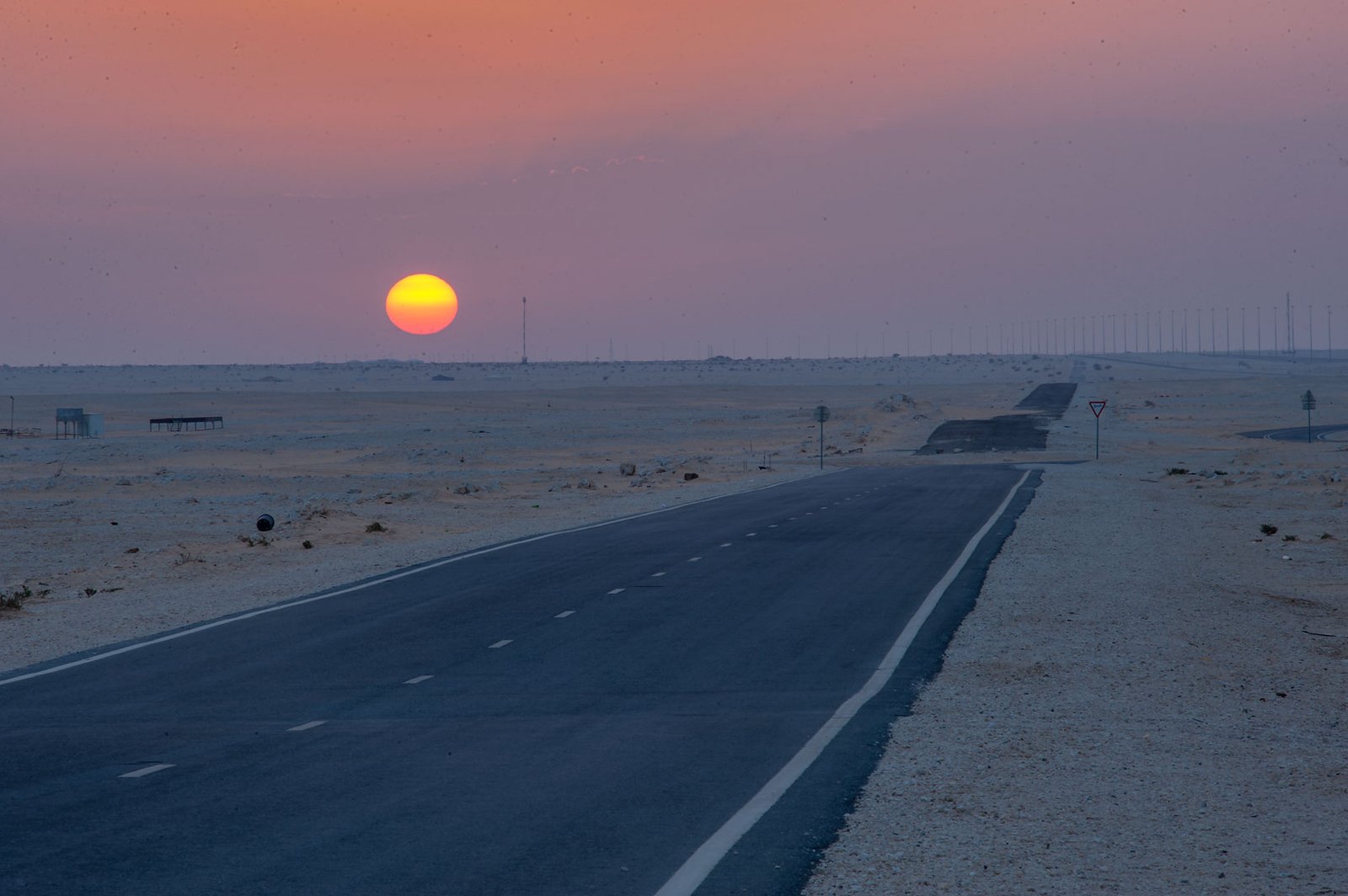
The road east from Al Zubarah back to Al Shamal Road is long, straight and quiet, with few services, so do not set off on an empty tank. Watch for camels near the road and for low sun in your mirrors.
Route 2: the west coast (Zekreet to Umm Bab)
Approx. 260–290 km round trip, 4.5–5.5 hours’ driving. Normal car to Zekreet village, Dukhan and Umm Bab; SUV or 4×4 for Film City and the peninsula tracks outside event season.
The west coast is Qatar at its emptiest: flat-topped limestone outcrops, a film set in the desert, an oil town, and a palm-fringed beach at the end of a long road. It is also the route where the state of the tracks and the season matter most, so read each stop before you go.
Stop 1: Zekreet (about 80 km, 60–75 minutes from Doha)
Leave Doha on the Dukhan Highway, a multi-lane road that runs west past Al Rayyan and Al Shahaniya. Take the Zekreet exit (Visit Qatar gives it as exit 72) and follow Zekreet Road towards the coast. The road to the village is paved. Zekreet Fort, just north of the village, is currently listed by Qatar Museums as temporarily closed until further notice, so check Qatar Museums before visiting and expect to see it only from outside.
Stop 2: Film City and the northern peninsula (about 15 km of tracks, 30–50 minutes)
Zekreet Film City, a mock Arabian village built as a set, sits in the northern part of the peninsula near Ras Abrouq. That northern area has been gated for long periods since around 2020–21 and has opened to the public mainly during Visit Qatar’s winter event, Brouq Season (the 2025–26 edition opened on 26 November 2025 and closed in February 2026). Dates for 2026–27 had not been announced when we checked, so outside the event expect gates. During the event the route has been signposted and event guides said a normal car usually managed; outside it, the last stretch is unpaved with ruts and loose sand, and a 4×4 or high-clearance SUV is the sensible choice. The resort Our Habitas Ras Abrouq is another way into the area, by reservation only.
The southern part of the peninsula, with many of the Zekreet mushroom rocks and Richard Serra’s sculpture, stays open; see route 6.
Stop 3: Dukhan Beach (about 30–35 km, 30–40 minutes back on paved road)
Return to the highway and continue to Dukhan Beach, the public shoreline beside the oil town. The town itself is a QatarEnergy area behind security gates that need a pass, so do not try to drive through. The public beaches, a mosque and a small shopping area with fast food and a supermarket sit outside the restricted zone. Dukhan is the west coast’s main place for fuel and food on this route.
Stop 4: Umm Bab and Palm Tree Beach (about 30 km, 30 minutes)
Head south to Umm Bab Beach, better known as Palm Tree Beach: a cluster of date palms and a breakwater at the end of a long road, about 25 km south of Dukhan. A normal car reaches the main beach; driving along the shore needs a 4×4 with lowered tyres. It is one of the best spots on the coast for a quiet swim and sunset, which is why it appears in our best beaches in Qatar and best sunset spots guides.
Back to Doha (about 110 km, 80–90 minutes)
Take the Umm Bab road (also called the Sawda Natheel road) about 35 km across the desert to Salwa Road, then turn north-east for Doha. This is a dark, quiet road after sunset. Visitors mention the petrol station at Mekaines on Salwa Road as the last reliable stop, so do not count on fuel between Umm Bab and there. If there is still daylight, Al Karaana Lagoon, just off Salwa Road about 60 km from Doha, is a good birdwatching stop.
Route 3: the south (Al Wakrah, Sealine and Khor Al Adaid)
Approx. 110–120 km round trip on tarmac, about 2 hours’ driving. Normal car to Sealine; the crossing to Khor Al Adaid is 4×4 only, and for visitors that means a licensed tour.
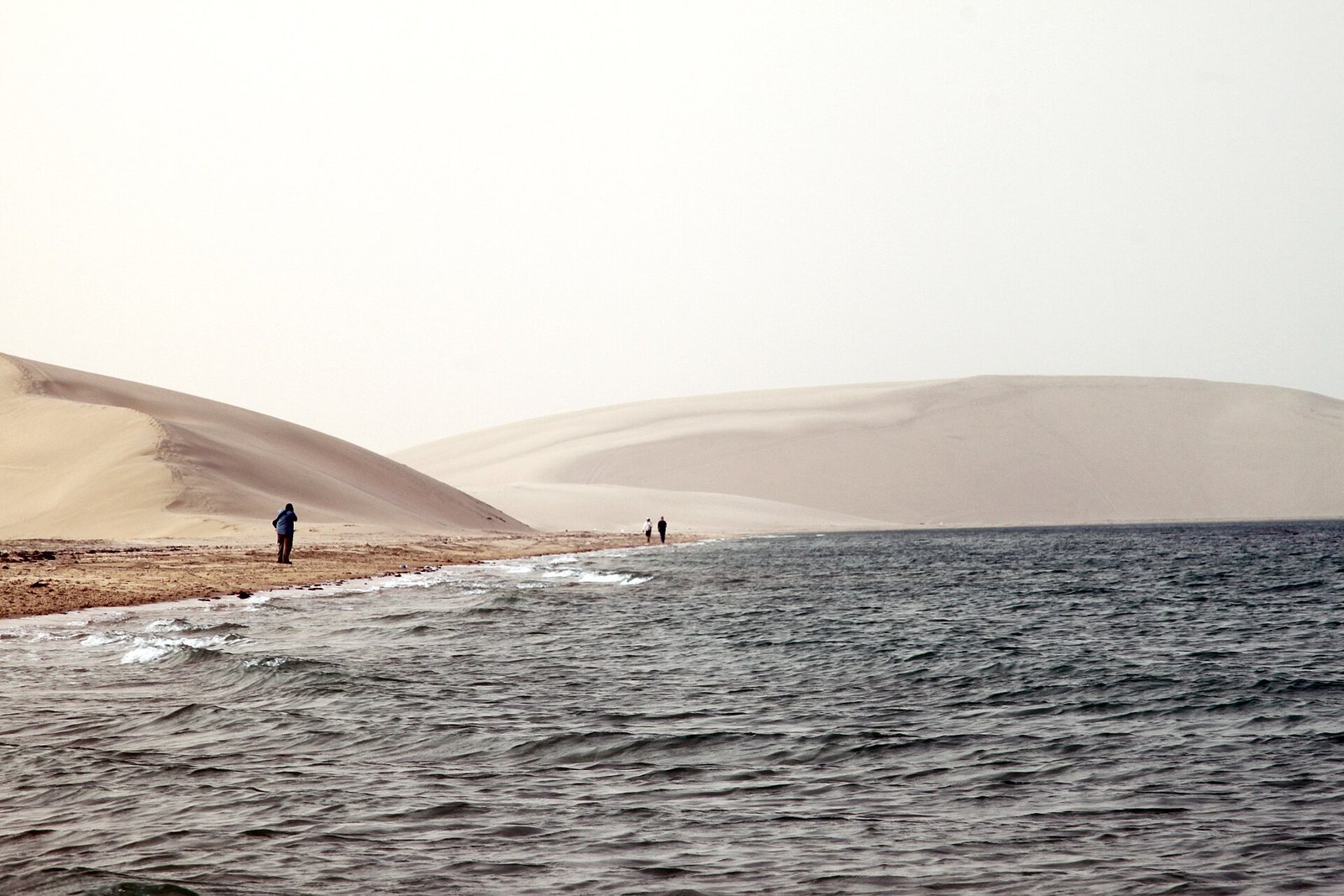
This is the shortest of the six routes and the one where the road genuinely ends. South of Mesaieed the tarmac stops at Sealine, and beyond it lies open sand all the way to the Inland Sea and the Saudi border.
Stop 1: Al Wakrah (about 20 km, 25–30 minutes from Doha)
Al Wakrah Souq and Beach combines a rebuilt souq of low clay-coloured buildings, a public beach and a working fishing harbour. Most souq shops open from the afternoon, so on this route Al Wakrah works best as the evening stop on the way home rather than first thing. It is also a handy place for fuel and supplies before you head south.
Stop 2: Sealine (about 40 km, around 40 minutes)
Follow Mesaieed Road south past the industrial city and on to Sealine Beach, where tall dunes run down to shallow water. You can swim, ride a camel, hire a quad bike or simply watch the tour cars letting their tyres down. For a longer stay there is Sealine Beach, a Murwab Resort, and overnight desert camping with Regency Sealine Camp. On the way, the Singing Sand Dunes, about 40 km south-west of Doha, make a short detour if you want to hear the sand hum.
Stop 3: Khor Al Adaid, the Inland Sea (tour or experienced 4×4 convoy only)
Khor Al Adaid is a tidal lagoon ringed by dunes in the far south-east. From the end of the tarmac at Sealine it is roughly 40 minutes to an hour across open sand, with no signs or marked tracks. Drivers lower tyre pressure (Visit Qatar and experienced local drivers suggest around 18 to 20 psi), navigate by GPS and experience, and reinflate with a compressor before rejoining the road. A normal car cannot go beyond Sealine, and a rental 4×4 is usually barred from off-road driving by the hire contract. Book a licensed operator instead: our desert safari guide explains how to choose one.
Route 4: the heritage forts trail (Umm Salal to Al Zubarah)
Approx. 240–260 km round trip, 3.5–4 hours’ driving. Normal car for paved roads; an SUV helps on the short final approach to Al Thaqab.
Qatar’s small desert forts make a satisfying chain across the north, but be clear about what you will see in 2026. Most of them are currently closed or view-only, and Al Zubarah is the one you can usually walk inside. Treat this as a route for architecture and photography from outside the walls, and check each site’s status with Qatar Museums before you set off. It overlaps with route 1, so you can also add these stops to the north loop.
Stop 1: Umm Salal Mohammed (about 20–25 km, 20–30 minutes from Doha)
The twin watchtowers of Barzan Towers are listed by Qatar Museums as temporarily closed until further notice, and the neighbouring Umm Salal Mohammed Fort is not open to visitors. Both are easy to see and photograph from the surrounding streets; allow 15 to 20 minutes. If you start early, the nearby Umm Salal Central Fish Market is lively in the morning.
Stop 2: Al Rakiyat Fort (about 105 km, 80 minutes)
Drive north on Al Shamal Road, then west on the road across the north-west interior towards Al Zubarah. Al Rakiyat Fort (officially Al Rekayat) is listed by Qatar Museums as temporarily closed until further notice. Walk around the outside to see its single southern gate and corner towers. Buy fuel before you leave Al Shamal Road.
Stop 3: Al Thaqab Fort (about 2.5 km, a few minutes)
Al Thaqab Fort stands just south-west of Al Rakiyat and is not open to the public, so view it from outside. The final approach may be an unmade track: drive slowly, stay on firm ground and avoid it after rain. Old wells in the area can be deep and unfenced.
Stop 4: Al Zubarah (about 10–15 km, 15–20 minutes)
End at Al Zubarah, where the fort and the excavated town are the highlight of the day. Check Qatar Museums before visiting for current hours. The return to Doha is about 105 km, 75 to 90 minutes.
Route 5: Al Shahaniya (camel racing, a farm and two collections)
Approx. 100–110 km round trip, 2–2.5 hours’ driving, normal car. A relaxed half day or an easy full day.
Central Qatar is the gentlest road trip in the country: multi-lane highways and paved local roads all the way, short hops between stops and plenty of air-conditioned time indoors. It suits families and anyone short on time. Do it Monday to Thursday if you can, because the Sheikh Faisal Museum closes on Sundays and Al Shaqab’s visiting days are Sunday to Thursday.
Stop 1: Al Shahaniya Camel Racetrack (about 45 km, 40–50 minutes from Doha)
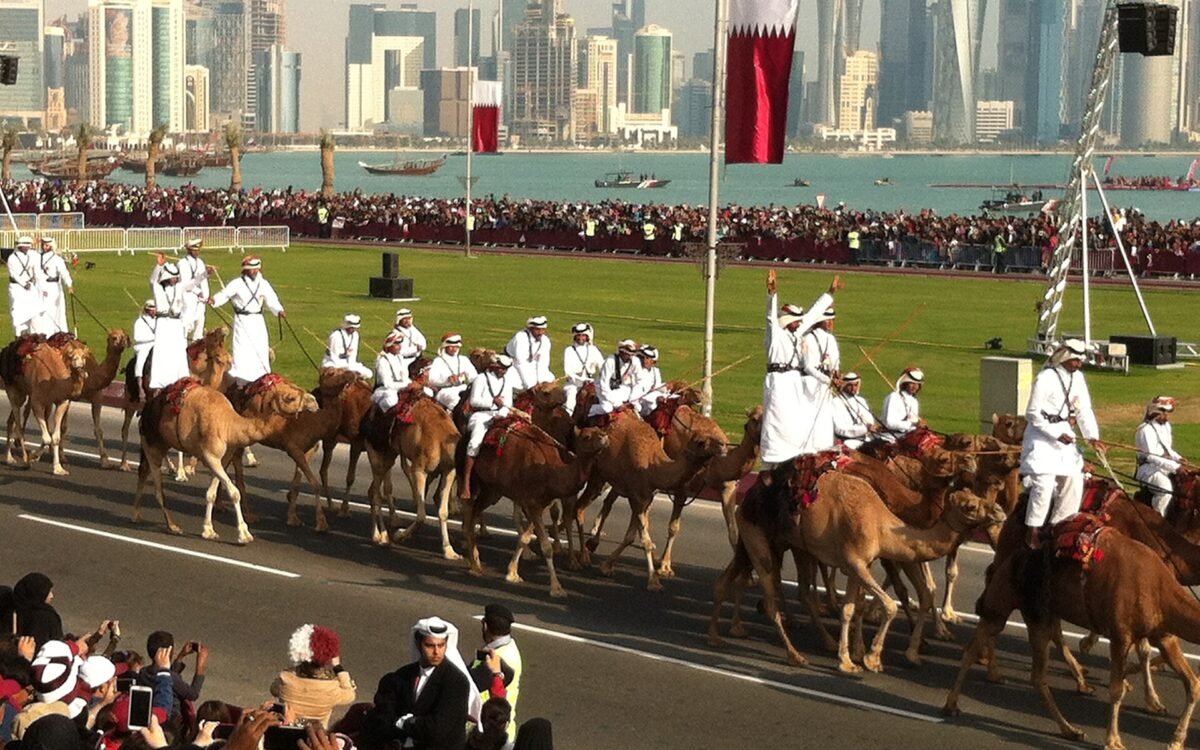
Drive west on the Dukhan Highway to the Al Shahaniya exits and follow your map pin through local roads to Al Shahaniya Camel Racetrack. The racing season runs roughly from September to April and races are held early in the morning, so this is your first stop. Entry on regular race days is free. Park on hard ground well clear of the road used by the owners’ convoy of 4x4s, which races alongside the camels, and never try to join it.

Stop 2: Heenat Salma Farm (about 20 km, 20–30 minutes)
Heenat Salma Farm is an organic farm in the Umm Leghab area, east of Al Shahaniya city, with farm-to-table meals, workshops and tented stays. Visits are by booking, so reserve breakfast or lunch in advance and use the location the farm sends you, as the final turns are on farm roads with little signage.
Stop 3: Sheikh Faisal Bin Qassim Al Thani Museum (about 10 km, 15 minutes)
The Sheikh Faisal Museum at Al Samriya holds a vast private collection, from vintage cars to manuscripts. Its website lists hours of Monday to Thursday 9am to 5pm, Friday 2pm to 7pm and Saturday 10am to 6pm, closed Sunday, with adult tickets at QAR 50 and under-12s free. Allow at least two hours.
Stop 4: Al Shaqab, Education City (about 20 km, 20–25 minutes)
Head back east to Al Shaqab Equestrian Centre on the western side of Education City, where Arabian horses are bred and shown. Our guide lists Sunday to Thursday 7.30am to 3.30pm with tours by arrangement, so book ahead and arrive before the afternoon. Just off Dukhan Road nearby, Al Wajbah Fort has no published hours and the gates may be shut, but the exterior is worth a quick look. Central Doha is 15 to 20 minutes from Al Shaqab.
Optional: Rawdat Rashed and Dahl Al Misfir
South of the Dukhan Highway, Rawdat Rashed is a desert area of green depressions and one of the central zones for winter camping. Driving onto a rawda is now an offence, so stay on existing tracks. Nearby Dahl Al Misfir Cave needs a 4×4 on stony, sandy tracks and is closed in rainy periods.
Route 6: desert art (East-West/West-East and Zekreet)
Approx. 180–200 km round trip, 3.5–4.5 hours’ driving including slow tracks. SUV or 4×4 strongly advised for the last few kilometres.
This short, intense route is about one artwork and the landscape around it. Richard Serra’s East-West/West-East, unveiled in 2014, is a line of four steel plates, two 14.7 metres and two 16.7 metres tall, spanning more than a kilometre across a valley in the Brouq Nature Reserve.
Stop 1: East-West/West-East (about 80 km, 75–90 minutes from Doha)
Follow the Dukhan Highway west, take the Zekreet exit (exit 72) and continue past the village, where the tarmac gives way to a network of graded and rutted desert tracks with rocky patches and soft sand. East-West/West-East is free, unfenced and has no set hours or facilities. One journalist covered the last four kilometres in about 40 minutes in a small sedan, which tells you it is possible in dry weather but slow; an SUV or 4×4 is the sensible choice, ideally with a second car. Park on hard ground beside the track.
Stop 2: the mushroom rocks (about 5–10 km of tracks)
The wind-carved Zekreet mushroom rocks around the Serra valley and along the tracks from Zekreet are the easiest to reach. The famous cluster near Film City lies in the northern zone, which is gated outside Brouq Season, so treat it as a bonus during the event rather than a plan. The track network is confusing: use GPS with an offline map.
Stop 3: Zekreet Fort, from outside (about 10–15 km)
On the way out, pass Zekreet Fort. It is temporarily closed per Qatar Museums, so check Qatar Museums before visiting; you can see the low stone ruin and the bay from the outside. Then rejoin Zekreet Road and the highway for the drive back, about 80 km and an hour or so. Fill up at Dukhan or on the highway before you head into the peninsula.
Fuel, road types and services along the way
Petrol is inexpensive by international standards, with prices announced monthly, and most stations are run by the national retailer WOQOD. The problem is not cost but spacing. Stations cluster in Doha and the towns, then thin out quickly. Treat these as your refuelling points, and fill up whenever you pass one with less than half a tank:
- North: Al Khor, then Madinat Al Shamal and Al Ruwais. The cross-country road from Al Zubarah back to Al Shamal Road has very few services.
- West: the Dukhan Highway and Dukhan town. There is nothing on the Zekreet peninsula tracks.
- South-west: the Mekaines area on Salwa Road is the last reliable stop for Umm Bab and Al Karaana.
- South: Al Wakrah and the Mesaieed area before Sealine.
- Centre: Al Shahaniya and the Dukhan Highway corridor.
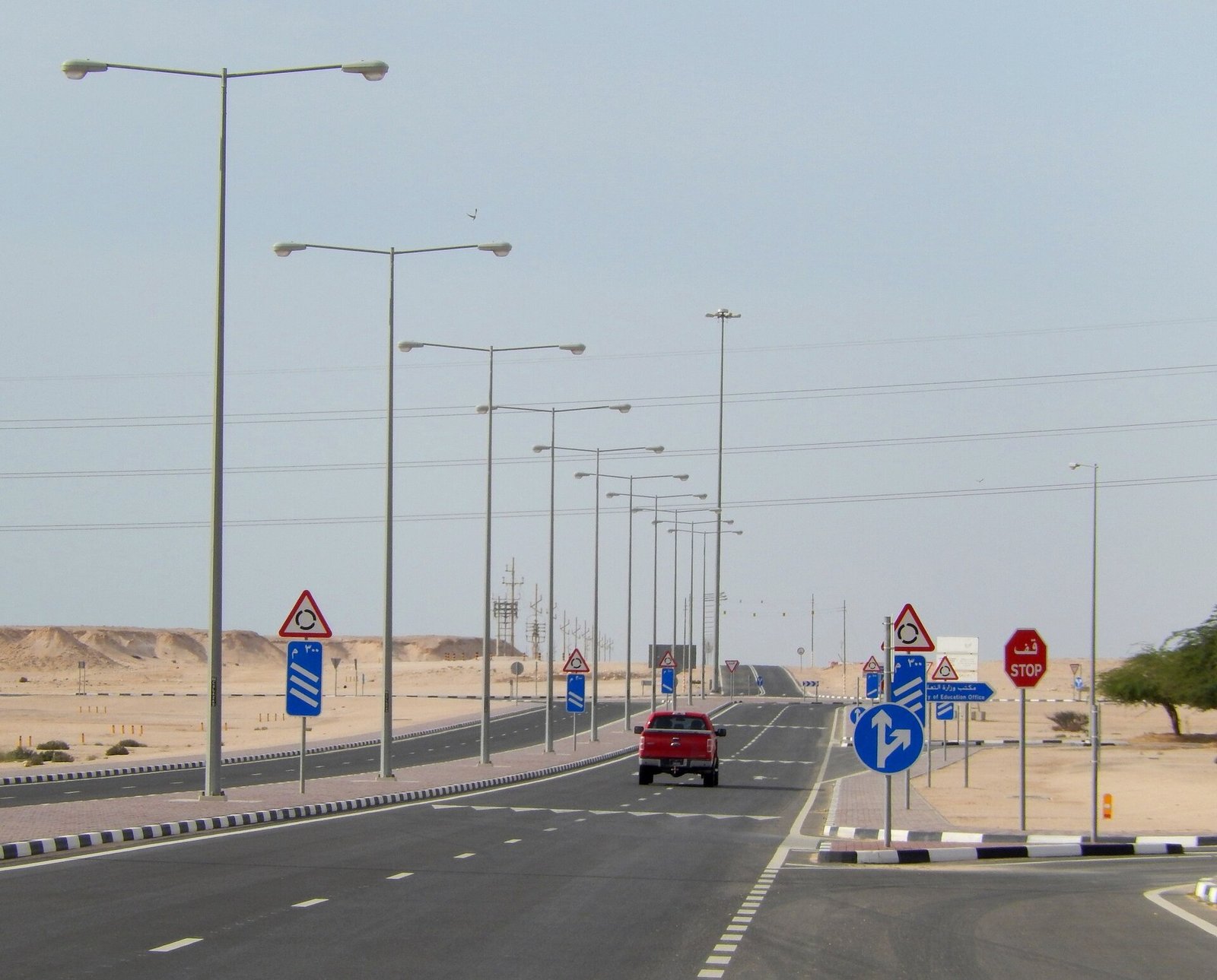
We have not verified every station’s opening hours, so do not rely on a single small station late at night. Road types fall into three groups: fast multi-lane highways (Al Shamal Road, the Dukhan Highway, Salwa Road, Mesaieed Road), quieter two-lane desert roads (the road west to Al Zubarah, the Umm Bab road, Zekreet Road), and unpaved tracks (Zekreet peninsula, the approach to some forts and ruins, the dunes beyond Sealine).
Speed cameras and driving etiquette
Qatar’s highways are excellent and fast, and enforcement is largely automatic. Fixed and mobile cameras are used across the network, and since September 2023 the Ministry of Interior has used automated cameras to record seatbelt and mobile phone violations. Fines are recorded electronically and show up in the Metrash app; your rental company will pass them on to you, often with an admin charge.
- Speed limits: limits vary by road and are clearly signed. Highways are typically 100 to 120 km/h, and limits drop sharply near towns and junctions. Stick to the posted limit, not the flow of traffic.
- Phones and seatbelts: using a handheld phone while driving is prohibited. The driver and front passenger must wear seatbelts, and all passengers should. Children under ten must not sit in the front seat.
- Lane discipline: the left lane is for faster traffic. Keep right unless overtaking, and expect fast cars to approach with lights flashing. Move over when it is safe; do not brake or react.
- Roundabouts and junctions: many old roundabouts have become signal-controlled junctions, but some remain. Give way according to signs and lane markings and choose your lane early.
- Accidents: in an emergency or if anyone is hurt, call 999. For minor accidents with no injuries, residents usually report through Metrash; as a visitor, call your rental company straight away and follow its instructions. Leaving the scene of an accident is an offence.
- Camels and dust: camels wander near roads in the north and centre. Dust and low sun at dawn and dusk can cut visibility fast; slow down and increase your following distance.
Desert driving safety and when you need a 4×4
The honest summary is that most visitors should not drive off-road themselves. Soft sand, hidden sabkha (salt flats that look solid and are not) and a lack of signal can turn a short detour into a long wait. Here is where a 4×4 is genuinely needed on these routes:
| Place | Normal car? | Notes |
|---|---|---|
| Khor Al Adaid (Inland Sea) | No | Experienced 4×4 driver in convoy, or a licensed tour |
| Zekreet Film City and Ras Abrouq | Not outside events | Unpaved tracks; northern area gated outside Brouq Season |
| East-West/West-East | Possible with great care | Last few kilometres on rutted tracks; SUV or 4×4 advised |
| Dahl Al Misfir Cave | No | 4×4 on stony, sandy tracks; closed in rainy periods |
| Umm Bab shoreline | To the main beach only | 4×4 with lowered tyres to drive along the sand |
| Al Thaqab Fort | Usually, with care | Final approach may be an unmade track; avoid after rain |
| Al Zubarah, Al Ruwais, Al Khor, Dukhan, Al Shahaniya | Yes | Paved roads; short dirt tracks at some stops |
If you do take a 4×4 off the tarmac, go with at least two vehicles and someone experienced, tell someone your route and return time, carry a tyre gauge, compressor, shovel, tow strap and plenty of water, and lower tyre pressure before soft sand and reinflate before the road. Never drive onto a rawda or across vegetation, never drive into sand you cannot see the bottom of, and turn back if conditions look worse than expected. For dunes, a guided trip from our desert safari guide is safer and often cheaper than a hire 4×4.
Planning to stay overnight? The official 2026–27 winter camping season runs from 25 October 2026 to 20 April 2027, with registration rules set by the Ministry of Environment and Climate Change. Our camping in Qatar guide explains the zones and options for visitors.
Best season, summer heat and what to pack
November to March is road-trip season: warm days, cool evenings and sunsets before 5.30pm in midwinter, which suits the west-facing routes. October and April are workable if you start early. From June to September temperatures regularly pass 40°C, humidity on the coasts is draining, and a breakdown on a desert road becomes a genuine risk.
- In summer, choose route 5 (mostly indoors) or a short coastal run, leave at dawn and be back by late morning.
- Never leave the tarmac alone in the heat, and never leave children or pets in a parked car, even briefly.
- Check your tyres and coolant before a long drive; heat is hard on both.
- Remember seasonal rules: Fuwairit closes 1 April to 1 August, camel racing pauses roughly May to August, and Brouq Season, when it runs, is a winter event.
What to pack
- At least 2 litres of water per person, plus spare water in the boot
- Food and snacks: there are long gaps between cafés in the north-west and south-west
- Offline maps and saved pins for every stop, plus a car charger or power bank
- Hat, sunglasses, sunscreen and closed shoes for gravel and ruins
- Modest clothing covering shoulders and knees for villages, mosques and heritage sites
- A warm layer in winter, when coastal wind cools quickly after sunset
- Rubbish bags: take everything home, as bins are rare at remote stops
- Your licence, IDP, passport or ID, and the rental agreement and emergency number
- For any off-road plans: tyre gauge, compressor, shovel and tow strap
Etiquette and mistakes to avoid
- Driving to a closed site without checking. Several heritage sites are temporarily closed or view-only. Check Qatar Museums and our place guides the day before.
- Climbing fences or entering through gaps. Fenced ruins are protected and often unstable. Stay outside, even if you see others inside.
- Taking a hire car onto sand. Many rental agreements forbid it, and recovery is expensive.
- Underestimating distances. The north loop and west coast routes involve four to five hours of driving. Leave after breakfast, not after lunch.
- Running low on fuel. Fill up in the towns listed above.
- Ignoring local norms. Dress modestly in villages, respect family-only and women-only beach days, don’t photograph people without asking, and remember that alcohol is not allowed in public places.
- Leaving rubbish. Leave no trace at beaches, ruins and desert stops.
Frequently asked questions
Can I do a road trip in Qatar with a normal car?
Yes, for most of it. Routes 1, 4 and 5 are on paved roads, and a normal car reaches Zekreet village, Dukhan, Umm Bab’s main beach and Sealine. You need a 4×4 for Khor Al Adaid, Dahl Al Misfir and the Zekreet peninsula tracks outside event season, and an SUV is strongly advised for the Richard Serra sculpture.
Can tourists rent a car and drive in Qatar?
Generally yes. Ministry of Interior guidance reported in 2026 lets visitors from approved countries drive on their home licence for a short period after arrival, and for up to six months with an International Driving Permit; GCC licence holders can drive for up to three months. Rental companies often ask for an IDP anyway, so get one before you travel and confirm with your rental company.
How long does it take to drive around Qatar?
Qatar is small. The longest routes in this guide, the north loop and the west coast, are about 270 to 300 km and four to five and a half hours of driving, comfortably done in a day. The far north and the west coast are each roughly 75 to 90 minutes from Doha.
Can I drive to Khor Al Adaid (the Inland Sea) myself?
Only if you are an experienced desert driver in a properly equipped 4×4 travelling in convoy. There are no roads or signs beyond Sealine, and rental contracts usually forbid off-road driving. For most visitors a licensed tour is the right choice.
Are there speed cameras in Qatar?
Yes. Fixed and mobile cameras are used across the road network, and automated cameras have recorded seatbelt and mobile phone violations since September 2023. Fines are logged electronically and passed on by rental companies.
Which heritage sites on these routes are open?
At the time of writing, Qatar Museums lists Zekreet Fort, Barzan Towers, Al Rakiyat Fort and Al Jassasiya as temporarily closed, while Al Thaqab, Umm Salal Mohammed Fort and Al Jumail are view-only from outside. Al Zubarah is normally open. Check Qatar Museums before visiting, as statuses change.
When is the best time of year for a road trip in Qatar?
November to March, when days are warm rather than hot. From June to September keep drives short, start at dawn and avoid desert tracks.
Last checked October 2026. Rules, fees and access can change, so confirm with the official source before you go.